Is the LEGO Ferrari 488 Pista Worth Buying?
7.52/10. Worth buying. The most powerful V8 Ferrari had ever built, rendered at 882 pieces with a working engine, hand-of-god steering and a proper S-Duct nose. A mid-size Technic supercar that punches above its parts count.
There is a particular size of Technic supercar that I have a soft spot for, and it is not the giant flagship that eats a whole afternoon and half a shelf. It is this one. The 488 Pista sits at 882 pieces, in that sweet middle bracket where you get a genuine mechanical build with a working engine and steering, without needing to clear the dining table for a week. It is the Technic supercar you can actually finish in a sitting and still feel like you built something with moving parts inside it.
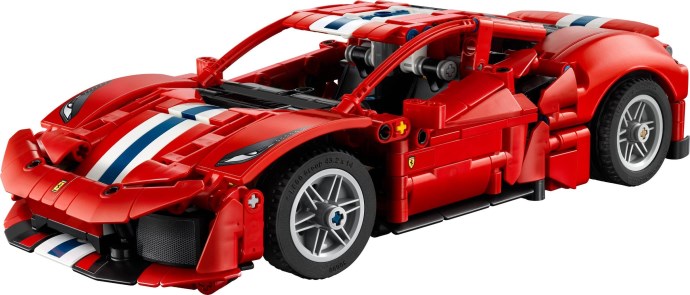
What sold me is that LEGO picked the right Ferrari. Not the everyday GTB, but the Pista, the stripped-out, track-obsessed version with the most powerful V8 Ferrari had ever fitted to a road car at the time. That means the model gets to wear the aggressive nose, the S-Duct and the purposeful stance, and a Technic car lives or dies on whether it looks purposeful. This one does. It reads as a Ferrari with intent from across the room, and the mechanical guts underneath back the swagger up.
At 882 pieces this is a mid-size Technic build, and it uses the space intelligently. You start where every good Technic car starts, with the chassis and the running gear, and the early stages are all about getting the drivetrain and the steering assembly seated and turning cleanly before any bodywork goes near them. It is the part of a Technic build I always enjoy most, because you are effectively assembling a little machine before you dress it.
The centrepiece function is the V8 engine, whose pistons pump up and down as you roll the model along. It is driven off the rear wheels through the gearing, and getting those eight little pistons cycling in sequence for the first time is the moment the build earns its keep. It is the sort of mechanical payoff that a static display model simply cannot offer, and it never gets old watching it through the rear deck.
Steering is the hand-of-god type, worked by a knob on the roof rather than a motor, and it turns the front wheels through a proper rack. Paired with the differential on the rear axle, you get a car that behaves like a car when you push it across a desk, the inside and outside wheels turning at their own rates through a corner. There are no batteries and no remote control here, which keeps the focus on the mechanicals you can see and feel.
The bodywork stage is where the panel builders will slow down and enjoy themselves. The 488 Pista's shape is all scoops, ducts and shoulders, and LEGO builds up the curved flanks and the distinctive front with angled panels and connector work rather than smooth moulded shells. The doors and the hood open, which adds a little fiddly framing to get the hinge lines sitting flush, but the reward is a model you can actually pose and peek inside. Budget somewhere around two to three hours, and none of it drags.
Finished, the Pista measures roughly 8 cm high, 28 cm long and 13 cm wide, which puts it in that satisfying hold-it-in-two-hands scale. It is big enough to have real presence on a shelf and small enough that it will not bully the rest of your display for space. That middle size is, to my eye, the most display-friendly format Technic makes.
The design does the important things right. The S-Duct nose, the deep front splitter and the aggressive intakes down the flanks are all present and legible, and the profile captures the low, hunched, ready-to-pounce stance of the real car. In the red colourway it looks every inch a Ferrari, and the exposed Technic elements around the engine bay lean into the mechanical honesty rather than trying to hide it behind smooth panels.
Because the doors and hood open, this is a model that rewards being handled and posed rather than sealed behind glass. Pop the doors up, open the rear deck to show the V8, and turn the wheels to a jaunty angle, and it photographs far better than a static shelf-sitter. The best angle is a low three-quarter front, where the S-Duct and the wide haunches are both in shot and the car looks like it is straining at the leash.
There are no minifigures here, which is entirely normal for licensed Technic, so the model is the whole show. It stands on its own detailing and its functions rather than any bundled extras, and at this scale it does not need a driver to make the point.
Eight hundred and eighty-two pieces is a healthy Technic haul for a mid-size car, and the parts mix is the useful kind. You get a full spread of pins, connectors, panels, gears and axles, the everyday currency of Technic, which means almost everything in this box has a second life in your own creations once the Pista has had its time on the shelf. That reusability is a quiet strength of buying Technic cars rather than System display models.
The functional gearing, the differential and the small-scale engine assembly are the standout technique pieces here, and they double as a compact reference for anyone learning how to route drive from wheels to pistons in their own builds. The panels that form the flanks are set-coloured to suit the Ferrari, so their wider reuse depends on your colour scheme, but structurally they are as versatile as any Technic panel.
On the collectible side, licensed Ferrari sets tend to hold interest well, because the badge carries its own following and the 488 Pista was a genuinely limited, sought-after car in real life. Sets tied to desirable, low-production machines generally age better than sets tied to passing fads, a pattern our LEGO Investing 101 guide walks through in detail.
Ferrari pulled the covers off the 488 Pista at the Geneva Motor Show in March 2018. The name is Italian for track, and it is not just marketing: the Pista was the hardcore, track-focused evolution of the 488 GTB, developed directly out of lessons learned in the 488 Challenge and GTE racing programmes. It was lighter, sharper and more aerodynamic than the car it was based on, and it carried the racing DNA onto the road with unusual honesty.
Under the rear deck sat a 3.9-litre twin-turbo V8 producing around 710 horsepower, which at launch made it the most powerful V8 Ferrari had ever put in a road car. That translated to a sprint from rest to 100 km/h in the region of 2.85 seconds and a top speed north of 340 km/h. Just as significant was the aerodynamics: the Pista was the first Ferrari road car to use an S-Duct at the front, an F1-derived solution that pulls air through the nose to generate downforce, and it is one of the details the LEGO model is careful to reproduce.
Production ran from 2018 to 2020, with roughly 2,000 examples built, a deliberately limited slice of the wider 488 family. That scarcity, combined with its status as the sharpest, most driver-focused car in the range, has made the 488 Pista one of the more coveted modern Ferraris. It is exactly the kind of car that earns a place in a Technic display case: not the volume model, but the special one.
Ferrari fans and supercar enthusiasts are the obvious core audience, and the choice of the Pista over the standard 488 gives this one extra appeal for people who actually follow the marque. It is the enthusiast's pick within the family, and the model wears the details that make the real car special rather than settling for a generic supercar shape.
It is also a strong choice for a builder who wants a proper mechanical Technic experience without committing to a flagship. The working V8, the steering and the differential deliver the core Technic joys, and 882 pieces is an achievable, satisfying build rather than a multi-day marathon. For anyone stepping up from smaller Technic sets, it is a very natural next rung on the ladder.
Younger builders in the recommended age range will get on well with it too, particularly the ones who like seeing how things work. The moving engine and the turnable wheels make the mechanical ideas tangible, and the opening doors and hood invite the kind of play and posing that a sealed display model discourages.
The Pista slots naturally into a Technic Ferrari shelf alongside the open-wheel racers like the Ferrari SF-24 (42207), giving you the road-and-track contrast of a homologated supercar next to a Grand Prix single-seater from the same stable. It is a pairing that tells the full story of what the badge does across very different disciplines.
For a hardcore-Ferrari grouping, it sits happily beside the Ferrari FXX K (42212), matching one track-focused special against another and letting the more extreme aero of the FXX K play off the road-legal purpose of the Pista. Two cars built to go fast, dressed very differently.
If your display leans more classic than modern, the Ferrari F40 (76934) makes a lovely generational counterpoint, the analogue turbo icon of the 1980s next to the digital-age track weapon. Together they show how far the idea of the road-going Ferrari halo car has travelled while keeping the same fundamental promise.
Pros
- Working V8 engine with pistons that pump as the wheels turn
- Hand-of-god steering and a rear differential give proper mechanical behaviour
- S-Duct nose and aggressive stance capture the real Pista's purpose
- Ideal mid-size scale that displays well and finishes in a sitting or two
- Opening doors and hood make it a model you pose rather than seal away
- Reusable Technic parts haul with genuinely versatile gears and connectors
Cons
- No motor or remote function, so everything is manual
- Curved bodywork in Technic never looks as smooth as a moulded shell
- Set-coloured panels limit wider reuse if you build in other colours
- No minifigures, as is standard for licensed Technic
The Ferrari 488 Pista is a smartly judged mid-size Technic supercar that gives you the mechanical goods without demanding a flagship's worth of time or shelf. The working V8, the hand-of-god steering and the differential deliver the core Technic pleasures, and LEGO picked the right, most desirable Ferrari to hang them on.
It earns EARL APPROVED status on the strength of its functions, its display-friendly scale and its faithful take on a genuinely special car, held just shy of the top tier by the inherent limits of curved bodywork in Technic and the absence of any powered functions. For what it sets out to be, it delivers cleanly.
Available now, and an easy recommendation for any Ferrari fan or Technic builder who wants a mechanical model they can actually finish and enjoy. The Pista was the sharp end of the 488 family, and this is a fittingly purposeful little machine to celebrate it.
- Ferrari SF-24 Technic Review - The Grand Prix single-seater from the same stable
- Ferrari FXX K Review - Another track-focused special, dialled up to eleven
- Ferrari F40 Review - The analogue turbo icon that started the halo-car lineage
- LEGO Investing 101 - Why sets tied to limited, desirable cars tend to age well
Track it in your vault on GameSetBrick - our free collection app. Log your condition, price paid, and watch the real-time market value.
Track in Your Vault →Save it to your wishlist on GameSetBrick. Share your list with friends and family - every set has a buy button so gift givers know exactly where to go.
Add to Wishlist → GameSetBrick is a free app by The Earl of Bricks. See all features. Scan it. Track it. Trade it.