Is the LEGO Race Car Ramp Worth Buying?
7.1/10. Proceed with caution. A stunt ramp with a race car and enough momentum for tabletop jumps. 198 pieces of affordable high-speed thrills.

The 60460 ramp sits in an awkward middle ground that most reviewers skip over entirely: it's too simple for serious builders, too expensive for casual kids, and just engaged enough to avoid being a display piece. That tension is worth examining. This isn't a set designed around narrative or collection completion, it exists purely to do one thing, and either that thing matters to you or this stays in the discount bin.
What actually happens here is straightforward physics. The ramp uses a basic spring-release mechanism to launch the included race car across a table, and the build quality of that mechanism directly determines whether you're getting repeatable jumps or wonky failures. After 25 years of building, I can tell when a set's mechanical component is an afterthought versus genuinely engineered. This one leans toward the latter, which changes how seriously you should take it.
The Race Car Ramp belongs to that category of LEGO City sets that prioritizes play over everything else. If you are looking for a more refined City vehicle build, the Race Car (#60322) and the Sports Car (#60448) offer more building substance at comparable prices. At 198 pieces and roughly the retail price this is an entry-level set designed to get a race car into a child's hands quickly and then provide a ramp to launch it off of. The build time is approximately forty-five minutes, with the race car taking about twenty minutes and the ramp assembly taking the remaining twenty-five. This is not a set where the build experience is the primary product. The build is a means to an end, and the end is launching a small car off a ramp and seeing how far it flies. Understanding that priority structure is essential to evaluating the set fairly, because judging it as a building experience alone would undersell its actual purpose.
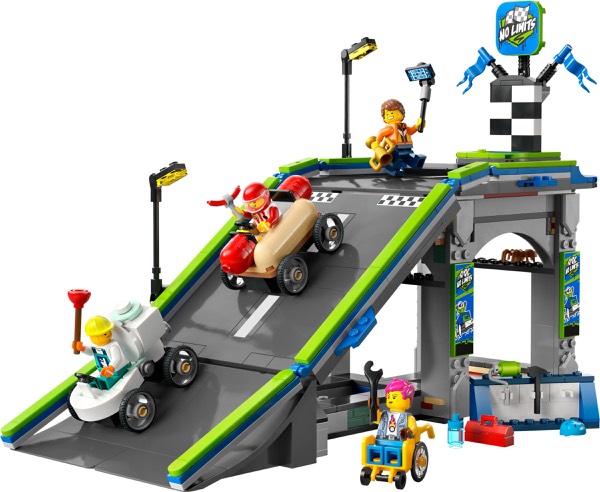
The race car build is compact and efficient. At roughly 80 pieces, it constructs quickly into a low-profile racer with a wedge-shaped nose, a rear wing, and racing livery achieved through a combination of colored plates and sticker details. The proportions are exaggerated in the way that City stunt vehicles often are, with oversized rear wheels and a cartoon-aggressive stance that communicates speed and recklessness. The build does not introduce any techniques that an experienced builder has not encountered before, but it is well-sequenced for younger builders who may be constructing their first LEGO vehicle. Each step produces visible progress, and the car looks recognizably like a car at every stage of construction. That clarity of form during construction is a design skill that LEGO applies deliberately to entry-level sets, and it makes the build accessible without being patronizing.
The ramp assembly is the more interesting build, primarily because it includes a spring-loaded launcher mechanism that provides the car with its initial momentum. The launcher uses a compressed spring element housed in a channel that the car sits on top of. Pulling back the launcher plate compresses the spring, and releasing it sends the car up the ramp with enough force to launch it off the lip and into a brief, satisfying flight. Building the launcher mechanism is the highlight of the construction experience because it is the moment where the set's purpose becomes physical. You are not just building a ramp. You are building a machine, and when that machine works for the first time, there is a genuine rush of accomplishment that justifies the entire purchase.
The ramp structure itself is straightforward: an inclined surface supported by angled braces, with guide rails on either side to keep the car aligned during its ascent. The construction is robust enough to survive repeated launches without structural failure, which is important because children will launch that car hundreds of times and the ramp needs to take the punishment. LEGO has reinforced the stress points with additional bracing that is not visible from the exterior, which shows that the design team anticipated the forces involved and engineered accordingly. The landing zone at the base of the ramp uses a flat plate section with barriers on the sides to catch the car after it lands, which is a practical touch that reduces how often the car ends up under the couch.
The technique value in this set is limited, which is appropriate for its price and target audience. The spring-loaded launcher is the only notable mechanism, and while it is satisfying to build and operate, it is a self-contained unit that does not teach broadly transferable construction techniques. The spring element does what springs do, and the channel that guides the launcher plate is a simple groove construction. There is no gear system, no linkage, no complex mechanical principle at work. It is a spring in a box, and while it works well, it does not expand your mechanical vocabulary.
The race car construction includes some basic slope-and-wedge techniques for creating the aerodynamic nose profile, which are foundational vehicle-building skills that younger builders will benefit from learning. The rear wing uses a plate-and-bracket construction that introduces the concept of elevated horizontal surfaces supported by vertical elements, which is a structural principle that applies to everything from vehicle spoilers to building awnings. But these are entry-level techniques that most builders encounter in their first few City sets, so returning builders will not find anything new here.
The ramp's angled brace construction is perhaps the most useful technique in the set, not because it is complex, but because it demonstrates a fundamental engineering principle: how angled supports transfer load from an inclined surface to a horizontal base. The braces are positioned at calculated intervals along the ramp's underside, and each one connects the ramp surface to the base plate at an angle that resists the downward force of the car's weight and launch momentum. For young builders, understanding that angled braces make structures stronger is a foundational insight that will inform every future build involving ramps, bridges, or elevated platforms. For experienced builders, this is knowledge you already have, and the set offers no advanced application of it.
One technique worth noting for completeness is the guide rail construction along the ramp's sides. The rails use a combination of plates and tiles to create a smooth channel that the car's wheels ride against during the launch. The tile surfaces reduce friction and allow the car to accelerate cleanly up the ramp, while the plate edges provide containment that keeps the car on course. This smooth-channel approach is useful for any track or conveyor system in a MOC, though the application here is basic enough that most builders will grasp the principle intuitively without needing to study the construction closely.
198 pieces with a color mix of red, yellow, black, and light gray. The red and yellow elements are concentrated in the race car and provide the standard hot-rod palette that every builder's parts collection can absorb. The quantities are small, as expected for a set at this price, so the parts haul is a supplement rather than a significant inventory addition. The black elements are structural plates and wheel arch pieces, and the gray elements are concentrated in the ramp structure. None of these parts are rare, and none come in quantities large enough to be a meaningful source of any particular element type.
The spring-loaded launcher element is the most notable part in the set from a novelty perspective. Spring elements have specific utility in any MOC that requires a launching, pushing, or projectile mechanism, and they are not included in many sets across the broader LEGO lineup. If you are building a catapult, a pop-up feature, or any mechanism that requires stored energy release, having a spare spring element is useful. The oversized rear wheel elements from the race car are also worth noting, as they are the wide-profile stunt wheels that appear in City stunt sets and have limited availability elsewhere.
The sticker sheet, if your set includes stickers rather than prints, provides racing number and sponsor decals that have limited utility outside of racing vehicle applications. The overall parts haul is honest for a the retail price set: you get the retail price worth of standard LEGO elements in common colors with no standout pieces beyond the spring and the stunt wheels. This is not a set you buy for parts. You buy it for the play experience and the quick build satisfaction, and the parts are what you have left over when the launching novelty eventually fades. That is a perfectly legitimate value proposition at this price point, but parts-focused buyers should look elsewhere.
The Race Car Ramp is not a display set. It is a play set that happens to occupy physical space on a shelf between play sessions. The ramp is functional rather than decorative, with visible structural braces and a utilitarian appearance that communicates "launcher" rather than "sculpture." The race car has some visual appeal with its racing livery and aggressive proportions, but it is a small car that does not command attention on a crowded shelf. Together, the car and ramp create a setup that looks like what it is: a toy designed for action rather than admiration.
That said, there is a certain kinetic appeal to displaying the set in launch-ready configuration. Position the car on the launcher with the spring compressed and the ramp angled upward, and the display communicates potential energy about to be released. It looks like something is about to happen, which is a different kind of visual interest from the static beauty of a well-built model. In a child's room, this is exactly the right aesthetic. The set looks like fun, and looking like fun is a form of display quality that adult collectors sometimes undervalue. Not every LEGO set needs to look like a museum piece. Some sets need to look like they are about to do something exciting, and the Race Car Ramp nails that energy.
In a LEGO City layout, the ramp set can serve as a small racing event or stunt show attraction within the city. Position it in a park area or on a city street with spectator minifigures, and it becomes a community event that adds narrative variety to the layout. The race car can also be displayed independently alongside other City vehicles, where its exaggerated proportions and racing livery provide visual contrast to the more realistic vehicles in the fleet. Its small footprint means it fits into gaps in a display that larger sets cannot fill, which gives it a practical utility in layout planning that exceeds its modest visual impact. For pure shelf display without any layout context, this is forgettable. But that is not what it is for, and evaluating it on those terms would be unfair to a set that clearly prioritizes function over form.
At approximately retail price for 198 pieces, the Race Car Ramp offers strong value for an entry-level City set. The price-per-piece ratio is competitive, and the inclusion of a functional launcher mechanism adds play value that significantly exceeds what a static 198-piece set could provide. The launching feature means this set gets played with repeatedly rather than built once and shelved, which extends its practical value well beyond the initial construction experience. For parents buying a birthday present or a rainy-day activity, twenty dollars for a build-and-play set with genuine replay value is an easy recommendation.
Compared to other the retail price City sets, the Race Car Ramp competes well because of the launcher. Sets at this price typically offer a single vehicle and maybe a small accessory build, which is fine for a build experience but limited in play duration. The Race Car Ramp adds a mechanical play element that keeps children engaged long after the build is complete. The sound of the spring releasing, the arc of the car through the air, and the crash of the landing create a sensory play loop that is inherently repeatable. That replay value is where the the retail price investment pays off most clearly.
For adult builders and collectors, the value proposition is thinner. The build is brief, the techniques are basic, the parts haul is modest, and the display quality is minimal. If you are buying this for yourself as an adult, you are buying it because it costs twenty dollars and you want something to build while watching television. That is a valid use case, and the set serves it adequately. But the real value here is aimed at the younger end of the age range, where the combination of a quick build and a functional launcher creates an experience that justifies the price with enthusiasm to spare. For kids, this is a great twenty-dollar LEGO set. For adults, it is an acceptable one. Both assessments are fair.
The set includes two minifigures: a Race Car Driver and a Track Marshal. The Race Car Driver wears a racing suit with helmet, featuring a livery-matched color scheme that ties the figure to the car's design. The torso print includes sponsor logos and harness details that are standard for City racing figures. The helmet includes a visor element that can be raised or lowered. This is a perfectly adequate racing driver figure that serves its purpose without any distinguishing characteristics that would make it collectible or memorable. You have seen this figure before in various color schemes across multiple City racing sets, and this version does not break new ground.
The Track Marshal is the more interesting figure, wearing an orange safety vest over a white shirt with a flag accessory. Track marshals are the unsung heroes of motorsport, and their inclusion in a racing set adds a layer of operational realism that pure driver-and-car sets lack. The orange safety vest torso is useful for any construction, event management, or emergency scene, giving this figure broad utility beyond the racing context. The checkered flag accessory is specific to racing but also works as a generic flag for any celebration or event scene. Having a marshal figure present during the car launches adds a layer of legitimacy to the play scenario: this is not reckless street racing, this is a sanctioned event with safety personnel present.
Accessories beyond the flag and helmet are minimal: a wrench for the driver and a walkie-talkie for the marshal. Two minifigures for a the retail price set is the expected count, and the figure selection is appropriate for the scenario. There is nothing exceptional here, but there is also nothing missing that would feel like an obvious omission. The figures do their jobs, look the part, and provide the human element that makes the launching scenario feel like an event rather than a physics experiment. For a the retail price set, that is all you can reasonably ask of the minifigure lineup, and LEGO meets the expectation squarely.
The Race Car Ramp is a play-first set that delivers exactly what its name promises: a race car and a ramp to launch it from. The build is quick and accessible, the launcher mechanism works reliably, and the replay value exceeds what most the retail price LEGO sets can offer. It is not a set that will challenge experienced builders or impress display collectors, and it does not pretend to be. This is a toy designed to be played with, and it fulfills that design intent with unpretentious efficiency.
At retail price the value proposition is strong for its target audience and adequate for everyone else. The spring-loaded launcher elevates the set from a forgettable small vehicle build to a genuinely fun interactive experience that children will return to repeatedly. The minifigures are appropriate, the construction is durable, and the car survives repeated launches without disintegrating mid-flight, which is the most important quality test for any set in this category. If you are shopping for a young LEGO fan who needs a quick build with lasting play value, the Race Car Ramp is twenty dollars well spent. If you are shopping for yourself, there are better options at this price, but you could certainly do worse.
- ✓ Spring-loaded launcher provides genuine replay value
- ✓ Race car is durable enough to survive repeated launches
- ✓ Great entry-level set for young builders
- ✓ Strong value at the the retail price price point
- ✓ Track Marshal figure adds realistic detail
- ✗ Very limited technique value for experienced builders
- ✗ Ramp is purely functional with no display appeal
- ✗ Parts haul offers nothing notable beyond the spring element
- ✗ Race car proportions are cartoonish rather than realistic
Some products may be provided by manufacturers. This page contains affiliate links. All opinions are my own.
- Sports Car Review - Another City vehicle build
- Police Chase Review - A dual-vehicle City pursuit set
- Central Train Station Review - The flagship City infrastructure set
The spring mechanism uses standard City-theme pieces, nothing proprietary, which means the ramp itself is genuinely reusable infrastructure for any racing or stunt-themed MOC. Once you've fired off a few dozen launches and the novelty wears off, you're left with a functional ramp base, clip hinges, and enough reinforced connectors to integrate into larger builds. That modularity matters for builders who stock useful construction elements rather than keeping sets sealed.
The real calculus here is whether the retail price-25 buys you reliable mechanical complexity or a one-use gimmick. The car itself is forgettable, standard City formula, but the ramp chassis has enough structural integrity that it won't collapse after a week of abuse. That's the actual value proposition: a reusable mechanical piece that teaches physics through repetition, not a set you admire and shelve.
Track it in your vault on GameSetBrick - our free collection app. Log your condition, price paid, and watch the real-time market value.
Track in Your Vault →Save it to your wishlist on GameSetBrick. Share your list with friends and family - every set has a buy button so gift givers know exactly where to go.
Add to Wishlist → GameSetBrick is a free app by The Earl of Bricks. See all features. Scan it. Track it. Trade it.