Is the LEGO Bulldozer Worth Buying?
7.8/10. Proceed with caution. A compact construction workhorse that punches above its weight class. 250 pieces of honest, dirt-moving machinery.

The 60466 Bulldozer lands in that awkward middle ground where City sets rarely get the credit they deserve. At 250 pieces, it's too substantial to dismiss as a shelf-warmer, yet undersized enough that collectors often skip past it hunting for the larger construction vehicles. That hesitation is exactly where the value lives. This isn't a set designed to dominate a display shelf, it's engineered as a working component, the kind of machine that belongs in an active construction site layout alongside other City builds. The shovel mechanism actually functions without cheap gimmicks, and the proportions avoid the oversized cartoon aesthetic that derails so many small vehicles.
What caught my attention during the build was how deliberately Lego constrained the part count. Every single piece earns its position; there's no padding, no redundant structural material hidden inside. The track drive system uses a refreshingly simple approach that doesn't sacrifice durability for spring-loaded theatrics. For builders who've moved past the "bigger equals better" phase and started thinking about cohesion within a theme, this one clicks. The 60466 understands what a working bulldozer actually needs to be, rather than what a toy company assumes kids want.
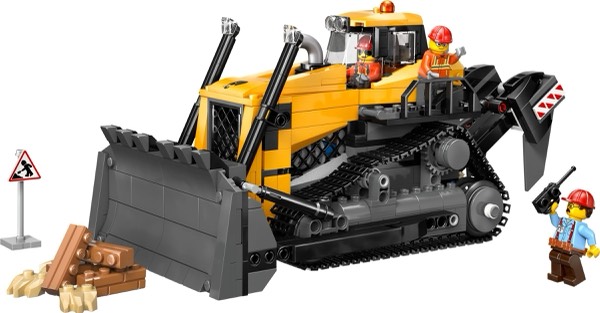
Construction vehicles are the backbone of LEGO City, and the Bulldozer is the kind of set that reminds you why. At 250 pieces, this is not a massive undertaking, but it is a focused and satisfying build that delivers a recognizable piece of heavy machinery in about an hour. The bulldozer is one of those real-world vehicles that almost everyone has seen operating on a construction site, and LEGO has done a respectable job of capturing its essential proportions at City scale. The low, wide stance. The massive blade up front. The tracked undercarriage that lets these machines crawl over anything. All of it is here, and all of it reads correctly from across a room.
The build starts with the tracked chassis, which is always one of the more enjoyable subassemblies in any construction vehicle set. There is something inherently satisfying about constructing track systems because you can see the mechanical logic taking shape as you work. Each link connects to the next, the drive wheels slot into place, and suddenly you have a functional rolling chassis that moves with a pleasing clickety weight when you push it across a table. The chassis is the foundation of the entire set, and LEGO has given it enough substance that the bulldozer feels solid in your hands rather than hollow or fragile. That matters for a vehicle that children will push around construction sites, and it matters for display because a bulldozer should look like it weighs something.
The cab construction is straightforward but well-proportioned. You build up the operator compartment with a roll cage structure and a seat for the minifigure driver, and the windshield element gives the cab a modern look that matches contemporary bulldozer designs. The blade assembly is the final major phase, and it connects to the front of the chassis with a hinge mechanism that allows it to raise and lower. This is a simple play feature, but it is executed well enough that it does not compromise the visual integrity of the model. The blade has the right curvature and width relative to the body, and when lowered to working position, the bulldozer looks ready to move earth. When raised, it looks like it is heading between job sites.
The construction site accessories that come with the set are a welcome addition. You get a small buildable barrier section, some construction cones, and the usual assortment of tools that populate every City construction scene. These are quick builds that add context to the bulldozer and give it a setting to operate in, even if your display space is limited to a single shelf. The entire build experience is what I would call reliably satisfying. There are no surprises, no particularly innovative moments, but also no frustrations. It does exactly what it sets out to do, and it does it with competence that speaks well of the design team's understanding of what construction vehicle fans want from a set at this price point.
The tracked chassis is the primary technique of interest here, and while LEGO has used similar track systems across dozens of construction and military-themed sets over the years, the implementation in the Bulldozer is clean and worth studying if you have not built a tracked vehicle before. The track links are connected in a loop around drive and idler wheels, with a tensioning system that keeps them taut enough to look right while still allowing free rotation. Understanding how this system works at LEGO scale is directly applicable to any tracked vehicle MOC you might want to build, from tanks to excavators to snowcats. The proportions matter here. Too few links and the tracks look comically tight. Too many and they sag unrealistically. LEGO has found the right balance, and you can learn from their choices.
The blade attachment mechanism uses a pair of hinged arms that connect the blade to the main chassis. This is a common LEGO technique for construction vehicle implements, but the specific geometry here is worth noting because it allows the blade to travel through a realistic arc. The hinge points are positioned so that when you raise the blade, it tips backward slightly, just as a real bulldozer blade does. This is a subtle detail that most builders will not consciously notice, but it contributes to the overall authenticity of the model. The technique itself is transferable to any MOC that requires an implement to move through an arc rather than simply pivoting at a single point.
The cab construction uses a combination of panel elements and a clip-mounted roll cage that creates an open-air operator compartment. This is a practical technique for any small-scale vehicle where you want interior access for minifigures without sacrificing the visual structure of an enclosed space. The roll cage is sturdy enough to protect the minifigure inside while remaining open enough to allow easy placement and removal. For MOC builders working on construction or industrial vehicles, this approach to cab design is a useful reference point for balancing playability with visual accuracy.
The color blocking technique throughout the model is also instructive. The bulldozer uses yellow as its primary color, which is standard for construction equipment, but the way LEGO distributes the yellow across the model and uses dark gray and black for mechanical components creates visual separation between the bodywork and the running gear. This kind of deliberate color zoning is something that elevates even simple builds, and it is a principle that applies to virtually any vehicle MOC. When mechanical parts are a different color from body panels, the model reads as more complex and realistic than it actually is.
At 250 pieces, this is not a massive parts haul, but it is a useful one. The yellow elements are the star of the show here, and you get a healthy assortment of yellow plates, bricks, and slopes in standard sizes that are always useful for construction vehicle MOCs. Yellow is one of those colors that you always seem to need more of when building City-scale construction scenes, and this set provides a meaningful contribution to your yellow inventory. The dark gray and black elements for the chassis and mechanical components are standard but welcome, as these colors are consumed in large quantities by any builder who constructs vehicles or infrastructure.
The track link elements are specialized but useful. If you build tracked vehicles with any regularity, having extra track links on hand is always valuable because the link count needs to be exact for any given wheel spacing, and having a supply of extras means you can experiment with different track configurations without running short. The blade element, if it is a specialized piece rather than a brick-built assembly, is a useful addition for construction scenes even outside the context of this specific bulldozer. Bulldozer blades, snowplow blades, and similar implements all use similar shapes, so any large curved element with the right proportions has value beyond its intended application.
The minifigure is a standard construction worker, which is never a bad addition to any City collection. Construction worker minifigures are among the most versatile figures in the City lineup because they can staff any construction site, operate any piece of heavy equipment, and populate any urban scene that involves building or infrastructure work. The accessories, cones, barriers, and tools are small but useful details that accumulate value over time as you build out construction scenes. Every construction site needs cones. Every work zone needs barriers. These are the kind of small elements that you never think about until you need them, and then you are glad you have a supply. The overall parts haul is efficient rather than spectacular, but at this price point, efficiency is exactly what you should expect and value.
The Bulldozer is a compact display piece that works best in context rather than isolation. On its own, it is a well-proportioned model of a recognizable piece of construction equipment, but it does not have the scale or visual complexity to command attention as a standalone display. Where it excels is as part of a construction scene or a City layout. Position it next to a building under construction, pair it with the Scrapyard or another construction set, and suddenly it becomes part of a story that is much more engaging than the sum of its parts. This is the nature of City-scale vehicles, and the Bulldozer leans into that role effectively.
The proportions are convincing at City scale. The wide track base, the forward-leaning blade, and the compact cab create a silhouette that is immediately recognizable as a bulldozer from any angle. The yellow color scheme is bright and eye-catching, which helps the model stand out in a City layout where gray and white tend to dominate the buildings. The blade adds a distinctive visual element at the front of the vehicle that gives it directional character. You can tell which way this machine is heading just by glancing at it, and that sense of directionality adds dynamism to any display arrangement.
The construction site accessories help with display by providing environmental context. A bulldozer sitting on a bare shelf is just a yellow vehicle. A bulldozer surrounded by cones and barriers with its blade lowered and a worker standing nearby becomes a scene. The accessories are minimal, but they are enough to establish the narrative context that makes construction vehicles interesting to look at. For builders who maintain active City layouts, the Bulldozer fills a gap that many collections have, because while police cars and fire trucks tend to accumulate, construction equipment is often underrepresented. Adding this bulldozer to a layout immediately makes any construction area feel more complete and realistic.
From a shelf appeal perspective, the Bulldozer works well at close range where you can appreciate the track detail and the mechanical elements of the blade assembly. From a distance, it reads as a bright yellow construction vehicle, which is correct and appropriate for its scale. It will never be the centerpiece of a display, but it is a reliable supporting player that adds authenticity and variety to any City construction scene.
The Bulldozer comes with a single construction worker minifigure, and while a single figure is about what you should expect at this price point, it is a good one. The construction worker features a high-visibility vest torso print over a work shirt, safety helmet, and the kind of no-nonsense expression that suggests this person has been operating heavy equipment for twenty years and has seen everything a construction site can throw at someone. The printing quality is standard LEGO, which means it is excellent, with clean lines and appropriate detail for the scale.
The worker includes a handheld tool accessory, which is a small but appreciated addition that gives the figure something to do when not seated in the bulldozer cab. For City builders who populate their layouts with working figures, this construction worker slots in seamlessly alongside other construction crew members. The high-visibility vest is particularly useful because it visually identifies the figure as a construction worker from across a room, making it easy to position correctly in a layout without needing to pick up and examine the figure closely. This kind of visual shorthand is important in City layouts where dozens of minifigures need to be identifiable by role at a glance.
I would have appreciated a second minifigure, perhaps a site supervisor or a traffic controller, to add more narrative possibilities to the set. However, at this price point, a single well-designed figure is a reasonable inclusion that does not feel stingy. The figure works well in the bulldozer cab and works well outside it, which is all you can really ask from a vehicle set minifigure. The construction worker archetype is one of the most useful in the City lineup, and this version is a solid addition to any collection.
At around retail price for 250 pieces, the Bulldozer lands at roughly ten cents per piece, which is standard for LEGO City sets. The value here is not in an exceptional price-to-piece ratio but in the quality and usefulness of what you receive. The bulldozer model is well-proportioned, fun to build, and fills a genuine gap in most City collections. Construction vehicles are popular for a reason, and a bulldozer is one of those machines that every construction site needs. If you are building out a City construction zone, this set is practically a requirement.
The play value is strong for younger builders who will push this bulldozer around their City layouts, raise and lower the blade, and create construction scenarios limited only by their imagination. The display value is solid for older builders who need a bulldozer to complete a construction scene. The parts value is adequate, with a useful selection of yellow elements and track links that MOC builders will appreciate. No single aspect of the value proposition is extraordinary, but no aspect is disappointing either. This is a well-rounded set that delivers exactly what it promises at a fair price. For construction enthusiasts, it is an easy recommendation. For general City builders, it is a worthwhile addition that adds a vehicle type you probably do not have enough of in your collection.
- ✓ Accurate bulldozer proportions at City scale
- ✓ Satisfying tracked chassis build
- ✓ Functional blade raise/lower mechanism
- ✓ Strong yellow parts selection for MOC builders
- ✓ Construction site accessories add scene-building potential
- ✓ Solid construction feels substantial in hand
- ✗ Only one minifigure included
- ✗ Limited display impact as a standalone set
- ✗ No particularly innovative building techniques
Some products may be provided by manufacturers. This page contains affiliate links. All opinions are my own.
- Scrapyard Review - Construction site companion
- Cement Mixer Review - Another construction essential
- Central Train Station Review - City flagship infrastructure
The real advantage here sits in the parts distribution. Standard dark tan and dark gray dominate the build, which means the chassis breaks down into reusable pieces that integrate seamlessly into terrain, construction barriers, or larger vehicles without color-matching headaches. The track assembly, particularly the drive wheel cluster, is worth studying if you're building custom heavy equipment. It's compact enough to retrofit into smaller MOCs but rigid enough that it doesn't require reinforcement tricks.
The shovel bucket specifically warrants attention. Rather than a single molded piece, Lego built it from standard bricks, which means you can disassemble and reshape it for different digging configurations. Builders working on industrial-themed MOCs will find themselves returning to this set's parts more often than expected, particularly if you're mixing City machinery with more realistic proportions. The track baseplate extends minimalist design far enough that custom building atop it becomes genuine design work, not just stacking on top of factory engineering.
Track it in your vault on GameSetBrick - our free collection app. Log your condition, price paid, and watch the real-time market value.
Track in Your Vault →Save it to your wishlist on GameSetBrick. Share your list with friends and family - every set has a buy button so gift givers know exactly where to go.
Add to Wishlist → GameSetBrick is a free app by The Earl of Bricks. See all features. Scan it. Track it. Trade it.