Is the LEGO Scrapyard Worth Buying?
8.5/10. Worth buying. Organized chaos in brick form. 450 pieces of industrial character that brings a side of city life LEGO rarely explores.

Scrapyard occupies strange territory in the City lineup. LEGO's urban sets typically sanitize the built environment, clean storefronts, ordered construction sites, functional spaces. This set leans into *entropy*. The aesthetic is deliberately grimy, asymmetrical, lived-in. After twenty-five years of building, what strikes me is how confidently it commits to this tone. The crane's weathered browns, the scattered refuse, the ramshackle office structure, none of it feels like an afterthought. This is a set that knows what it is and doesn't apologize for it.
What matters: Scrapyard asks you to think differently about what a City set *represents*. Most builders use these models as building blocks for larger layouts, visual anchors in diorama construction. Scrapyard demands you engage with its specific flavor of infrastructure, the unglamorous backbone of how cities actually function. At 450 pieces, it's substantial enough to matter but scaled perfectly for integration. The real question isn't whether it's detailed enough; it's whether you're willing to celebrate an aesthetic that most builders reflexively pass over.
The Scrapyard is one of the most surprising sets in the 2025 City lineup, and I mean that as a genuine compliment. LEGO City tends to gravitate toward the glamorous side of urban life: police stations, fire departments, hospitals, and shopping centers. The industrial infrastructure that keeps a city functioning, the scrapyards, the recycling centers, the salvage operations, rarely gets attention. So when LEGO releases a set called Scrapyard with 450 pieces and a price tag that says they are taking the concept seriously, it is worth paying attention. This is not a throwaway filler set. This is a legitimate attempt to represent a piece of urban infrastructure that most people drive past without thinking about but that every city absolutely requires.
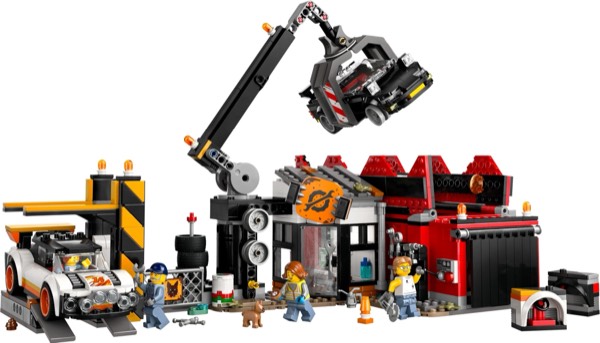
The build experience is surprisingly varied for what might initially seem like a monotonous subject. You are not just stacking bricks to make walls. You are constructing an environment with multiple distinct zones: the sorting area, the crane operation zone, the storage area for salvaged materials, and the perimeter fencing that defines the scrapyard boundary. Each zone has its own character and construction approach, which keeps the build engaging across its two-to-three-hour duration. The sorting area might feature conveyor belt elements or chute mechanisms. The crane zone centers on the magnetic crane build, which is the set's mechanical highlight. The storage area uses stacked elements and container-like structures to suggest piles of salvaged material waiting for processing.
The crane is the centerpiece of the build, and constructing it is the most satisfying phase. It rises from a stable base through a telescoping arm structure to a working head with a magnet or claw mechanism. Building a functional crane at any scale is inherently enjoyable because cranes are machines that fascinate us at a fundamental level. They lift things. They move things. They represent human ingenuity applied to the problem of gravity, and building one in LEGO taps into that same fascination. The crane construction teaches you about counterweight, about reach versus stability, and about the engineering compromises that real crane operators deal with every day.
The environmental details are what truly elevate this build. Scrapyards are visually chaotic places, and LEGO has captured that organized chaos by including scattered vehicle parts, stacked material elements, and the kind of controlled clutter that suggests a working industrial site rather than a tidy display model. Building these details is a different kind of satisfaction from constructing the crane or the structures. It is the satisfaction of creating atmosphere, of making a model feel lived-in and operational rather than pristine and unused. The best LEGO builds are the ones where you can look at the finished model and imagine what happened five minutes ago and what will happen five minutes from now. The Scrapyard achieves that temporal quality in a way that few City sets manage.
The crane mechanism is the technique showpiece, and it delivers genuine learning value. The base rotation uses a turntable element that allows the crane arm to swing across the scrapyard's operational area. The arm itself uses a combination of rigid structural elements and hinge connections that allow it to elevate and extend, creating a working envelope that covers a meaningful portion of the scrapyard layout. The head mechanism, whether it uses a magnetic element or a mechanical claw, introduces a pickup-and-release function that turns the crane from a static structure into an interactive tool. Building this mechanism teaches you the fundamentals of crane engineering at LEGO scale, and those fundamentals are directly applicable to any MOC that requires a lifting or moving mechanism.
The counterweight system on the crane is worth studying closely. Real cranes require counterweights to prevent them from tipping when lifting heavy loads at full extension, and LEGO has incorporated this principle into the design. The rear of the crane arm or the base structure includes weighted elements that balance the load capacity of the front, creating a system that is both functionally sound and educationally valuable. Understanding counterweight is one of those engineering principles that, once learned, informs every subsequent build involving cantilevers, overhangs, or extended structures. The Scrapyard teaches it in a context that makes the principle intuitive and memorable.
The environmental construction techniques are perhaps more subtly valuable than the crane mechanism. Creating the appearance of industrial clutter using LEGO elements requires a different mindset than building clean structures. Instead of seeking symmetry and order, you are deliberately placing elements in irregular arrangements that suggest randomness while actually being carefully designed to be structurally sound and visually convincing. This controlled chaos technique is applicable to any MOC that needs to look weathered, used, or industrial. Ruins, construction sites, workshops, garages, and warehouses all benefit from this approach, and the Scrapyard provides a masterclass in how to achieve it within the constraints of LEGO geometry.
The perimeter fencing technique uses a chain-link pattern created from standard LEGO elements arranged in a grid. This is a technique that City builders need constantly because fences define boundaries in urban environments, and having a reliable method for building convincing fences at minifigure scale is essential. The Scrapyard's fencing approach is clean, repeatable, and visually effective, making it a template you can adapt for any City MOC that requires perimeter definition. From schoolyard fences to parking lot boundaries to construction site barriers, the technique demonstrated here has nearly universal City-building application.
At 450 pieces, the Scrapyard delivers a substantial and unusually diverse parts haul. The color palette alone sets this set apart from typical City offerings. While most City sets deal in primary colors and clean surfaces, the Scrapyard incorporates grays, dark blues, rusty oranges, and earth tones that reflect its industrial setting. These muted, industrial colors are genuinely hard to accumulate from other City sets, and they are exactly the colors you need when building workshops, factories, warehouses, or any urban environment that is not a showroom. The orange and brown elements in particular are useful for any build that needs to suggest age, wear, or industrial character.
The crane components constitute a valuable mechanical parts collection. Turntable elements, hinge joints, structural beams, and the lifting mechanism parts are all pieces that MOC builders use extensively for any project involving mechanical movement. Having these elements available from a single set, already configured in a functional arrangement that you have built and therefore understand, means you can confidently repurpose them for future projects knowing exactly how they connect and what loads they can bear. The structural beams used in the crane arm are particularly versatile, finding applications in bridges, building frameworks, tower structures, and any project that requires rigid, lightweight linear elements.
The environmental detail elements are a treasure trove for City builders. Vehicle parts, whether whole or designed to suggest salvaged components, are useful for creating realistic construction sites, mechanic shops, and industrial scenes. The stacking and container elements work in any storage or shipping context. The fencing elements have universal application in City layouts. And the scattered tools, barrels, and industrial accessories are the kind of scene-setting details that transform bare baseplates into believable environments. This is one of those sets where the parts haul actually exceeds the model's apparent complexity because so much of the part value is distributed across small, versatile elements rather than concentrated in large specialized pieces.
The minifigure selection likely includes scrapyard workers in industrial clothing, which adds to the growing collection of working-class City figures that builders need to populate realistic urban scenes. These figures work in any industrial or construction context, making them more versatile than theme-specific characters. Overall, this is one of the most useful parts hauls in the 2025 City lineup, particularly for builders who construct industrial, construction, or urban-gritty scenes that need colors and elements beyond the typical City palette.
The Scrapyard is a set that rewards close inspection. From a distance, it reads as an industrial site with a prominent crane, which is accurate and appropriate. But step closer and the details reveal themselves: the scattered vehicle parts, the stacked salvage materials, the chain-link fencing, the tools hung on walls or leaned against structures. This layered viewing experience is rare in City sets, which typically present the same level of detail at any distance. The Scrapyard has depth, and that depth makes it a set that display collectors will appreciate because it continues to offer something new even after weeks on a shelf.
The crane provides the dominant vertical element that every display scene needs. Without vertical variation, LEGO displays can look flat and monotonous, especially at City scale where buildings tend to be similar heights and vehicles are uniformly low to the ground. The crane breaks this flatness dramatically, reaching above the rest of the scrapyard and creating a focal point that draws the eye upward. When positioned with the arm extended over the work area, the crane creates an active, dynamic composition that suggests motion and purpose even in a static display. This is the kind of set that photographers will love because it offers interesting angles and compositions from every viewpoint.
In a City layout, the Scrapyard occupies a unique niche. It is not residential, not commercial, not emergency services. It is industrial infrastructure, and that category is chronically underrepresented in most City layouts. Adding the Scrapyard to a layout immediately expands the city's functional vocabulary. Your city does not just have homes and shops and police stations. It has an industrial district where things get recycled, salvaged, and repurposed. That functional completeness makes the entire layout more convincing as a representation of urban life. The Scrapyard pairs particularly well with construction sets like the Bulldozer and the Cement Mixer, creating an industrial zone within your layout that has its own visual character distinct from the residential and commercial areas.
The industrial color palette gives the Scrapyard a visual identity that stands apart from the bright primary colors of most City sets. This distinctiveness is an asset in display because it creates visual variety within a layout. Too many City displays suffer from color monotony because the sets are all designed with the same bright, cheerful palette. The Scrapyard's grays and earth tones provide contrast that makes the whole layout more visually interesting. It is the same principle that makes a dark piece of furniture stand out against a light wall. The Scrapyard provides the visual anchor that bright sets can play against, and that contrast benefits both the Scrapyard and its neighbors.
The Scrapyard includes multiple minifigures representing scrapyard workers, and their industrial character design is a welcome departure from the clean-cut figures that dominate most City sets. These are figures who look like they work for a living. The torso prints feature work clothes, safety vests, and the kind of practical attire you would expect from people who spend their days operating cranes, sorting metal, and moving heavy materials. The expressions suggest competence and focus rather than the generic cheerfulness that LEGO sometimes defaults to. These are people with jobs to do, and their faces reflect that professional intensity.
The worker figures include appropriate tool accessories that reinforce their roles within the scrapyard operation. Hard hats are standard safety equipment in any industrial setting, and their inclusion is both accurate and visually distinctive, immediately identifying these figures as industrial workers rather than office employees or retail staff. The tools they carry, wrenches, cutting implements, or sorting equipment, give each figure a specific function within the scrapyard that creates display and play opportunities. One figure operates the crane. Another sorts materials. A third manages the incoming vehicles. Each figure has a role, and those roles create the structure for imaginative narratives.
The inclusion of a vehicle driver figure, someone delivering a car to the scrapyard, adds a narrative dimension that connects the scrapyard to the broader City ecosystem. Scrapyards do not exist in isolation. They receive vehicles and materials from the city around them, and having a figure who represents that supply chain creates a link between the Scrapyard and the rest of your City layout. This figure might have a different style of clothing, casual rather than industrial, that visually distinguishes them from the scrapyard workers and reinforces the narrative of someone arriving from outside the industrial zone.
For City builders who populate their layouts with dozens of minifigures, the scrapyard workers fill a specific employment category that is hard to source from other sets. Industrial workers are not police officers. They are not doctors. They are not shopkeepers. They are the people who do the heavy, essential work that keeps a city functioning, and their presence in a City layout adds a layer of socioeconomic realism that purely white-collar or emergency-service figures cannot provide. The Scrapyard minifigures are quietly important additions to any City population, and their industrial aesthetic makes them visually distinctive in any crowd scene.
At approximately retail price for 450 pieces, the Scrapyard delivers reasonable value with a strong bonus of thematic uniqueness. The price-to-piece ratio is just under nine cents per piece, which is good for City. But the real value here is not in the ratio. It is in the fact that no other current City set does what this one does. If you want industrial infrastructure in your City layout, this is your only option, and it is a good one. That monopoly on a specific niche gives the Scrapyard a value that transcends its piece count because it provides something irreplaceable to your layout rather than adding another variation on a theme you already have covered.
The build experience justifies the price through variety and duration. Three hours of engaged building across multiple distinct zones is excellent entertainment value compared to virtually any other leisure activity at this price point. The crane mechanism alone provides enough mechanical interest to justify a significant portion of the cost, and the environmental detail building adds a creative dimension that straight structural builds do not offer. For parents buying this as a gift, the extended build time and the play scenarios enabled by the crane and the scrapyard environment provide hours of engagement beyond the initial construction. For adult builders and display collectors, the unique industrial aesthetic and the detailed environment create a display piece that is genuinely different from anything else in the City lineup.
The parts value is strong because of the unusual color palette and the useful mechanical components. Industrial colors and environmental detail elements are hard to accumulate from other City sets, so the Scrapyard provides parts you cannot easily get elsewhere. That scarcity adds value beyond the raw piece count. When you combine the thematic uniqueness, the mechanical interest, the build variety, the display quality, and the parts utility, the Scrapyard offers one of the best overall value propositions in the 2025 City range. It is not the cheapest set or the most piece-dense, but it is one of the most interesting and useful, and that counts for a lot.
- ✓ Unique industrial theme fills a genuine gap in City
- ✓ Functional crane mechanism with real engineering interest
- ✓ Environmental detail creates atmosphere rare in City sets
- ✓ Industrial color palette provides hard-to-find elements
- ✓ Multiple build zones keep construction varied and engaging
- ✓ Strong minifigure selection with working-class character
- ✓ Pairs beautifully with other construction City sets
- ✗ Industrial theme may not appeal to younger builders seeking action
- ✗ Requires shelf space for a set that sprawls horizontally
- ✗ Some environmental clutter is fragile in play scenarios
Some products may be provided by manufacturers. This page contains affiliate links. All opinions are my own.
- Bulldozer Review - Construction site companion
- Recycling Truck Review - Another industrial City set
- City Tower Review - City flagship building
The modular design here opens doors. Unlike showpiece City sets, Scrapyard's component logic, the crane structure, the enclosed compactor mechanism, the office booth, breaks apart naturally. Serious builders will recognize immediately that these subsystems can be extrapolated. The weathering techniques applied to the brown and tan elements suggest a vocabulary you can extend. That office structure, in particular, reverse-engineers into a framework that scales up or sideways without strain.
The parts distribution reinforces this. You get genuine scrap-building material, irregular brown slopes, scattered grays, tan framework elements, that feel like leftovers from other builds. That's not accidental packaging. For builders thinking about industrial-themed terrain or creating a functional junkyard that actually serves a purpose in a larger layout, the seed catalog here is rich. The crane alone provides a construction mechanism that translates to entirely different contexts.
Track it in your vault on GameSetBrick - our free collection app. Log your condition, price paid, and watch the real-time market value.
Track in Your Vault →Save it to your wishlist on GameSetBrick. Share your list with friends and family - every set has a buy button so gift givers know exactly where to go.
Add to Wishlist → GameSetBrick is a free app by The Earl of Bricks. See all features. Scan it. Track it. Trade it.