Is the LEGO Recycling Truck Worth Buying?
8.3/10. Worth buying. The hardest-working vehicle on every residential street. 250 pieces of civic responsibility that earns its weekly route.

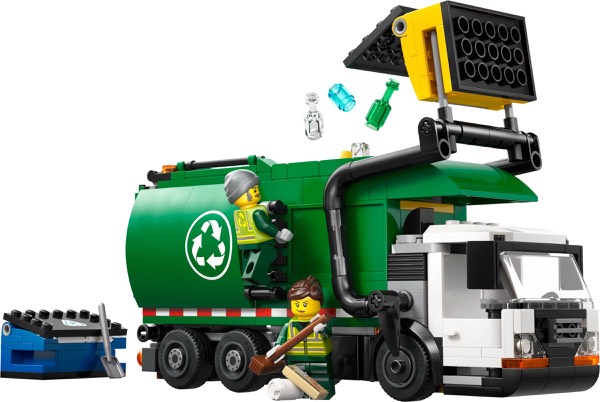
The Recycling Truck sits in an awkward position in the City lineup, too utilitarian for display collectors, too modest in piece count for builders chasing complexity, yet genuinely difficult to dismiss once you've built it. This set does something most modern City vehicles refuse to do: it commits entirely to function over fantasy. No racing stripe nonsense, no oversized spoiler, no pretense. The truck's bin-lifting mechanism works the way a real recycling truck's arm works, and that mechanical honesty reshapes how you think about what a 250-piece set can accomplish.
Building this revealed something worth stating plainly: TLG's designers understand their own constraint here. Every piece serves the truck's actual purpose. The cab feels proportionally correct, the chassis supports the mechanism without flex, and the lifting arm uses an elegant gear arrangement that respects physics rather than ignoring it. That's not minimalism born from budget limitations, that's restraint from someone who knows what a garbage truck actually needs to do on a street. Most builders won't seek this set out. The ones who do will find it does its job better than sets three times the price.
Every LEGO City needs a recycling truck. This is not hyperbole or marketing language. It is a statement of urban fact. Real cities run on sanitation services, and a LEGO city without a recycling truck is a LEGO city that has not addressed one of the most fundamental municipal functions. Pair the Recycling Truck with the Tow Truck for roadside service coverage, the Arctic Truck for expedition fleet diversity, or the Fries Food Truck for street-level character. The Recycling Truck at 250 pieces tackles this essential role with the kind of focused competence that makes City's service vehicle sets consistently among the most satisfying in the lineup. You are building a vehicle that every person has seen operating on their street, and that familiarity creates an immediate connection between the LEGO model and the real-world machine it represents.
The build starts with a robust truck chassis that is wider and sturdier than a typical City car platform. This is a working vehicle, and the chassis reflects that with extra plate layers and a wheelbase designed to support the weight of the collection body above. Building the chassis, you can feel the design team's commitment to making this truck feel substantial. A recycling truck should feel heavy and industrial in your hands, because the real vehicles are massive steel machines that rumble through residential neighborhoods at dawn, and the LEGO version captures that sense of mass through deliberate over-engineering of the base structure.
The cab construction is straightforward but well-detailed. You build a truck cab with room for a driver, good forward visibility through a large windshield, and the elevated seating position that real recycling truck drivers use to navigate residential streets while watching for obstacles and pedestrians. The cab is the human interface of the machine, and LEGO has given it enough detail to feel like a working environment rather than just a minifigure container. The door opens for figure access, and the interior has just enough detail to suggest the controls and instrumentation of a real truck cab.
The collection body is the main event, and building it is the most engaging phase of the construction. This is where the truck's function is defined: the compartments for different recyclable materials, the loading mechanism, and the structural framework that holds everything together. LEGO has likely divided the collection body into color-coded sections that represent different recycling streams, paper, plastic, glass, and building these compartments teaches you about the real-world sorting process while providing a satisfying organizational build experience. Each compartment is distinct in color and possibly in shape, creating a model that is visually interesting because it is functionally accurate.
The recycling bin accessories and the sorting elements that come with the set complete the build with the environmental context that makes the truck operational. You get bins that correspond to the truck's compartments, creating a complete recycling scenario from curbside pickup to truck loading. These small builds are quick but important because they establish the truck as part of a system rather than an isolated vehicle. The bins give the truck somewhere to collect from, and that connection to the broader recycling ecosystem makes the entire build feel purposeful and complete. The total build time is about an hour, and it maintains engagement throughout because each phase, chassis, cab, collection body, accessories, introduces a new functional element that advances the model toward its operational identity.
The loading mechanism is the standout technique in the Recycling Truck. LEGO has implemented a system that allows the recycling bins to be lifted and emptied into the truck's collection compartments, mimicking the automated arm or rear-loading mechanism that real recycling trucks use. This mechanism, whether it uses a hinged arm, a tipping platform, or a lever-operated lift, introduces mechanical principles that are directly applicable to any MOC requiring a lifting or tipping function. Understanding how to create a mechanism that picks something up, moves it to a new position, and deposits it there is a fundamental engineering skill at LEGO scale, and the Recycling Truck teaches it in a context that is intuitive and immediately understandable.
The compartmentalized collection body demonstrates internal division techniques that apply far beyond recycling trucks. Any build that needs separate internal spaces, apartment buildings with distinct rooms, warehouses with different storage zones, ships with multiple cargo holds, requires the ability to create sturdy dividing walls within an enclosed space. The Recycling Truck's compartments are small-scale examples of this technique, with dividers that need to be strong enough to contain their designated materials while remaining thin enough to leave useful space within each compartment. Balancing structural strength with space efficiency is a technique challenge that this set addresses elegantly.
The color-coding technique used for the compartments is an instructional design principle as much as a building technique. Using different colors to distinguish different functional zones within a single model is something that LEGO employs across many themes, but it is particularly clear and purposeful here because the colors correspond to real-world recycling categories. This deliberate use of color as functional communication is a technique that MOC builders can apply to any model where different zones serve different purposes. Color-coded districts in a City layout. Color-coded departments in a building interior. Color-coded sections of a vehicle. The principle is the same: color communicates function, and the Recycling Truck demonstrates it clearly.
The truck body construction uses a frame-and-panel approach where structural elements create a skeleton that panels then fill in to create the exterior surfaces. This technique produces a body that is lighter than solid brick construction while maintaining clean external surfaces. The frame absorbs the structural loads while the panels provide the visual appearance, and understanding this division of labor between structural and surface elements is valuable for any large vehicle or building MOC. You save pieces, reduce weight, and create a model that is easier to modify because the panels can be removed independently of the structure. The Recycling Truck teaches this technique at a manageable scale where the principles are visible and understandable.
The 250-piece parts haul is notable for its color diversity. The compartmentalized collection body means you receive elements in multiple distinct colors corresponding to the recycling categories, and this chromatic variety is unusual for a set of this size. Most 250-piece sets deliver a relatively monochromatic parts selection, but the Recycling Truck's functional color-coding means you get useful quantities of green, blue, yellow, and possibly red or orange elements, all within a single set. This rainbow distribution is excellent for builders who need accent colors or small quantities of multiple colors for diverse projects.
The green elements are particularly valuable because green is always in demand for landscaping, park scenes, nature builds, and any City project that includes vegetation or environmental features. The Recycling Truck likely uses green as its primary body color, which means you receive a meaningful quantity of green plates, bricks, and panels that serve any green-themed project. Combined with the green compartment elements and the green recycling bin accessories, this set is one of the better sources of green parts in the current City lineup, and green is a color that City builders consume in large quantities for trees, lawns, and park areas.
The truck chassis elements are standard but essential vehicle-building parts: plates, bricks, axles, and wheel assemblies in dark gray and black. These are the foundation elements of any vehicle build, and having a reliable supply is non-negotiable for active City builders. The mechanical elements from the loading mechanism, hinges, levers, and connection points, are versatile parts that find applications in any project requiring movement or articulation. The recycling bin accessories are small, colorful containers that work in any residential or commercial City scene where waste management is part of the environment.
The minifigure accessories include tools and equipment appropriate for a recycling crew, which adds practical character items to your collection. Brooms, gloves, and sorting tools are the kind of everyday objects that populate realistic City scenes, and they are surprisingly difficult to accumulate in quantity because they tend to appear one or two at a time across many different sets. The overall parts haul is practical, colorful, and well-suited to City builders who maintain active layouts with diverse color needs. The combination of green body elements, multi-colored compartment elements, and standard vehicle parts creates a haul that serves multiple building needs simultaneously.
The Recycling Truck has exceptional display quality for a City vehicle at this price point, and the reason is simple: everyone knows what a recycling truck looks like, and this one looks right. The proportions are accurate for a medium-duty collection vehicle, with the elevated cab, the wide body, and the rear loading area all positioned and proportioned in a way that reads immediately and correctly as a recycling truck. That instant recognition creates a connection between the viewer and the model that more obscure vehicle types cannot achieve. People see this truck on their street every week. They know what it looks like. And when the LEGO version matches their mental image, the model earns immediate credibility and affection.
The color-coded compartments visible on the truck body add visual interest that most City vehicles lack. Where a standard truck is a single color with some detail elements, the Recycling Truck is a multi-colored machine with distinct zones that create pattern and variety across its surface. This visual complexity makes the model interesting to look at from every angle because different compartments are visible from different viewpoints. The front shows the cab and the leading edge of the body. The side shows the full parade of colored compartments. The rear shows the loading mechanism and the access point. Each angle offers a different visual experience, which is rare and valuable in a City vehicle.
In a City layout, the Recycling Truck is a scene-completing vehicle that brings residential streets to life. Position it on a residential road with recycling bins set out on the curb and a crew member loading materials, and you have created a slice of everyday urban life that is both realistic and charming. The recycling scenario is one of the most universally relatable City scenes because it happens on every residential street in every city, and representing it in a LEGO layout adds a layer of domestic realism that emergency vehicles and commercial buildings cannot provide. The truck transforms a residential street from a backdrop into a living scene where municipal services are actively operating.
The recycling bins themselves serve as miniature display accessories that can be placed along any street in your layout, extending the truck's visual impact beyond its immediate vicinity. A row of colorful bins on a curb suggests that the recycling truck is somewhere in the neighborhood, even if it is parked several streets away. This ambient environmental storytelling is a subtle but powerful display technique that the Recycling Truck enables through its accessories. The bins are not just play objects. They are environmental details that make your entire residential district feel more functional and lived-in. That is remarkable value from a few small plastic containers, and it speaks to the thoughtful design that permeates this set.
The Recycling Truck includes recycling crew minifigures who represent one of the most essential and underrepresented professions in the City lineup. Sanitation and recycling workers are the backbone of urban civilization, and LEGO does well to give them representation in this set. The figures wear high-visibility work gear with protective equipment, creating an appearance that is both functionally accurate and visually distinctive. These are figures you can identify as recycling workers from across a room, which matters in populated City layouts where dozens of figures need to communicate their roles through visual shorthand alone.
The crew likely includes a driver and at least one collection worker, creating a two-person team that reflects how real recycling operations function. The driver manages the truck and navigates the route. The collection worker handles the bins, loads the materials, and manages the curbside operation. This division of labor creates natural play scenarios and display compositions that tell the story of a working crew performing an essential service. The two-figure team also creates more interesting display possibilities than a single figure, because two people working together implies coordination, routine, and the kind of professional partnership that develops over thousands of shared collection routes.
The character design for the recycling workers strikes the right tone between professional and approachable. These are not glamorous figures, and they should not be. They are working people doing a vital job, and their expressions and attire reflect that combination of pride and pragmatism. The high-visibility vests are the most visually prominent feature, creating the bright, safety-conscious appearance that real recycling crews present. The hard hats or caps protect against the occupational hazards of the job, and the gloves suggest hands-on work with various materials. Every detail contributes to a character portrait that respects the profession while making the figures engaging and displayable.
For City builders who value demographic diversity in their layouts, the recycling crew figures add essential-service workers to a population that often skews toward police, fire, and medical professionals. A city staffed entirely by emergency responders is missing the ordinary working people who make urban life function between emergencies. The recycling crew fills part of that gap, joining construction workers, transit operators, and shop staff in the essential-but-everyday category that gives City layouts their real-world texture. These are figures that your layout needs not because they are exciting but because they are authentic, and authenticity is what separates a good LEGO city from a toy collection.
At approximately retail price for 250 pieces, the Recycling Truck delivers outstanding value for a City vehicle set. The price-to-piece ratio is standard, but the total value package, the functional loading mechanism, the color-coded compartments, the recycling bin accessories, the well-designed minifigure crew, and the exceptional display quality, pushes the perceived value well above what the numbers alone suggest. This is one of those sets where everything works. The build is engaging. The model is attractive. The play features are functional. The accessories extend the set's impact beyond the truck itself. When every element contributes to the total experience, the sum exceeds the parts, and that is exactly what happens here.
The environmental message embedded in the set adds a value dimension that purely entertainment-focused sets cannot match. For families with children, the Recycling Truck provides an opportunity to discuss recycling, waste management, and environmental responsibility through the medium of play. The color-coded compartments teach sorting categories. The collection scenario teaches the logistics of curbside pickup. The crew figures teach that real people do this essential work. These educational dimensions do not replace the entertainment value, they augment it, creating a set that is fun to build and play with while also being genuinely informative about an important civic function.
For adult builders and display collectors, the value is in the model's display quality and its contribution to layout realism. A LEGO city with a recycling truck operating on its residential streets is a more complete and convincing representation of urban life than one without. That completeness has value that is difficult to quantify but easy to appreciate. The Recycling Truck is not a luxury purchase for City builders. It is a utility purchase, a set that fills a genuine functional gap in your layout's civic infrastructure. And At retail price, filling that gap costs less than lunch for two. That is exceptional value for a set that will occupy a permanent position in your City layout and bring a residential street to life every time you look at it.
- ✓ Color-coded compartments are visually striking and educational
- ✓ Functional loading mechanism adds genuine play value
- ✓ Recycling bin accessories extend impact to entire layout
- ✓ Fills an essential gap in City municipal services
- ✓ Excellent display quality for the price point
- ✓ Strong minifigure crew with working-class character
- ✓ Multi-color parts haul is unusually diverse
- ✗ Compartment opening mechanism could be more robust
- ✗ Bins are small and easily lost
- ✗ Truck body shape is somewhat boxy compared to modern recycling vehicles
Some products may be provided by manufacturers. This page contains affiliate links. All opinions are my own.
- Scrapyard Review - Industrial waste management
- Cement Mixer Review - Another City work vehicle
- Central Train Station Review - City flagship infrastructure
- Tow Truck Review - Another essential City service vehicle
- Arctic Truck Review - Off-road presence for your City layout
- Fries Food Truck Review - City street life at its most charming
The bin-lifting mechanism deserves serious attention from anyone considering custom refuse vehicles or compact utility MOCs. The arm assembly uses a straightforward L-Beam and gear setup that scales surprisingly well; building a heavier-capacity version for a larger truck frame requires only modest replication of the core structure, not complete redesign. The relatively open construction of the cab also leaves real room for custom detailing without cannibalizing critical structural components.
More practically: the chassis is built clean enough that swapping the cab or extending the wheelbase feels natural rather than destructive. Builders exploring custom City municipal vehicles, fire departments, water services, road maintenance, will find the engineering approach here transferable without modification. It's the kind of working vehicle that teaches you something about part economy rather than just entertaining you with complexity.
Track it in your vault on GameSetBrick - our free collection app. Log your condition, price paid, and watch the real-time market value.
Track in Your Vault →Save it to your wishlist on GameSetBrick. Share your list with friends and family - every set has a buy button so gift givers know exactly where to go.
Add to Wishlist → GameSetBrick is a free app by The Earl of Bricks. See all features. Scan it. Track it. Trade it.