Is the LEGO Arctic Truck Worth Buying?
7.8/10. Proceed with caution. A rugged Arctic workhorse with genuine off-road personality. 298 pieces of frozen frontier exploration.

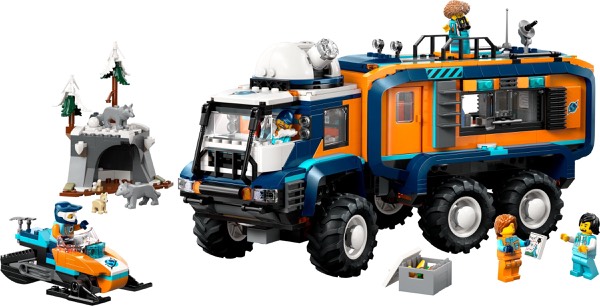
Arctic Truck 60471 occupies a strange middle ground that caught me off guard. This isn't the stripped-down utilitarian vehicle you'd expect from a City set at 298 pieces, it's got genuine design conviction. The proportions feel honest to actual expedition vehicles, with that slightly ungainly wheelbase and elevated ride height that screams "this goes places regular trucks don't." Most City vehicles telegraph their function through oversimplification. This one doesn't. There's a particular frustration in watching LEGO chase licensed off-roaders year after year when sets like this prove they can build authentic expedition personality without the brand tax.
Build-wise, the frame construction deserves attention because it's where this set flexes. Rather than the hollow, brick-shell approach typical at this piece count, there's actual internal bracing that explains why the suspension feels substantial. The tilting cargo bed mechanism works without fussiness, no springs that weaken over time, no fragile friction points. Twenty-five years in, I still notice when a vehicle's mechanical systems outlast the builder's patience, and this one won't frustrate you there.
The Arctic Truck is the latest addition to LEGO City's long-running Arctic subtheme, and at 298 pieces, it occupies a comfortable middle ground between the smaller Arctic explorer vehicles and the larger base camp sets that have defined this corner of the theme over the years. The build takes approximately ninety minutes and progresses through a logical sequence: chassis and wheel assemblies first, then the cab structure, followed by the cargo bed and the specialized Arctic equipment mounted on the back. There is nothing revolutionary about the construction sequence, but it is well-organized and maintains your interest throughout the entire process.
The chassis construction is the most engaging portion of the build. LEGO has used a modified Technic-pin connection system for the front axle that gives the truck a wider stance than typical City vehicles, which immediately communicates that this is a vehicle designed for rough terrain. The oversized tires sit on deep-tread rims that look genuinely capable of traversing snow and ice. When you attach those wheels to the completed chassis, the truck suddenly gains a personality that sets it apart from the standard City delivery vans and utility vehicles. It looks like it belongs somewhere cold and remote, and that visual identity is established before you even begin the cab construction.
The cab itself uses a standard City vehicle windscreen element with a raised roof section that provides headroom for the driver minifigure. The doors open cleanly, the minifigure seats without difficulty, and the steering wheel is positioned correctly relative to the seat. These are basic requirements, but LEGO does not always get the proportions right on smaller vehicles, so credit where it is due. The cargo bed construction involves building a flatbed with tie-down points and then mounting the Arctic research equipment, which includes a radar dish, a crate of supplies, and a small generator unit. Each of these subassemblies is quick to build but adds meaningful detail to the finished truck. The generator unit in particular uses a clever combination of grille tiles and a small exhaust pipe that reads as a convincing piece of field equipment at minifigure scale.
Where the build falls slightly short is in the cab detailing. The interior is minimal even by City vehicle standards. There is a steering wheel, a seat, and nothing else. No dashboard details, no radio equipment, no thermal coffee mug. For a vehicle that is supposedly heading into the Arctic wilderness, the complete absence of survival equipment inside the cab feels like a missed opportunity. A printed tile for a navigation screen or a pair of binoculars mounted to the dashboard would have added character without increasing the piece count significantly. This is a minor complaint, but it is the kind of detail that separates a good City vehicle from a memorable one.
The standout technique in this build is the front axle assembly. LEGO uses a combination of Technic pins and a modified plate bracket to create a wider-than-standard front axle that gives the truck its aggressive off-road stance. This is a technique that translates directly to any custom off-road vehicle MOC. The specific connection method allows the front wheels to sit outboard of the body panels, which is both visually accurate for an expedition vehicle and structurally sound enough for play. If you have ever tried to build a wide-stance truck using standard City vehicle construction methods, you know how difficult it is to make the wheels look right without the axle connection appearing fragile or improvised. This build solves that problem elegantly.
The cargo bed mounting system uses a rail-and-clip arrangement that allows the research equipment to be positioned and repositioned on the flatbed. The radar dish sits on a rotating bracket that can be angled in multiple directions, and the supply crates use a standard box construction with a lid that opens on a single hinge plate. None of these are groundbreaking techniques individually, but the combined effect teaches an important lesson about modular cargo systems for vehicle MOCs. The idea of building a flatbed with standardized mounting points and then creating interchangeable cargo modules is a design approach that scales well to larger truck builds and even train freight cars.
The roof construction uses a slightly unusual approach where the raised roof section is built as a separate subassembly and then attached to the cab using clip-and-bar connections rather than standard stud connections. This gives the roof a slight overhang that looks more realistic than a flush-mounted roof would. The technique also means the roof can be easily removed for minifigure access, which is a practical consideration for play but also demonstrates a useful removable-roof construction method. The color blocking on the exterior uses white lower panels with orange accent stripes, achieved through plate-and-tile layering that creates clean color boundaries without relying on printed elements. For builders who want to learn how to create clean color separation on vehicle bodies, this is a solid reference build.
298 pieces with a palette dominated by white, light bluish gray, orange, and black. The white elements are the most useful for Arctic or winter-themed MOCs, and you get a decent quantity of white plates and slopes in sizes that are always in demand. The orange accent pieces are less versatile in large quantities but work well for construction vehicles, safety equipment, or any build that needs high-visibility color pops. The black elements are primarily structural and include the oversized tire elements, which are excellent for any off-road vehicle project.
The oversized tires and deep-tread rims are the highlight of the parts haul from a secondary market perspective. These specific tire elements are not as common in City sets as the standard small-vehicle tires, and they command a reasonable price when sold individually. If you are building a fleet of off-road vehicles for a LEGO display, multiple copies of this set would provide an efficient source of these tires. The radar dish element, the grille tiles used in the generator subassembly, and the clip-and-bar connections throughout the build are all useful general-purpose elements. The minifigure accessories include a walkie-talkie, a wrench, and a pair of ice axes, which are welcome additions to any Arctic or adventure-themed collection.
What prevents this from being a truly outstanding parts haul is the lack of any particularly rare or hard-to-find elements. Everything in this set is available through other sets or through BrickLink at reasonable prices. The value of the parts haul is in its practical utility rather than its exclusivity. You get useful parts in useful colors at a reasonable price per piece, but there is no single element that makes this set essential for parts buyers. The overall distribution is well-balanced, though, with enough structural elements to build with and enough detail elements to finish with. For a the retail price set, you get your money's worth in plastic.
The Arctic Truck displays well for a vehicle of its size. The wide stance, oversized tires, and raised roof give it a profile that reads as rugged and capable even from across a room. The white and orange color scheme is clean and visually distinctive, making it easy to spot in a mixed display of City vehicles. The cargo bed equipment adds visual interest from above and behind, preventing the truck from looking like a plain pickup when viewed from the rear. The radar dish in particular provides a nice vertical element that breaks up the otherwise horizontal profile of the truck.
In a LEGO City layout, the Arctic Truck works best as part of a research station or expedition camp vignette. Pair it with a small ice cave build or a basecamp tent, and it immediately tells a story about polar exploration. On its own, it is a competent but not spectacular display piece. The proportions are good, the color blocking is clean, and the equipment details add character, but it lacks the visual drama of larger Arctic sets. There is no cracking ice plate beneath it, no polar bear encounter, no aurora borealis backdrop. It is a truck, and it looks like a good truck, but a truck alone does not create a scene.
The minifigures help with display quality. The Arctic explorer figure with the fur-trimmed hood and the research assistant with the safety vest provide human context that makes the truck feel purposeful. Position them around the vehicle with their accessories deployed, and the display gains narrative energy. One figure examining ice samples while the other checks the radar dish tells a story that the truck alone cannot. For shelf display, the truck measures approximately six inches long and three inches tall, which makes it a manageable size that fits well alongside other City vehicles without dominating the shelf. It is a supporting player in a collection rather than a centerpiece, and that is perfectly acceptable for a set at this price point.
At approximately retail price for 298 pieces, the Arctic Truck lands at a price-per-piece ratio of roughly ten cents, which is standard for LEGO City vehicles in 2025. You get a well-built truck with good play features, a pair of minifigures with relevant accessories, and a parts haul that leans practical. The value proposition is solid without being exceptional. You are paying a fair price for a fair amount of LEGO, and the finished product delivers on the promise of the box art without exceeding expectations.
Where the value improves slightly is in the play department. The opening doors, the removable roof for minifigure access, the rotating radar dish, and the modular cargo equipment all contribute to a toy that functions well beyond the initial build. For younger builders who will actually play with this truck, the value extends beyond the piece count into the hours of imaginative play that the Arctic exploration theme naturally encourages. For adult collectors and display builders, the value is more modest because the truck is not a statement piece. It fills a role in a collection without defining one.
Compared to other the retail price City vehicles currently available, the Arctic Truck holds its own. The piece count is competitive, the build quality is consistent, and the theme is evergreen. Arctic exploration sets have been popular with LEGO fans for decades, and this truck continues that tradition without reinventing it. If you are building an Arctic display or simply want a rugged-looking truck for your City layout, thirty dollars is a reasonable ask. If you are looking for a City vehicle that will make you rethink what LEGO trucks can be, this is not that set. It is reliable, competent, and fairly priced, and sometimes that is exactly what you need from a Tuesday afternoon build.
The set includes two minifigures: an Arctic Explorer and a Research Assistant. The Arctic Explorer wears a blue parka with a fur-trimmed hood, which is a well-designed torso print that communicates cold-weather expedition gear effectively. The facial expression is confident and adventurous, which fits the character without being cartoonish. The Research Assistant wears an orange safety vest over a thermal base layer, with a beanie rather than a hood. The contrast between the two figures suggests a hierarchy of field experience that adds a subtle narrative element to the set. One is the veteran polar explorer, the other is the eager research assistant on their first expedition. It is a small storytelling detail, but it enriches the play experience and gives each figure a distinct personality.
The accessories are functional without being lavish. The walkie-talkie and ice axes are standard Arctic set fare, and the wrench serves double duty as both a maintenance tool and a survival implement. I would have liked to see a pair of binoculars or a camera included, as both would add to the research expedition narrative. The lack of a printed tile representing a map or data tablet is also a missed opportunity. These are inexpensive additions that other City sets at this price point have included, and their absence here is noticeable when you compare the accessory count to competing vehicles in the same wave.
Overall, the minifigures are competent but not collectible. The Arctic Explorer torso is useful for any winter-themed MOC, and the Research Assistant's orange vest torso has broad utility across construction, safety, and industrial scenes. Neither figure includes a unique printed element that would make them essential for minifigure collectors, but both are well-designed and functionally appropriate for the set they come with. For a the retail price set, two minifigures with relevant accessories is the minimum acceptable count, and LEGO meets that threshold here without exceeding it.
If you are building a fleet of City work vehicles, the Tow Truck and Recycling Truck complement the Arctic Truck well, each filling a different municipal role. The Arctic Truck is a competent, well-built City vehicle that delivers exactly what it promises: a rugged exploration truck with enough detail and play features to justify its price. The wide-stance axle technique is worth learning, the oversized tires give the truck genuine off-road character, and the modular cargo equipment adds functional interest to the build. It does not reach the heights of the best City vehicles released this year, but it does not need to. Not every set needs to be a statement piece. Some sets just need to be good trucks, and this is a good truck.
The Arctic subtheme continues to be one of City's most reliable corners, and this truck fits comfortably alongside previous Arctic releases. If you are building an Arctic expedition display, this truck fills the medium-vehicle slot perfectly. If you are a casual City builder looking for a satisfying build under the retail price the Arctic Truck delivers approximately ninety minutes of focused construction with a display-worthy result. It earns a solid recommendation without qualification or caveat. It is not the set that will convert you to LEGO City fandom, but if you are already a fan, it will not disappoint you either.
- ✓ Wide-stance front axle gives genuine off-road presence
- ✓ Oversized deep-tread tires look excellent
- ✓ Modular cargo equipment adds play and display value
- ✓ Clean white and orange color scheme
- ✓ Rotating radar dish is a nice functional detail
- ✗ Cab interior is bare - no dashboard details at all
- ✗ No unique or rare elements in the parts haul
- ✗ Minifigure accessory count feels light for the price
- ✗ No terrain base or environmental elements included
Some products may be provided by manufacturers. This page contains affiliate links. All opinions are my own.
- Central Train Station Review - The flagship City infrastructure set
- City Tower Review - Another major City landmark
- Air Ambulance Review - Another City emergency vehicle
- Tow Truck Review - Another City workhorse with a functional mechanism
- Recycling Truck Review - Essential City municipal infrastructure
- Airport Fire Truck Review - Heavy-duty emergency response
The parts selection here is a quiet win for modification. Tan/dark tan appear in deliberate quantities that go beyond this single build, enough to create serious terrain bases or expand toward expedition basecamp concepts without hunting through your bulk bins. The wheel assembly uses standard axles and rims, meaning swaps toward larger tires or specialty configurations cost nothing. More importantly, the frame's open-beam construction invites meaningful changes without requiring rebuilds. Extend the cargo box, reroute the suspension, add weight distribution tooling, the skeleton supports experimentation rather than fighting it.
Where it becomes genuinely useful: that tilting bed mechanism is modular enough to adapt to larger custom frames or alternate cargo implementations. Rather than being a signature gimmick locked to this set's proportions, it's actually hackable. For builders working on Arctic/expedition themes across multiple projects, this set functions less as a finished product and more as a parts platform with a competent vehicle already assembled. That's a different value calculation than most City sets offer.
Track it in your vault on GameSetBrick - our free collection app. Log your condition, price paid, and watch the real-time market value.
Track in Your Vault →Save it to your wishlist on GameSetBrick. Share your list with friends and family - every set has a buy button so gift givers know exactly where to go.
Add to Wishlist → GameSetBrick is a free app by The Earl of Bricks. See all features. Scan it. Track it. Trade it.