Is the LEGO Air Ambulance Worth Buying?
8.2/10. Worth buying. A medical helicopter with opening patient bay and a purpose-built design that takes emergency air transport seriously. 306 pieces of life-saving aviation.

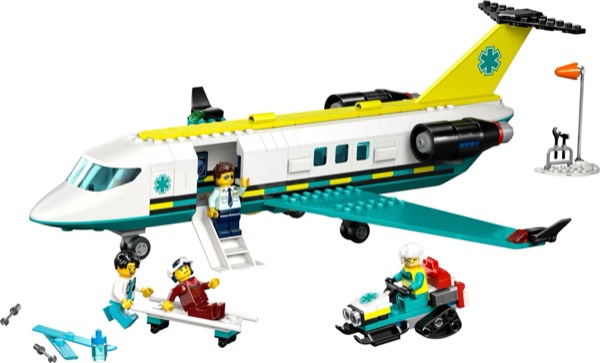
City's medical sets occupy strange territory, they're functional vehicles first, storytelling props second. This Air Ambulance refuses to choose. The moment you crack open that patient bay door and see the stretcher mechanics built into the fuselage, you're holding something that respects both the vehicle engineering and the narrative purpose. Most helicopter sets in this scale treat the medical aspect as decoration; this one threads the needle between authentic aviation design and a working interior that actually serves the scene you're building.
What matters here is the restraint. Sixty pieces go to the fuselage, rotor assembly, and undercarriage, the things that make it *fly* visually. Another forty build medical functionality that doesn't betray itself through bright stickers or oversimplification. The minifigure lineup (pilot, flight paramedic, patient, ground crew) arrives with purpose, not as filler. For builders past the casual phase, this is the rare City set where the engineering decisions feel deliberate rather than diluted for market appeal.
Air ambulances occupy a fascinating space in the emergency services world. They are the aircraft you hope you never need, but when you do, they represent the difference between minutes and hours in getting critical patients to a hospital. That urgency and purpose makes the Air Ambulance one of the most compelling vehicle concepts in the City lineup, and LEGO has done a commendable job translating that purpose into a build that feels as serious and purposeful as the real aircraft it represents. At 306 pieces, this is a focused helicopter build that takes approximately ninety minutes and dedicates every brick to creating a medical aircraft with genuine functional credibility.
The build begins with the fuselage floor and the patient compartment, which is an interesting sequencing choice that establishes the helicopter's medical purpose before you even begin the external structure. The patient compartment includes a stretcher that slides in and out through a side-opening door, medical equipment panels built from small tiles and bracket elements, and enough interior space for both a patient on the stretcher and a medical attendant minifigure. Building this interior first means you understand what the helicopter is for before you see what it looks like, and that inside-out construction approach gives the subsequent external build more meaning. You are not just wrapping a shell around empty space. You are enclosing a purpose-built medical facility, and knowing what is inside makes the outside matter more.
The fuselage construction surrounds the patient compartment with a shell that is wider and taller than a standard City helicopter to accommodate the medical interior. This larger-than-typical fuselage is one of the set's most visually distinctive features, and building it reinforces the relationship between form and function. The helicopter is bigger because it needs to be bigger, because the stretcher and the medical equipment demand interior volume that a standard police or rescue helicopter does not. The engineering serves the narrative, and the narrative justifies the engineering. That circular logic produces a construction experience that feels purposeful at every step.
The cockpit section uses a large windscreen element that provides excellent visibility for the pilot minifigure. The instrument panel is built from printed tiles that represent medical dispatch communications and flight instruments, which is a detail that most builders will never see once the windscreen is in place but which demonstrates LEGO's commitment to interior authenticity. The main rotor assembly sits on top of the fuselage with a robust mounting point that handles vigorous spinning without wobbling, and the tail rotor is a separate subassembly that adds the crucial anti-torque function to the helicopter's visual profile. The landing skids are the final element, and they use a wider-stance design than standard City helicopter skids to support the broader fuselage. The overall build sequence is well-paced, with the medical interior providing an engaging opening act and the external construction building steadily toward a satisfying conclusion when the rotors go on and the helicopter is complete.
The most valuable technique in this build is the side-opening door with integrated stretcher rail system. The door hinges outward on a pin connection that allows a roughly ninety-degree opening arc, and the interior floor includes a pair of smooth tile rails that the stretcher subassembly slides along. The stretcher uses small wheel elements on its underside that roll along the tile rails, creating a smooth loading and unloading action that is both a play feature and a medical accuracy detail. Real air ambulances have stretcher rail systems that allow rapid patient loading, and translating that functional detail into LEGO form produces a mechanism that is both educational and entertaining. The tile-rail and wheel-stretcher combination is a technique that applies to any MOC requiring a sliding element on a smooth track: cargo containers in a ship's hold, trays in a restaurant kitchen, or drawers in a minifigure-scale desk.
The wider fuselage construction teaches an important lesson about scaling LEGO vehicles beyond standard proportions. Most City helicopters use a fuselage width of roughly four studs, which is narrow enough for a single-seat cockpit. The Air Ambulance expands to approximately six studs wide to accommodate the patient compartment, and managing this wider profile while maintaining a visually coherent helicopter shape requires careful slope and plate work that is more nuanced than standard-width construction. The wider fuselage needs larger windscreen and canopy elements, broader landing skid spans, and modified tail boom proportions to maintain visual balance. Understanding how changing one dimension of a vehicle propagates changes through every other dimension is a fundamental design principle that this build demonstrates clearly.
The medical equipment panels inside the patient compartment use a bracket-and-tile construction that creates small-scale technical detail within a confined space. The brackets mount small tiles and plates perpendicular to the fuselage walls, creating the impression of monitor screens, equipment racks, and supply shelves. This perpendicular-mounting technique is essential for building detailed interiors in vehicles and buildings, because it allows you to place detail elements on walls rather than on the floor or ceiling. The specific implementation here is compact enough to reference directly when building interior details in any small-scale vehicle or room MOC.
The tail boom construction uses a progressive narrowing technique that transitions from the wide fuselage to a slender tail section. This tapering is achieved through a series of plate-width reductions combined with slope elements that smooth each transition. The technique is common in aircraft construction but executed particularly well here because the wider starting point makes the taper more dramatic and the intermediate steps more visible. Each width reduction is a visible construction choice, and following the sequence teaches you how to plan and execute a smooth dimensional transition along the length of any elongated structure.
306 pieces with a color palette dominated by white, red, and bright light blue in the medical helicopter livery. The red elements include the characteristic medical cross markings and accent pieces that are standard across City emergency medical sets. The white elements form the majority of the fuselage and are always in demand for any build requiring a clean, professional appearance. The bright light blue accents are less common in City palettes and provide a pleasant alternative to the standard blue for medical, scientific, or modern architectural applications.
The stretcher element and its wheel components are notable inclusions. The stretcher is a specialized piece with limited applications outside medical scenes, but within that niche, it is essential. The small wheel elements that allow the stretcher to roll on the tile rails are standard LEGO wheels that see broad utility in any mechanism requiring small rolling elements. The large windscreen element for the cockpit is a valuable transparent piece that works for any wide-bodied helicopter or small aircraft MOC. The medical equipment tiles include printed elements with monitor and instrument graphics that are useful for any technological or medical interior scene.
The rotor blade elements are the standard four-blade City helicopter rotor set, which is useful for any helicopter build but not exclusive to this set. The slope elements used in the fuselage construction come in a useful variety of angles and sizes in white, which are versatile across any building application. The bracket elements from the interior medical panels are small but practically useful connectors that every builder can use. The overall parts haul is solid for a the retail price set, with a good mix of structural elements, detail elements, and specialty parts. The white-and-red medical palette is clean and professional, and the parts serve well in any modern or emergency-themed build. The price-per-piece at approximately 9.8 cents is standard for City vehicles, delivering fair value without any exceptional bargains or disappointments.
The Air Ambulance is one of the better-looking City helicopters in recent memory, and that distinction comes from its proportions rather than its complexity. The wider fuselage gives the helicopter a substantial, purpose-built appearance that standard-width City helicopters lack. It looks like a helicopter designed around its mission rather than a generic helicopter with medical stickers applied. The white, red, and light blue color scheme is clean and professional, communicating medical authority without the aggressive energy of fire or police vehicles. There is something reassuring about the Air Ambulance's visual presence, which is exactly the emotional response a medical helicopter should evoke. It says help is here, and everything is going to be all right.
The side-opening door with the stretcher visible in the patient compartment adds a layer of display interest that closed-body helicopters cannot match. When the door is open, viewers can see the medical equipment and the stretcher rails, which prompts questions and conversation about how the helicopter works and what it does. That functional transparency is one of the most engaging display qualities a LEGO model can have, because it invites viewers to look inside rather than just at the surface. The interior detail is modest but sufficient to reward that closer inspection, which creates a two-level viewing experience: impressive at a distance for its proportions, interesting up close for its functionality.
In a LEGO City layout, the Air Ambulance is a prestige vehicle that elevates the entire emergency services section. Position it on a hospital helipad with the patient door open and a stretcher being loaded, and you have one of the most compelling emergency scenes in any City display. The helicopter's larger-than-standard size gives it visual weight that commands attention in a crowded layout, and the medical color scheme is distinctive enough to stand out from the red fire vehicles and blue police vehicles that typically dominate emergency services displays. For helicopter collectors specifically, the Air Ambulance represents a specialized aircraft type that adds variety to a fleet that might otherwise consist entirely of police and rescue helicopters.
For standalone shelf display, the helicopter measures approximately nine inches long and four inches wide, with the rotor blades extending the effective footprint to roughly twelve inches in diameter. This is a manageable size that works well on a standard shelf without requiring special accommodation. The landing skids provide a stable base that keeps the helicopter level without rocking, which is important for display because an unstable model is an irritating model. Displayed with the patient door open and the stretcher partially deployed, the Air Ambulance tells a complete story about emergency medical response without requiring any additional context or scene-building. It is one of those rare City vehicles that works as a standalone narrative display piece, and that self-contained storytelling ability is its greatest display asset.
At approximately retail price for 306 pieces, the Air Ambulance offers good value for a specialized City helicopter. The price-per-piece ratio is standard for the theme, and the functional features - the sliding stretcher, the opening patient door, the detailed medical interior - add play and display value that exceeds what a simpler helicopter at the same price would provide. The medical specialization adds a premium of interest that generic rescue helicopters lack, because the Air Ambulance has a specific purpose that informs every aspect of its design. You are not buying a helicopter that could be anything. You are buying a helicopter that is specifically and intentionally a flying medical unit, and that purposefulness adds value to the experience.
Compared to previous City medical helicopters, this iteration represents an improvement in both design quality and functional features. The wider fuselage, the stretcher rail system, and the detailed interior are all enhancements that justify the current price point. Previous medical helicopters at similar prices tended to be standard-width helicopters with red cross stickers, which captured the concept without committing to it. The 60465 commits to the air ambulance concept at every level of design, and that commitment produces a more convincing and engaging product.
For emergency services collectors and hospital display builders, this set is essentially required. No LEGO hospital is complete without an air ambulance on the helipad, and this is the best air ambulance LEGO has produced in the current design language. For general City builders, the value is strong because the helicopter adds a distinctive vehicle type that diversifies any fleet. For casual builders looking for a satisfying ninety-minute project At retail price the Air Ambulance delivers a build that is engaging throughout and produces a display-worthy result. Across all buyer profiles, the value proposition is positive. The price is fair, the product is well-designed, and the experience justifies the investment. That consistent value across audiences is the mark of a well-calibrated LEGO product.
The set includes three minifigures: a Pilot, a Paramedic, and a Patient. The Pilot wears a flight suit in the helicopter's white-and-blue color scheme with a helmet and communication headset element. The torso print includes flight harness and medical service insignia details that are clean and professional. This is a competent pilot figure that serves its role effectively without being particularly distinctive. The helmet-and-headset combination is standard for City helicopter pilots but always looks correct and adds functional credibility to the cockpit scene.
The Paramedic is the standout figure. The torso print features a detailed medical uniform with stethoscope, ID badge, and utility pockets rendered in white and bright blue. The figure includes a medical bag accessory and a syringe element, which are specific enough to establish the character's medical role without being graphic or frightening for younger audiences. The facial expression is calm and competent, which is exactly the demeanor you want from someone treating you in the back of a helicopter. This is a well-designed minifigure that captures the professionalism of emergency medical personnel, and the torso print is useful for any hospital, clinic, or medical scene in a LEGO display.
The Patient figure is a crucial narrative element that transforms the set from a vehicle with operators into a rescue story in progress. The patient wears casual clothing with a printed arm cast or bandage detail on one arm, suggesting an injury that requires air transport. The figure is designed to lie flat on the stretcher, which is a practical consideration that required careful proportion management. The facial expression shows mild distress but not agony, which strikes the right tone for a children's toy. Having a patient figure makes the medical features of the helicopter matter: the stretcher is not just a play feature, it is for this person. The medical equipment is not just decoration, it is keeping this person stable. That human element elevates every functional detail in the set from mechanical to meaningful.
Accessories include the medical bag, the syringe, a walkie-talkie for the pilot, and a clipboard for the paramedic. The clipboard is a particularly nice touch, suggesting patient documentation and medical protocols that add a layer of procedural realism to the play scenario. Three minifigures for a the retail price set meets the expected count, and the inclusion of a patient figure rather than a third crew member was the right design decision. The narrative value of the patient justifies forgoing an additional operator, and the resulting three-figure lineup tells a more compelling story than four crew members with no one to save.
The Air Ambulance is one of the most purposefully designed City vehicles in the current lineup. Every element - the wider fuselage, the stretcher rail system, the medical interior, the specialized minifigure lineup - serves the air ambulance concept with commitment and credibility. The build experience benefits from the inside-out construction approach that establishes medical purpose before external form. The display quality benefits from the wider-than-standard proportions that give the helicopter a distinctive, purpose-built appearance. And the play value benefits from the functional stretcher loading system that makes the medical features interactive rather than decorative.
At retail price the Air Ambulance delivers a focused, well-designed helicopter build with above-average interior detail and a minifigure lineup that includes the essential patient figure. It is not the largest or most complex helicopter LEGO has produced, but it may be the most purposeful. The design team understood that an air ambulance is not just a helicopter with a red cross on it. It is a flying medical facility, and every design decision in this set reflects that understanding. For City builders, emergency services collectors, and anyone who appreciates a LEGO set where form and function are inseparable, the Air Ambulance earns a confident recommendation. This is what purpose-built City design looks like, and LEGO should do more of it.
- ✓ Wider fuselage gives the helicopter a purpose-built appearance
- ✓ Functional stretcher rail system is both play feature and accuracy detail
- ✓ Detailed medical interior rewards close inspection
- ✓ Patient minifigure transforms the set into a narrative experience
- ✓ Clean white, red, and light blue medical color scheme
- ✓ Inside-out build sequence establishes purpose before form
- ✗ No ground vehicle or landing pad included
- ✗ Tail boom feels slightly long relative to fuselage width
- ✗ Stickers required for medical cross markings
Some products may be provided by manufacturers. This page contains affiliate links. All opinions are my own.
- Helicopter/Fire/Sub Remix Review - Another City rescue vehicle set
- Airport Fire Truck Review - A specialized City emergency vehicle
- Central Train Station Review - The flagship City infrastructure set
The rotor assembly deserves mention because it's neither over-engineered nor flimsy. Eight pieces lock together in a way that spins freely without that hollow rattle you get in cheaper helicopter builds. The pitch here is purely functional, no red/white striping theatrics, just a medical cross on unpainted blades that *work*. Builders upgrading from 2018-era City sets will notice immediately that LEGO's tightened tolerances on these connection points.
The patient bay transforms everything about how you'll use this in a collection or layout. Removable stretcher, hinged doors, and sight lines that let you actually see the medical scenario, this changes whether the set sits as a display piece or becomes an active part of your emergency response scenes. Few sets in this price range justify that level of interior detail. That working interior means resale potential stays strong because the next builder will *use* it rather than display it sealed.
Track it in your vault on GameSetBrick - our free collection app. Log your condition, price paid, and watch the real-time market value.
Track in Your Vault →Save it to your wishlist on GameSetBrick. Share your list with friends and family - every set has a buy button so gift givers know exactly where to go.
Add to Wishlist → GameSetBrick is a free app by The Earl of Bricks. See all features. Scan it. Track it. Trade it.