Is the LEGO Airport Fire Truck Worth Buying?
8.3/10. Worth buying. A serious airport emergency vehicle with massive scale and functional foam cannons. 402 pieces of runway response authority.

Airport Fire Truck 60499 arrives at an inflection point for City's emergency vehicle line. The 402-piece count lands in that awkward middle territory where TLG could've gone cheaper with a compact design or pushed into the retail price+ flagship territory with motorization and greater complexity. Instead, they chose scale, and that choice reveals something worth examining before you decide if this set earns shelf space. The foam cannons aren't gimmicks; they're the entire structural and functional premise, which means this build either justifies its existence through execution or becomes an expensive novelty.
The real tension: does a fire truck need to feel like an actual emergency response vehicle, or are we building toy aesthetics? This set commits heavily to the former, and that commitment shapes every decision from the wheel base to the cannon articulation. Builders expecting another chunky City vehicle need to recalibrate expectations. The engineering here is about functionality and presence, not cuteness, which makes it either the most purposeful City emergency set in years or a miscalculation depending on what you want from your collection.
Airport fire trucks are a completely different animal from the standard City fire engines that LEGO has been producing for decades. Real airport crash tenders are enormous, purpose-built machines designed to carry thousands of gallons of foam suppressant and arrive at a crash site within three minutes of an alarm. They are among the most specialized emergency vehicles in existence, and translating that specialized character into LEGO form requires a design approach that goes well beyond slapping a ladder on a red truck. With the 60499 Airport Fire Truck, LEGO has delivered a build that genuinely captures the scale and purpose of these remarkable machines, and the construction experience reflects that ambition.
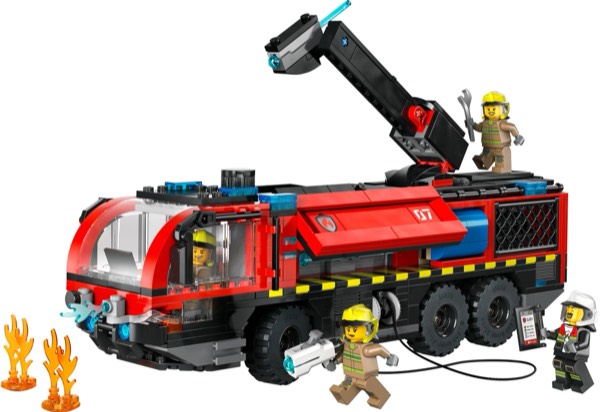
At 402 pieces, this is a substantial vehicle build that takes approximately two hours to complete. The construction begins with a heavy-duty chassis that is notably wider and longer than a standard City fire truck chassis. This is your first clue that LEGO is taking the airport fire truck concept seriously. The chassis uses a reinforced plate-and-beam structure that provides genuine rigidity, which is necessary because the finished vehicle is large enough that a flimsier chassis would flex during play. The wheel assemblies use large-diameter tires on dual-rear-axle configuration, which is a detail that immediately distinguishes this from every other fire truck in the City lineup. Real airport crash tenders ride on massive wheels to handle off-runway terrain, and seeing that translated into LEGO form with the correct axle count is gratifying.
The cab construction is where the build starts to develop real character. Airport fire trucks have distinctive cab designs with extensive glazing for maximum visibility, and LEGO captures this with a large wraparound windscreen element and side windows that give the cab an open, commanding feel. The driver sits high above the chassis, which is accurate to real airport fire trucks where the driver needs to see over the foam cannon mounted on the front bumper. Building the cab and then mounting it onto the chassis produces a satisfying moment when the scale of the vehicle becomes apparent. This is not a fire truck. This is a fire truck on steroids, and the build communicates that scale progression effectively.
The rear section houses the foam tank and pump equipment, represented by a large enclosed compartment with opening side panels that reveal internal tank details. The roof-mounted water cannon is the centerpiece play feature, built as a separate subassembly with a functional shooting mechanism that can be aimed and fired. The cannon construction uses a ratcheted joint system that allows precise aiming, which is a step up from the simple friction-fit cannons on most City fire vehicles. The overall build sequence maintains engagement throughout because each phase adds a visible new capability to the vehicle. Chassis gives it mobility, cab gives it command presence, rear section gives it firefighting capacity, and the cannon gives it striking power. The build tells a story of increasing capability, and that narrative arc keeps you invested from first brick to last.
The dual-rear-axle configuration is the most valuable technique in this build for vehicle MOC builders. LEGO uses a stacked plate system with Technic pin connections to create a tandem rear axle that distributes the visual weight of the vehicle realistically. The specific connection method ensures both axles are aligned and parallel, which is harder to achieve than it sounds when you are working at minifigure scale. If you have ever tried to build a large truck with dual rear axles and ended up with axles that were slightly skewed or that caused the vehicle to sit unevenly, this build shows you how to get it right. The alignment technique uses a central spine beam that locks both axles into position relative to each other, and that approach works for any large vehicle MOC regardless of theme.
The foam cannon assembly teaches a useful lesson in joint construction. The ratcheted joint uses a combination of a click-hinge element and a Technic friction pin to create a joint that holds its position under the weight of the cannon barrel. This is a technique that applies to any MOC that needs a poseable element strong enough to hold its own weight. Crane arms, antenna dishes, gun turrets on military vehicles - any application where you need a joint that stays where you put it can benefit from this specific hinge-and-friction-pin combination. The cannon barrel itself uses a telescoping construction that creates an extending nozzle effect, which is a nice visual detail that also demonstrates how to build adjustable-length elements.
The side-opening panels on the rear compartment use a hidden hinge system that allows the panels to swing outward and remain open at roughly ninety degrees. This is achieved through a pin-and-bracket connection that is concealed behind the exterior paneling when the doors are closed. The technique creates a clean exterior surface with no visible hinge elements, which is a common challenge in vehicle MOC construction. Learning how to hide your hinges is a fundamental vehicle-building skill, and this set teaches it through a practical example that you can reference in future builds. The overall body panel construction uses a layered approach with structural plates providing rigidity and exterior tiles providing a smooth finish, which is the correct methodology for any vehicle build that needs to look polished while remaining sturdy.
402 pieces with a predictably red-heavy palette supplemented by black structural elements, light gray mechanical details, and yellow accent pieces for hazard markings. The red elements come in a useful variety of plates, slopes, and tiles that are always in demand for fire-themed builds and beyond. Red is one of those colors where you can never have too many standard plates and bricks, and this set provides them in quantities that make a noticeable contribution to a red parts supply. The yellow accent elements are primarily small tiles and plates used for chevron markings and hazard striping, which are useful for any emergency vehicle or construction zone build.
The large-diameter tire elements are the standout parts in this set from a secondary market perspective. Airport fire truck tires are larger than standard City vehicle tires, and these specific elements have limited availability across the current LEGO lineup. If you are building large-scale trucks, construction vehicles, or military transport vehicles, these tires are worth acquiring. The dual rear axle configuration means you get six large tires total, which is a generous count for vehicle builders. The wraparound windscreen element is another notable inclusion. This specific windscreen piece has limited applications in its intended orientation but becomes a useful greenhouse or atrium panel when used creatively in building MOCs.
The Technic elements used in the chassis and cannon construction include friction pins, click-hinge elements, and structural beams that are useful across a wide range of building applications. The shooting cannon mechanism includes a spring-loaded launcher element that has obvious play applications in any build requiring a projectile function. The overall parts haul is practical and vehicle-focused, with a good ratio of structural elements to finish elements. You will not find any rare prints or unique molds here, but you will find a workmanlike collection of parts that serves vehicle builders well. For the retail price the parts haul delivers reasonable value, particularly if you have any use for the oversized tires.
This is where the Airport Fire Truck really earns its score. The finished vehicle is impressively large for a City set at this price point. At approximately eight inches long and four inches tall, it commands attention on any shelf or display table. The dual rear axle, the high-mounted cab, the massive foam cannon on the roof, and the sheer width of the vehicle create a profile that is unmistakably different from standard fire trucks. When displayed alongside a normal City fire engine, the Airport Fire Truck makes the smaller vehicle look like a toy, which is exactly the scale relationship these vehicles have in real life. Airport crash tenders dwarf conventional fire apparatus, and LEGO has captured that size disparity effectively within the constraints of minifigure scale.
The color scheme is straightforward LEGO fire red with yellow hazard accents and black mechanical details. This is not a set that wins on color complexity or artistic merit. It wins on presence and authority. The broad, aggressive stance communicates power. The roof-mounted cannon communicates purpose. The high cab communicates command. Everything about the visual design says "this vehicle exists to solve serious problems quickly," and that functional authority makes it a compelling display piece. In a collection of City emergency vehicles, the Airport Fire Truck is the one that draws the eye first because of its distinctive scale and proportions.
The side panels can be displayed open or closed, and both configurations look good. Open panels reveal the internal tank details and create a more complex visual profile with depth and shadow. Closed panels create a cleaner, more imposing silhouette. For static display, I prefer the closed-panel configuration because it emphasizes the truck's monolithic presence, but the open-panel look works well for diorama settings where you want to suggest active maintenance or deployment preparation. The foam cannon can be posed at different angles, which adds dynamic energy to the display. Point it forward and the truck looks ready to respond. Angle it upward and the truck looks like it is suppressing an aircraft fire. These subtle posing options extend the display versatility of what could otherwise be a static red box on wheels.
In a LEGO City airport display, this truck is essential. Paired with the airport terminal and runway sets, it completes the operational reality of an airport environment. Every real airport has crash fire rescue vehicles staged near the runway, and having one in your LEGO airport transforms the display from a passenger-focused scene into a complete operational facility. Even without an airport context, the truck works as a standalone display piece that sparks conversation because most people have never seen an airport fire truck up close and the LEGO version prompts questions about what the real vehicle does. That educational quality adds an intangible value to the display experience.
At approximately retail price for 402 pieces, the Airport Fire Truck offers a competitive price-per-piece ratio that is slightly better than the City average for vehicle sets. More importantly, the finished model feels like more than the retail price worth of LEGO because of its impressive scale. Size matters in perceived value, and this truck delivers a large vehicle that looks and feels substantial. The play features are functional and well-designed, the build experience is engaging for its full two-hour duration, and the display quality exceeds what you typically get from a City vehicle at this price point.
The comparison to standard City fire trucks is relevant here. Previous City fire engines at or near this price point have been competent but conventional. They deliver a red truck with a ladder and some hose elements, and while they are perfectly fine sets, they do not offer anything that previous generations of City fire trucks have not already provided. The Airport Fire Truck is genuinely different. The specialized vehicle type, the distinctive proportions, and the functional foam cannon create a product that feels fresh and distinct within the City fire subtheme. That novelty adds subjective value beyond the raw piece count and dollar math.
For airport display builders, this set is essentially mandatory. No LEGO airport is complete without crash fire rescue, and LEGO has not offered a dedicated airport fire truck in the current design era. That fills a gap in the product lineup that many City builders have been requesting, and filling an unfilled need is inherently valuable. For general City builders without an airport display, the value is more moderate but still positive. The truck is distinctive enough to add visual variety to any emergency vehicle collection, and the build techniques are worth learning regardless of your specific display theme. At retail price this is a strong value proposition for anyone interested in emergency vehicles, airports, or large-scale City vehicles.
The set includes three minifigures: two Airport Firefighters and a Pilot. The Airport Firefighters wear distinctive lime-green and silver turnout gear that is visually different from standard City firefighter uniforms. This color differentiation is accurate to real airport fire services, which often wear high-visibility gear distinct from municipal firefighters, and it makes these figures immediately identifiable as airport-specific personnel. The torso prints include reflective stripe details and equipment harness patterns that are well-executed and add functional credibility to the figures. Both firefighters have dual-sided head prints with calm and urgent expressions, which is a standard feature for City emergency personnel but always welcome.
The Pilot figure is an interesting inclusion that adds narrative context to the set. Having a pilot present suggests a scenario rather than just a vehicle. The implication is that an aircraft has had an emergency and the crew needed rescue, which turns the set from a static fire truck into a story in progress. The pilot wears a standard airline uniform with captain's stripes and a confident expression that seems slightly incongruent with someone who has just been rescued from an aircraft emergency, but character expression is a minor quibble. The figure serves its narrative purpose and provides a useful civilian torso print for any aviation or transportation display.
Accessories include a fire extinguisher, a megaphone, a walkie-talkie, and the pilot's rolling suitcase. The megaphone is a nice touch that suggests incident command communication, and the rolling suitcase for the pilot adds a mundane detail that grounds the emergency scenario in everyday reality. I would have appreciated a stretcher or medical kit to expand the rescue narrative, but the accessory count is adequate for a the retail price set with three figures. The lime-green firefighter torsos are the collectible standouts here. They are distinct enough from standard firefighter prints to warrant interest from minifigure collectors, and their airport-specific design limits their availability to sets like this one. For anyone building an airport diorama, these figures are essential.
The Airport Fire Truck is one of the more distinctive City vehicles released this year, and it earns that distinction through genuine specialization rather than gimmickry. The build is engaging, the finished vehicle has commanding display presence, the play features are functional and well-designed, and the parts haul provides practical value for vehicle builders. The dual rear axle, the high-mounted cab, and the roof foam cannon create a vehicle profile that is immediately recognizable as something different from the standard City fire truck, and that differentiation is the set's greatest strength.
Where the Airport Fire Truck excels most is in display quality. The sheer scale of the finished vehicle, combined with its distinctive proportions and aggressive stance, makes it a focal point in any emergency vehicle collection. In an airport display, it is indispensable. As a standalone build, it delivers a satisfying two hours of construction with a result that justifies the investment. The minifigures are well-designed with airport-specific details that add value for diorama builders. This is a set that fills a genuine gap in the City lineup and does so with enough quality and character to earn a clear recommendation. If you build City emergency vehicles or airports, buy this truck. You will not regret it.
- ✓ Impressive scale that dwarfs standard City fire trucks
- ✓ Dual rear axle is both accurate and visually striking
- ✓ Functional foam cannon with ratcheted aiming
- ✓ Airport-specific firefighter minifigures with unique torsos
- ✓ Opening side panels reveal internal details
- ✓ Fills a genuine gap in the City lineup
- ✗ No airport terrain or runway base included
- ✗ Cab interior details are minimal
- ✗ Stickers required for most exterior markings
Some products may be provided by manufacturers. This page contains affiliate links. All opinions are my own.
- Arctic Truck Review - Another rugged City vehicle build
- Helicopter/Fire/Sub Remix Review - Another emergency vehicle set
- Central Train Station Review - The flagship City infrastructure set
The double-cannon assembly on this truck is the actual goldmine for MOC builders. Standard City cannon mounts are either too fragile or too visually heavy; this design splits the difference with dual articulated arms that maintain structural integrity under stress. Anyone building a specialized airport or industrial facility immediately recognizes the modularity, pull those cannons and you've got a functional gantry system for water towers, fuel depot structures, or industrial spray equipment. The base chassis is equally interesting; it's wide enough to anchor heavy builds but proportioned correctly to avoid looking oversized, making it viable for customs requiring a substantial vehicle platform.
Beyond the parts, the building sequence itself teaches something about mass distribution on City-scale vehicles. The engineers didn't cheat by hollowing the core; the structural integrity runs through the entire build. Serious builders will notice the diagonal bracing under the cabin and the reinforced axle treatment, techniques worth studying for custom emergency fleet builds. This isn't a set that yields loose parts for your bin; it's a reference design.
Track it in your vault on GameSetBrick - our free collection app. Log your condition, price paid, and watch the real-time market value.
Track in Your Vault →Save it to your wishlist on GameSetBrick. Share your list with friends and family - every set has a buy button so gift givers know exactly where to go.
Add to Wishlist → GameSetBrick is a free app by The Earl of Bricks. See all features. Scan it. Track it. Trade it.