Is the LEGO Helicopter, Fire Truck & Sub Worth Buying?
8.0/10. Worth buying. Three rescue vehicles in one box - a helicopter, fire truck, and submarine that deliver maximum variety for the price. 348 pieces of emergency versatility.

Three vehicles in one box used to mean compromise, one decent build, two afterthoughts. This set breaks that pattern. The helicopter isn't a stub with rotors; the fire truck doesn't sacrifice its ladder to fund the submarine. Instead, TLG found an actual balance point where each vehicle demands separate building time and delivers distinct building satisfaction. That's rarer than it sounds in the City theme, where multi-vehicle sets often collapse into one star player and two footnotes.
What matters more: this particular combination exists for a reason that isn't obvious until you've built it. A rescue helicopter, a fire truck, and a submarine don't naturally belong in the same emergency. But they do belong in the same collection when you're a builder managing limited shelf space and budget. That's the actual conversation worth having before you decide whether 348 pieces of split focus works for your building agenda.
The Helicopter, Fire Truck and Sub Remix is one of those LEGO City sets that tries to give you a little bit of everything, and the question is always whether the breadth of content comes at the expense of depth in any individual build. At 348 pieces divided among three vehicles, each vehicle is necessarily smaller than it would be in a dedicated set. But the flip side of that equation is variety, and variety is something that LEGO City multi-packs consistently deliver better than single-vehicle sets. You build an aircraft, a land vehicle, and a marine vessel in one sitting, and that diversity of construction types keeps the build experience fresh across its approximately two-hour total duration.
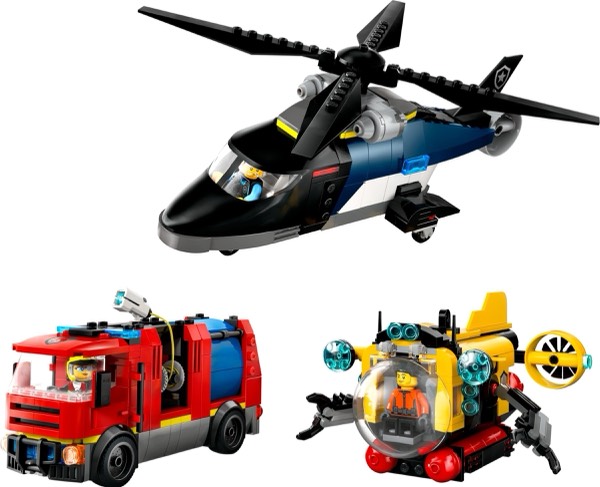
The helicopter build comes first and takes approximately forty minutes. It is a compact rescue helicopter with a two-blade main rotor, a tail boom with stabilizer, and a cabin large enough for one pilot and a rescue stretcher. The construction follows the standard LEGO helicopter template: fuselage shell, cabin interior, skid landing gear, and rotor assembly. There are no surprises in the sequence, but the execution is clean. The fuselage has a pleasantly rounded profile achieved through slope elements, and the cabin glazing uses a wraparound windscreen that gives the helicopter an open, modern appearance. The rotor attaches via the standard friction-fit pin connection that allows it to spin freely, which is the minimum acceptable rotor functionality for any LEGO helicopter. The tail boom construction is perhaps the most enjoyable part of the helicopter build because it transitions from the broad fuselage to a narrow tail section, and making that transition look smooth at this small scale requires careful slope and plate work that is more engaging than the box-like fuselage construction.
The fire truck is the second build, taking approximately thirty-five minutes. At this price and piece count, the fire truck is necessarily a smaller apparatus rather than a full-size ladder truck. It is a rapid-response unit with a water cannon mounted on the roof and compartments on the sides for equipment storage. The build is straightforward and produces a truck that looks recognizably like emergency apparatus without attempting to replicate any specific real-world vehicle. The cab construction is compact, the water cannon uses a simple swivel mount, and the side compartments open to reveal tool storage. What keeps this build interesting is the contrast with the helicopter that preceded it. After building a curved fuselage and a spinning rotor, constructing a boxy truck with wheels and compartments feels like a completely different discipline, and that contrast maintains your engagement through what might otherwise be a routine vehicle build.
The submarine is the final build and takes approximately forty-five minutes, making it the largest and most complex of the three vehicles. Submarine construction in LEGO requires creating a watertight-looking hull from elements that were not designed for hull shapes, and this build handles the challenge respectably. The hull uses a combination of curved slope elements and inverted slopes to create a rounded cross-section that reads convincingly as a submersible vessel. The conning tower is a small but effective vertical element that provides the submarine with its characteristic silhouette. The propeller assembly at the stern uses a simple shaft-and-blade construction that spins freely. Building a submarine after a helicopter and a fire truck provides a satisfying conclusion to the build experience because it is the most three-dimensionally complex of the three vehicles. The hull requires thinking about the shape from multiple angles simultaneously, which is a more demanding construction challenge than the largely planar helicopter and truck builds.
The technique value of this set lies in its breadth rather than its depth. No single vehicle introduces an advanced technique, but the set as a whole exposes you to three different construction disciplines: aircraft fuselage shaping, wheeled vehicle construction, and marine hull building. For builders who tend to specialize in one vehicle type, being forced through all three in a single sitting is a useful cross-training exercise that may reveal techniques or principles that transfer between disciplines. The curved slopes that work for a helicopter fuselage also work for a submarine hull. The structural reinforcement that keeps the fire truck rigid also applies to aircraft and marine construction. These cross-disciplinary connections are not explicitly called out in the instructions, but observant builders will notice them.
The submarine hull is the most technique-rich of the three builds. Creating a rounded hull from rectangular elements requires a specific approach: inverted slopes on the bottom, standard slopes on the top, and plates or tiles along the sides to fill the gaps and create a smooth transition between upper and lower hull sections. This slope-sandwich technique is the fundamental method for building any curved surface in LEGO, from aircraft fuselages to boat hulls to organic sculptures. The submarine's hull is small enough that the technique is demonstrated quickly, but the principle scales to any size. Understanding how to combine slopes and inverted slopes to approximate a curved cross-section is one of the most useful spatial construction skills a LEGO builder can develop, and this submarine provides a compact, accessible introduction to the concept.
The helicopter's tail boom transition is the second most interesting technique. Going from a wide fuselage to a narrow tail section requires progressively narrowing the construction while maintaining structural continuity. The build achieves this through a series of offset plates that step the width down gradually, combined with slope elements that smooth the transitions between width steps. This tapering technique applies to any elongated structure that changes width along its length: aircraft fuselages, rocket bodies, ship bows, and architectural spires all benefit from the same progressive-narrowing approach. The fire truck offers the least technique value, with standard box construction and simple mechanical features that experienced builders will find entirely familiar.
348 pieces with a diverse color palette reflecting the three different vehicles. The helicopter contributes orange and white elements in the rescue helicopter color scheme. The fire truck provides red and gray elements in the standard fire apparatus palette. The submarine adds dark blue, light gray, and yellow elements in an undersea exploration scheme. This color diversity is one of the advantages of multi-vehicle sets: you get useful parts in multiple color families rather than a large quantity in a single palette. For builders who work across multiple themes and genres, the varied color distribution of this set is more useful than a single-vehicle set with 348 pieces in one dominant color.
The helicopter rotor blades, the submarine propeller element, and the fire truck's water cannon components are all specialized parts that serve specific vehicle-building applications. The rotor blades in particular are useful for any helicopter or drone MOC, and having a spare set from a relatively affordable set is convenient. The slope elements from the helicopter and submarine builds come in a variety of angles and colors that are useful for any streamlined vehicle or organic shape. The wheel and tire elements from the fire truck are standard City vehicle fare but always welcome in a parts collection.
The windscreen and canopy elements from the helicopter are notable inclusions. Transparent canopy elements are disproportionately expensive on the secondary market relative to their part count, so acquiring them through sets is almost always more cost-effective. The submarine's transparent elements for portholes and observation windows are similarly useful for marine or Space-themed builds. The overall parts haul is well-distributed across categories: structural plates and bricks for building, slopes and curves for shaping, transparent elements for glazing, and specialized vehicle parts for specific applications. For the retail price this is a parts haul that delivers broad utility across multiple building disciplines, which mirrors the multi-vehicle nature of the set itself. The variety compensates for the modest quantity of any individual element type.
Individually, none of the three vehicles in this set is a display centerpiece. Each is too small to command attention on its own, and the proportions are optimized for play rather than display accuracy. But collectively, the three vehicles create a rescue force display that is greater than the sum of its parts. Position the helicopter in flight attitude above the submarine and the fire truck, and you have an emergency response team covering air, land, and sea operations. The visual variety of three different vehicle types in three different color schemes creates more shelf interest than a single vehicle three times the size would.
The helicopter looks best displayed in a slight nose-down attitude that suggests forward flight, which can be achieved by resting the front of the skid landing gear on a small elevation like a folded tile. The fire truck displays well in profile with the water cannon angled upward as if actively fighting a blaze. The submarine is the trickiest to display because submarines look most natural underwater, and without a water context, a submarine sitting on a shelf can look like a fish out of water - literally. A small blue plate underneath it to suggest ocean surface helps, but the submarine's display quality is inherently limited by the terrestrial nature of most display environments.
In a LEGO City layout, all three vehicles find natural homes. The helicopter can sit on a helipad or be suspended above the layout on a clear support. The fire truck joins the emergency vehicle fleet alongside other fire apparatus. The submarine can be displayed at a waterfront dock or near the Central Train Station if your City includes a harbor section. The versatility of having three different vehicle types means the set contributes to multiple areas of a layout rather than occupying a single spot. That distributed presence gives the set an outsized impact on a City display relative to its modest piece count and price. For City builders who want to populate their layout quickly across multiple sectors, this set is one of the most efficient purchases available.
At approximately retail price for 348 pieces and three vehicles, the Helicopter, Fire Truck and Sub Remix offers excellent value by almost any metric. The price-per-piece ratio is favorable for City, and the three-vehicle format means you are getting significantly more play content and display variety than a single-vehicle set at the same price could provide. Each vehicle is a complete, functional build with distinct character, and together they provide a rescue team that covers all three operational domains. For the retail price that breadth of content is hard to beat.
The multi-vehicle format also provides a longer build experience than a single-vehicle set at this price would. Two hours across three builds, each with a different construction style, is more engaging than two hours on a single build because the variety prevents monotony. The transitions between builds serve as natural break points that make the overall experience more accessible for younger builders who may not have the attention span for a sustained two-hour construction project. Building one vehicle per session gives you three separate building experiences from a single purchase, which effectively triples the number of "new LEGO to build" evenings that the set provides.
Compared to buying three individual City vehicles at roughly the retail price-15 each, the Remix set offers comparable or better value because the vehicles are designed to complement each other rather than being standalone purchases that may overlap in type or function. You are getting intentional variety rather than accidental redundancy, and that curatorial quality adds value beyond the raw piece count. For City builders who want to add air, land, and sea capabilities to their layout in a single purchase, the the retail price price is well-calibrated to the content provided. This is one of the best value propositions in the 2025 City lineup, and it earns that distinction through smart product design rather than aggressive discounting. LEGO has given you three reasons to buy this set and priced it as though you only needed one.
The set includes four minifigures: a Helicopter Pilot, a Firefighter, a Submarine Pilot, and a Rescued Civilian. The Helicopter Pilot wears a flight suit with helmet and visor in the rescue orange color scheme, which is a well-designed figure that matches the helicopter's livery. The Firefighter wears standard City fire gear with a helmet and oxygen tank accessories, which is functional and appropriate but not distinctive from firefighters in other City sets. The Submarine Pilot wears a diving suit with a wetsuit torso print and diving goggles, which is the most visually unique figure in the set and useful for any marine or diving-themed display.
The Rescued Civilian is a thoughtful inclusion that transforms the set from three disconnected vehicles into a unified rescue scenario. This figure wears casual clothing with a life vest, suggesting someone rescued from a water-based emergency. Having a person in need of rescue gives the entire set narrative cohesion: the helicopter spots the distressed civilian, the submarine approaches from below, and the fire truck provides shore-side support. That integrated narrative is far more engaging than three vehicles with three operators who have no reason to be in the same scene. The life vest on the civilian figure is a small accessory that adds tremendous narrative value at negligible cost.
Accessories include a megaphone, a fire extinguisher, flippers for the submarine pilot, and a flotation ring. The flippers are a fun accessory that is not commonly included in City sets and adds a diving play element. The flotation ring can be thrown from the helicopter or the shore to the civilian, which creates a rescue action sequence that ties the vehicles together functionally. Four minifigures for a the retail price set is generous and above the typical count for this price point. Each figure has a distinct role and visual identity, and together they tell a coherent rescue story that enriches the play experience. The minifigure lineup is one of the set's strongest elements and demonstrates how thoughtful character selection can elevate a multi-vehicle set from a parts collection into a narrative experience.
The Helicopter, Fire Truck and Sub Remix is one of the smartest value propositions in the current City lineup. Three complete vehicles covering air, land, and sea operations, four minifigures with a coherent rescue narrative, and a build experience that maintains variety across two hours of construction - all. No individual vehicle is a masterpiece, but the set is not asking you to evaluate each vehicle in isolation. It is asking you to appreciate the whole package, and the whole package is greater than the sum of its parts.
The submarine is the build highlight with its hull-shaping techniques. The helicopter is the play highlight with its spinning rotor and flight-ready proportions. The fire truck is the reliable foundation that anchors the set in classic City territory. Together, they create a rescue force that populates three different sectors of a City layout from a single box. The four-minifigure lineup with the Rescued Civilian ties everything together with narrative purpose. For City builders looking to maximize variety per dollar, this is among the best purchases you can make in 2025. It is not the most impressive set on any individual axis, but across the combined metrics of build variety, play value, display utility, and pure value for money, the Remix package delivers a total experience that competes with sets at higher price points. Strong recommendation.
- ✓ Three complete vehicles provide exceptional variety
- ✓ Submarine hull-shaping is a useful technique introduction
- ✓ Four minifigures with coherent rescue narrative
- ✓ Outstanding value at the the retail price price point
- ✓ Populates three sectors of a City layout from one box
- ✓ Rescued Civilian figure ties the set together
- ✗ Individual vehicles are small due to shared piece count
- ✗ Fire truck is the least distinctive of the three
- ✗ No environmental elements or scenery builds included
Some products may be provided by manufacturers. This page contains affiliate links. All opinions are my own.
- Airport Fire Truck Review - A dedicated City emergency vehicle
- Air Ambulance Review - Another City aircraft build
- Central Train Station Review - The flagship City infrastructure set
The helicopter contributes a genuine cockpit module with transparent canopy that separates cleanly from the fuselage, useful for scratch builders working on custom emergency aircraft. The fire truck yields more: a functional turntable ladder rig that uses standard technic connections, meaning the build system isn't proprietary. Strip those pieces loose and you're working with repeatable mechanisms, not single-use substructures. The submarine's hull is worth attention too, it's a straightforward brick-built shell without complex SNOT work, which means modular building. None of these vehicles demands you keep them whole.
What builders actually mine from this set: the helicopter's landing skid geometry (cleaner than typical), the ladder's base gearing (adaptable for other rescue builds), and the submarine's ballast tank logic. The parts selection favors utility over novelty, which means secondary-market pricing on these pieces stays reasonable. You're not paying premium for exclusive molds; you're getting functional vehicle systems that feed forward into larger projects.
Track it in your vault on GameSetBrick - our free collection app. Log your condition, price paid, and watch the real-time market value.
Track in Your Vault →Save it to your wishlist on GameSetBrick. Share your list with friends and family - every set has a buy button so gift givers know exactly where to go.
Add to Wishlist → GameSetBrick is a free app by The Earl of Bricks. See all features. Scan it. Track it. Trade it.