Is the LEGO Jet vs Car Worth Buying?
7.5/10. Proceed with caution. Two vehicles, one scenario, plenty of action. 350 pieces of high-speed City drama for builders who like their sets with a story.

City sets live or die on scenario believability, and 60489 commits harder to that than most. Two vehicles, a chase narrative baked into the box design itself, this isn't "here's a jet, here's a car, build them separately." The set assumes you're building a story, which immediately separates it from the usual "construct these models in isolation" approach. That narrative scaffolding either clicks for you or it doesn't, and it shapes everything from part selection to playability expectations in ways builders don't always anticipate.
The tension here sits between functional variety and practical restraint. 350 pieces across two moving vehicles means neither gets the deep engineering treatment you'd find in a dedicated vehicle set, yet both need enough mechanical integrity to actually perform their implied roles, one airborne, one terrestrial, both fast. That constraint generates specific build decisions that reward attention but demand acceptance of compromise. This set knows exactly what it is, and whether that matters depends entirely on what you wanted it to be.
The "versus" format in LEGO City sets is a formula that has been refined over years of police-chases-robber and fire-fights-blaze scenarios. Jet vs Car takes this confrontational format and applies it to a pairing that promises speed, action, and visual contrast. If you want to see City's aerial ambitions taken further, check out the Galactic Spaceship (#60446), and for more ground-level racing thrills, the Race Car Ramp (#60460) delivers a spring-loaded launch experience: a sleek aircraft against a ground vehicle, two modes of transportation facing off in a scenario that immediately suggests a story. At 350 pieces, this is a mid-range set that delivers two complete vehicle builds plus accessories, giving you roughly two hours of building time and a finished pair that works for both play and display.
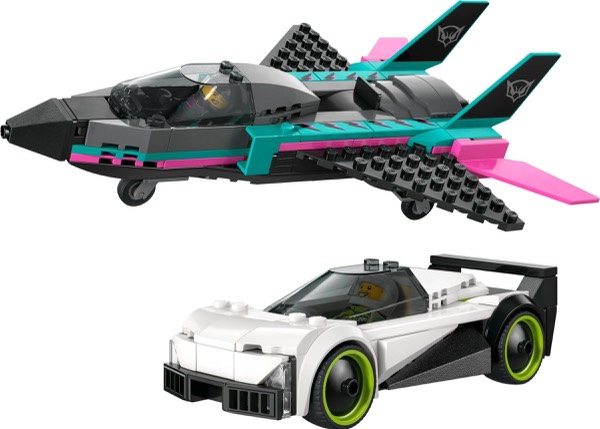
You get to choose which vehicle to build first, and that choice already tells you something about the set's appeal. The jet build is the flashier of the two, with swept wings, a cockpit canopy, and the kind of aerodynamic shaping that makes aircraft builds inherently exciting. Building a jet at LEGO scale is always engaging because aircraft have such distinctive silhouettes that every element you add moves the model closer to a shape your brain recognizes instantly. The wings go on and suddenly the model is not a collection of bricks anymore. It is a jet. That transformation moment is one of the most satisfying experiences in LEGO building, and the Jet vs Car delivers it reliably.
The car build provides a grounded counterpoint to the jet's airborne ambitions. This is likely a sports car or a modified street car, something fast enough to justify the "versus" concept while remaining recognizably road-legal. The car build is lower to the ground, wider in stance, and uses a different vocabulary of shapes than the jet. Where the jet is all pointed angles and swept surfaces, the car is broad shoulders and aggressive wheel arches. Building both vehicles back to back highlights these contrasts and gives you an appreciation for how LEGO uses different element combinations to create distinct vehicle characters within the same design system.
The accessories and the staging elements that establish the versus scenario are the final build phase. These might include a starting line, launch platform, or other environmental elements that create the context for the confrontation between jet and car. These are quick builds that serve a narrative rather than a structural purpose, and while they are not the most exciting construction in the set, they are important because they transform two separate vehicles into a scene with momentum and conflict. Without the staging elements, you have two nice vehicles. With them, you have a story, and stories are what make LEGO sets memorable.
The overall build experience is solid but not exceptional. Both vehicles are competently designed and provide satisfying construction sequences, but neither one reaches the level of mechanical complexity or architectural interest that the best City sets achieve. This is a set that delivers reliably rather than brilliantly, and for many builders, that reliability is exactly what they want. You know what you are getting with a City versus set, and the Jet vs Car delivers on that established promise without reinventing the wheel, or the wing, or the fuselage.
The jet build offers the most technique value, primarily through its wing construction and cockpit assembly. Aircraft wings in LEGO require solving the problem of creating thin, swept surfaces from elements designed for stacking. The jet's wings likely use a combination of wedge plates and angled elements to create a profile that suggests aerodynamic thinness while maintaining the structural integrity necessary for a toy that will be handled, swooshed through the air, and occasionally crashed into the carpet at high speed. Studying how the wing root transitions from the fuselage to the wing surface is instructive for any builder interested in aircraft MOCs, because that transition is where structural and aesthetic requirements conflict most intensely.
The cockpit canopy integration is another technique worth studying. Canopy elements are among the most specialized pieces in the LEGO system, and the way they connect to the surrounding fuselage structure determines whether the cockpit looks like a natural part of the aircraft or an afterthought stuck on top. The Jet vs Car set uses the canopy as a structural element as well as a decorative one, with the canopy's base providing a connection platform for the surrounding fuselage plates. This dual-function approach is standard in LEGO aircraft design but always worth noting because it demonstrates the principle of making structural elements serve aesthetic purposes simultaneously.
The car build teaches vehicle proportion management, which is a fundamental skill for any City-scale builder. A sports car needs to look low, wide, and aggressive, and achieving those proportions at minifigure scale requires careful choices about wheel positioning, roof height, and body width. The car in this set demonstrates how to create the impression of speed through static proportions alone. The wheelbase is stretched, the roof is low, the fenders are wide, and the overall stance suggests a vehicle that wants to move even when sitting still. Understanding how to build speed into a static model through proportion rather than action features is a valuable technique that applies to any fast vehicle MOC.
The versus staging elements, whatever form they take, demonstrate environmental storytelling through minimal construction. Creating a scene with just a few elements requires each element to carry maximum narrative weight. A starting line needs only a few tiles and perhaps a flag element to communicate its purpose clearly. A launch platform needs only a ramp angle and a surface to establish its function. These minimal constructions teach an important lesson about narrative efficiency in LEGO building: you do not need to build complete environments to tell complete stories. A few well-chosen elements in the right arrangement can establish a setting and a scenario that the vehicles and figures populate with implied action.
At 350 pieces split between two vehicles and staging accessories, the parts haul is distributed rather than concentrated. You receive elements from two distinct vehicle palettes, which provides color variety but means you get smaller quantities of each color than you would from a single-vehicle set of the same total piece count. The jet elements, wedge plates, angled slopes, cockpit canopy, and fuselage components, are useful for any aircraft or sleek vehicle MOC. The car elements, wheel arches, wide plates, low-profile bricks, and windshield, are standard vehicle-building parts that serve any car or truck project.
The color distribution likely features a primary color for each vehicle, perhaps blue for the jet and red for the car, or some similarly contrasting pairing that makes the versus concept visually clear. Having elements in two distinct color groups is useful for builders who work across multiple projects because it provides starter sets for two different color-coded builds. The jet's color group offers parts for other aircraft, spacecraft, or sleek vehicles. The car's color group offers parts for other ground vehicles, small buildings, or accent details. That dual-palette approach gives the parts haul more breadth than a single-vehicle set typically provides.
The canopy element from the jet is a specialized part with high value for aircraft and space vehicle builders. Canopies are among the most visually impactful elements in any build because they immediately suggest a piloted vehicle, and having extras available means you can incorporate cockpits into future MOCs without needing to source individual canopies from other sets or the secondary market. The wheel assemblies from the car are standard but essential vehicle parts that every builder needs in quantity. You can never have too many wheels, and the specific size and style included here will match the needs of other City-scale vehicle projects.
The staging accessories provide a small collection of decorative and environmental elements, flags, barriers, tiles, that have broad application in any City scene that involves events, competitions, or displays. These are not high-value parts individually, but they accumulate usefulness over time as you build out event scenes, parades, or competition scenarios in your City layout. The minifigure accessories round out the haul with character-appropriate items that support the action narrative. Overall, the parts haul is adequate and varied but not concentrated enough in any single category to make it a targeted parts-sourcing purchase. You buy this set for the build experience and the finished models, not for the inventory contribution.
The display potential of Jet vs Car lives or dies on how you arrange the two vehicles. Displayed separately, each vehicle is a decent but not exceptional model. The jet has good proportions and the inherent visual appeal of any aircraft, but at this scale, it lacks the presence to stand alone as a display centerpiece. The car is similarly competent but not commanding, a nice City-scale sports car that does not distinguish itself from the many other City cars in the lineup. The magic happens when you display them together in a way that captures the versus dynamic, the confrontation, the speed comparison, the drama of two vehicles from different domains meeting in competition.
Arranging the jet and car on a shelf with the staging elements creates a dynamic display that tells a story at a glance. The jet angled upward as if taking off. The car positioned at the starting line with its nose aimed forward. The staging elements establishing the competition context. Together, these elements create a miniature tableau that is more engaging than any single vehicle could be alone. This is the display strategy for any versus set: the individual models are components of a scene, and the scene is the display piece. Trying to display the jet or the car in isolation misses the point of the set and wastes its narrative potential.
In a City layout, the jet and car create an event within the urban environment. Most City layouts are built around everyday scenarios: commuting, shopping, emergency response, and construction. A jet versus a car introduces spectacle and competition, a special event that draws minifigure spectators and creates a focal point of excitement within the otherwise routine urban landscape. That contrast between the everyday and the exceptional is what makes event-themed sets valuable in layouts. They break the routine and create visual peaks that draw the eye to specific locations.
The color contrast between the two vehicles is important for display because it creates visual tension that reinforces the competitive narrative. Two vehicles in similar colors would look like a fleet. Two vehicles in contrasting colors look like opponents. That chromatic opposition is a display principle that LEGO understands and employs effectively in versus sets, and it makes the display arrangement more visually dynamic than monochromatic alternatives. From a photography perspective, the contrasting colors provide natural composition anchors that make the versus scene easy to frame and photograph effectively, which matters for builders who share their collections on social media or community sites.
The Jet vs Car includes pilot and driver minifigures that represent the two sides of the competition, and the character contrast between them is essential to the set's narrative. The pilot wears flight gear, a helmet with visor, a flight suit, and the confident expression of someone who is accustomed to moving at high speed several thousand feet above the ground. The driver wears racing or casual street gear, with an expression that suggests competitive intensity and the kind of ground-level confidence that comes from knowing every curve of every road. These are characters defined by their vehicles, and their distinct visual identities make the versus concept legible through the figures alone, even without the vehicles present.
The pilot figure is useful beyond the jet context. Flight-suited figures work in any aviation scenario, from commercial airports to military bases to space centers. The helmet and visor combination is a versatile headgear option that serves multiple roles, and the flight suit torso works for any piloting context. The driver figure is similarly versatile, working in any racing, driving, or motorsport scenario within a City layout. Both figures have the specificity to be interesting and the versatility to be useful, which is the ideal balance for City minifigures.
If the set includes spectator or official minifigures, those additions enhance the scene significantly by providing an audience for the competition. A race without spectators is a test run. A race with spectators is an event. The presence of bystanders transforms the competitive scenario from a private challenge into a public spectacle, which is more engaging for both play and display. Officials such as referees, timekeepers, or flag wavers add another layer of legitimacy and structure to the competition, making it feel like an organized event rather than an impromptu drag race.
The minifigure accessories support the competitive narrative with appropriate items: a trophy for the winner, tools for the vehicles, flags or timing devices for the officials. These accessories are small but they define the set's story. A trophy implies a contest with a resolution. Tools imply vehicles that need maintenance between races. Flags imply rules and structure. Each accessory adds a thread to the narrative tapestry, and together they create a complete competitive event at minifigure scale. For a versus set, the minifigures are not just vehicle operators. They are characters in a drama, and the Jet vs Car gives them enough personality and equipment to play their roles convincingly.
At approximately retail price for 350 pieces, the Jet vs Car is priced at just under nine cents per piece, which is competitive for City. The two-vehicle format provides more physical product than a single-vehicle set at the same price, and the versus narrative adds a play dimension that standalone vehicles lack. However, the split attention between two vehicles means that neither one reaches the quality or complexity level that a dedicated single-vehicle set At retail price could achieve. You get breadth rather than depth, quantity rather than refinement, and whether that trade-off appeals to you depends on what you value in a LEGO purchase.
For younger builders who prioritize play scenarios, the versus format provides strong value because the competitive narrative is immediately accessible and endlessly replayable. Who wins today? The jet or the car? That question powers hundreds of play sessions, and the answer can change every time. For adult builders and display collectors, the value depends on whether the versus display appeals to your aesthetic sensibilities. If you enjoy dynamic, narrative-driven displays, the jet and car together create a scene worth the price. If you prefer refined, standalone models, you might find more satisfaction in a single dedicated vehicle set at the same price point.
The parts value is adequate but distributed across two color palettes and two vehicle types, which limits its concentration in any single category. The build experience provides roughly two hours of engagement, which is reasonable entertainment value for thirty dollars. The minifigure selection adds character and narrative value that enhances both play and display. Overall, the Jet vs Car is a competent versus set that delivers the expected formula reliably. It is not the best value in the 2025 City lineup, but it is far from the worst, and for builders who enjoy the versus format and the specific vehicle pairing, it provides a satisfying package at a fair price. Know what you want from it before you buy, and it will deliver.
- ✓ Two-vehicle format provides varied building experience
- ✓ Jet and car contrast creates strong visual dynamic
- ✓ Versus narrative is immediately engaging for play
- ✓ Good aircraft construction technique in the jet build
- ✓ Minifigure character contrast supports the competition theme
- ✓ Staging elements create complete scene out of the box
- ✗ Neither vehicle reaches standout quality on its own
- ✗ Parts split between two palettes limits MOC utility
- ✗ Versus format is familiar and somewhat predictable
- ✗ Staging accessories feel minimal for the price
Some products may be provided by manufacturers. This page contains affiliate links. All opinions are my own.
- Sports Car Review - Another fast City vehicle
- Yellow Taxi Review - City street vehicle
- Central Train Station Review - City flagship infrastructure
This set slots perfectly for builders aged 10-13 who've already mastered basic builds but aren't yet chasing minifigure collections or complex mechanical systems. The 350-piece count hits a specific sweet spot: substantial enough to feel like a genuine build session (roughly 45-90 minutes of actual construction), but compact enough to hold focus without fatigue. City theme regulars in this age band specifically, builders who already own multiple City vehicles and understand the implicit rules of that sub-theme, will extract the most satisfaction here. These are the builders who treat vehicles as functional pieces of a larger urban narrative, not display pieces.
Collectors of City police and emergency vehicles should approach cautiously. The jet-versus-car framing means neither gets the specialized equipment budget of a dedicated police or chase vehicle. You're trading comprehensive details for narrative scenario instead. That's the right trade for storytelling-focused builders; it's a loss for those chasing complete emergency service equipment catalogs. The set rewards builders comfortable with "good enough" aesthetics in service of dynamic action sequences, which describes a specific audience, not the broadest City demographic.
Track it in your vault on GameSetBrick - our free collection app. Log your condition, price paid, and watch the real-time market value.
Track in Your Vault →Save it to your wishlist on GameSetBrick. Share your list with friends and family - every set has a buy button so gift givers know exactly where to go.
Add to Wishlist → GameSetBrick is a free app by The Earl of Bricks. See all features. Scan it. Track it. Trade it.