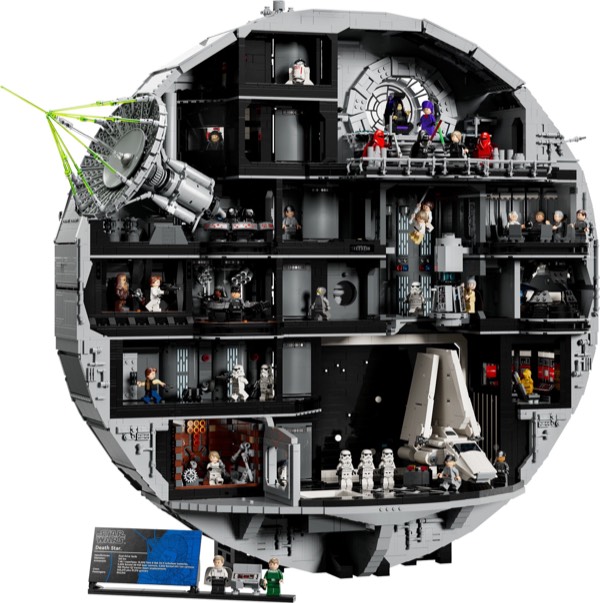
There are LEGO sets, and then there are events. The Death Star is an event. At 9,023 pieces, this is not a weekend project or even a week-long commitment. This is a multi-week building journey that will test your patience, reward your dedication, and produce a display piece that fundamentally changes the room it occupies. LEGO has attempted the Death Star before, but this 2025 version represents the most ambitious Star Wars LEGO set ever engineered - a complete spherical construction with detailed interior scenes, an army of 40 minifigures, and structural engineering that keeps nearly ten thousand pieces locked together under their own weight.
The build begins with the internal framework, a Technic-heavy structural skeleton that establishes the spherical volume and provides the mounting points for every interior scene and exterior hull panel that follows. This phase is the least visually exciting but the most critical - the framework determines the structural integrity of the entire model, and LEGO has designed it with redundant connections and cross-bracing that distribute the weight of the upper hemisphere effectively. Plan for several hours on the framework alone.
From the framework, the build progresses through a series of interior scene modules: the throne room, the detention block, the trash compactor, the hangar bay, the superlaser control room, and the conference room where Vader force-choked Admiral Motti. Each scene is essentially a self-contained micro-build that slots into the framework like a drawer into a cabinet. This modular approach breaks the 9,023-piece count into manageable sessions, and the variety of scene construction keeps the build experience fresh across the entire project. You never build the same thing twice, and that is the genius of the design.
The primary technical achievement is the sphere. Building a convincing spherical shell from rectangular bricks is one of the hardest challenges in LEGO engineering, and the Death Star solves it through a combination of panel sections that attach to the internal framework at varying angles. Each hull panel is flat or gently curved individually, but the aggregate of dozens of panels arranged at calculated angles creates a sphere that reads convincingly from display distance. The panel attachment system uses ball-joint and hinge connections that allow fine angular adjustment, and the instructions guide these angles precisely.
The superlaser dish is the second major technical highlight. The concave dish on the northern hemisphere uses a dedicated internal structure that creates the distinctive eight-faceted depression, with the weapon emitter at the center. The transition from flat hull surface to concave dish is handled through a series of angled plate connections that create a smooth inward slope. When viewed from the front, the dish focal point draws the eye exactly as it should - this is the Death Star's defining visual feature and LEGO has given it the engineering attention it demands.
The interior scenes demonstrate a different kind of technique: narrative construction at miniature scale. The trash compactor features a movable wall mechanism. The hangar bay has enough depth to display ships and figures in a convincing diorama arrangement. The throne room captures the elevated platform and the viewing windows looking out into space. Each scene uses space-efficient building techniques that pack maximum visual detail into the limited volume available within the sphere. For builders who appreciate both structural engineering and diorama craft, this set delivers education in both disciplines. The Titanic (#10294) is the closest comparison for sheer structural ambition, and the Hogwarts Castle (#71043) shares the interior-scene-within-a-shell approach, but the Death Star surpasses both in overall complexity.
9,023 pieces make this one of the largest LEGO sets ever produced, and the parts haul is correspondingly massive. The dominant colors are light bluish grey for the hull surface and dark bluish grey for the structural framework, with black, tan, and various accent colors appearing in the interior scenes. The sheer volume of grey elements - plates, tiles, slopes, curved slopes, modified bricks - makes this set a major inventory addition for any builder who works in the grey palette. You will have more grey curved slopes after building this set than most builders accumulate in years.
The Technic elements for the internal framework represent a substantial collection of beams, axles, pins, and connectors that are the backbone of advanced MOC construction. The ball-joint and hinge elements used for the hull panel connections are versatile mechanical components. The interior scenes contribute specialized pieces including minifigure accessories, printed tiles for control panels and screens, and small decorative elements that add variety to the parts profile.
The 40 minifigures are themselves a massive parts contribution. Each figure includes torso, legs, headpiece, and accessories, and the range spans iconic characters from across the original trilogy. The minifigure accessories alone - lightsabers, blasters, droids, helmets - constitute a collection that would cost significant money to acquire separately. For builders who value minifigure-scale play and display, the Death Star is essentially a minifigure army pack with a 9,000-piece bonus build included.
The Death Star is a room-defining display piece. The completed sphere stands approximately 42cm tall and 41cm in diameter, making it the largest single-object display model in most collections. The spherical form is immediately recognizable from any position in the room, and the superlaser dish provides the orientation detail that anchors the viewer's recognition. The hull surface texture - a mix of smooth tiles and greebled plate sections - creates the kind of surface variation that catches light and suggests the immense scale of the original station.
The cutaway sections that reveal the interior scenes add a dimension of display depth that pure exterior models cannot match. Viewers are drawn in from the impressive exterior silhouette to the miniature narrative scenes within, each populated with recognizable characters in iconic moments. The trash compactor scene with Luke, Leia, Han, and Chewbacca. The throne room confrontation. The detention block rescue. Each scene is a display piece in its own right, and the aggregate effect is a model that rewards extended viewing and repeated discovery.
This is not a shelf model. The Death Star requires a dedicated table, stand, or display cabinet with sufficient depth and weight capacity. Plan your display location before you begin building, because moving the completed model is a two-person operation. The visual impact justifies the space commitment - visitors will see this before they see anything else in the room. For display planning, our display ideas guide covers weight distribution and cabinet recommendations for flagship models. Among the best LEGO sets for adults in 2026, the Death Star occupies a category of one.
At $999.99 for 9,023 pieces and 40 minifigures, the Death Star comes in at roughly 11.1 cents per piece - an excellent ratio for a licensed Star Wars set of this complexity. The minifigure count alone represents substantial value: 40 figures including named characters, troopers, droids, and accessories that would cost several hundred dollars to acquire individually through secondary market purchases. The piece count delivers weeks of build time, and the completed model provides years of display value.
The honest question at this price point is not whether the set delivers value per piece, but whether the total investment fits your budget and space. A thousand dollars is a significant commitment, and the completed model demands dedicated display real estate. For collectors who have the means and the space, the Death Star represents one of the highest value-per-dollar propositions in LEGO's flagship lineup when you account for the minifigure army, the engineering complexity, the build duration, and the display impact.
The comparison to other flagship sets reinforces the value proposition. The Titanic at 9,090 pieces and a similar price point offers comparable build time but no minifigures and a more linear display format. The Hogwarts Castle at a lower price point offers interior scenes but at smaller scale. The Death Star combines the best of both approaches: massive structural engineering and detailed interior diorama scenes, topped with an unmatched minifigure count. For the serious Star Wars collector, this is not an expense. It is an investment in the centerpiece of a collection that everything else orbits around - just like the Death Star itself.
Forty minifigures. That number alone makes this set a milestone in LEGO Star Wars history. The lineup spans the original trilogy's most iconic characters and populates every interior scene with the figures needed to recreate the moments that defined the franchise. Luke Skywalker appears in multiple outfit variants - farm boy, Stormtrooper disguise, and Jedi black. Princess Leia includes her white Senatorial gown and the detention block rescue outfit. Han Solo comes with both his standard vest outfit and a Stormtrooper disguise. Chewbacca, Obi-Wan Kenobi, C-3PO, and R2-D2 round out the hero roster.
The Imperial contingent is equally impressive. Darth Vader features premium torso printing with the chest control panel and cape. Emperor Palpatine appears in his hooded robe with the withered face print. Grand Moff Tarkin, Admiral Motti, and General Tagge populate the conference room scene. Stormtroopers, Death Star troopers, Imperial officers, and Royal Guards provide the rank-and-file presence that makes the interior scenes feel populated rather than empty. The variety of Imperial uniforms and armor types creates a visual hierarchy that reflects the command structure of the station.
The droid contingent includes multiple astromech and protocol droid variants, an interrogation droid for the detention block scene, and mouse droids for the corridor displays. Each minifigure includes appropriate accessories - lightsabers, blasters, electrobinoculars, and specialized equipment. The overall print quality across 40 figures is consistently high, with detailed torso, leg, and helmet printing that reflects the premium 18+ presentation standard. This minifigure collection alone represents one of the most comprehensive original trilogy character lineups LEGO has ever assembled in a single set, making it invaluable for diorama builders and minifigure collectors alike.
- ✓ 9,023 pieces and 40 minifigures - unprecedented scale and value
- ✓ Convincing spherical construction with detailed superlaser dish
- ✓ Multiple interior scenes recreate iconic original trilogy moments
- ✓ Modular build approach keeps weeks-long project fresh and varied
- ✓ Room-defining display presence unlike any other LEGO set
- ✗ $999.99 price requires serious budget commitment
- ✗ Completed model requires dedicated table or cabinet display space
- ✗ Moving the finished model is a two-person operation
- ✗ Internal framework phase is long and visually unrewarding
Some products may be provided by manufacturers. This page contains affiliate links. All opinions are my own.
- Titanic Review - The other 9,000+ piece flagship build
- Hogwarts Castle Review - Interior scenes within an iconic exterior shell
- Best LEGO Sets for Adults 2026 - Where the Death Star ranks among the year's best
- LEGO Display Ideas - Display planning for flagship models
- All Reviews - Browse every set we have reviewed
Track it in your vault on GameSetBrick - our free collection app. Log your condition, price paid, and watch the real-time market value.
Track in Your Vault →Save it to your wishlist on GameSetBrick. Share your list with friends and family - every set has a buy button so gift givers know exactly where to go.
Add to Wishlist → GameSetBrick is a free app by The Earl of Bricks. See all features. Scan it. Track it. Trade it.