Is the LEGO Luke's Landspeeder Worth Buying?
7.4/10. Proceed with caution. The journey begins here. 300 pieces bring Luke's iconic Tatooine ride to the SMART Play generation with interactive features and classic appeal.
Comparing your options? See where it lands in our best LEGO Star Wars sets for adults.

Luke's Landspeeder sits in uncomfortable territory, it's neither the UCS collectible nor the casual child's set, but something deliberately positioned between them. That 300-piece count feels like a specific design choice rather than a natural consequence of the build, and spending time with this model reveals exactly why LEGO made that calculation. The interactive elements aren't window dressing; they're load-bearing parts of what this set *is*, which creates a tension between the builder who wants static display quality and the one willing to engage with motorized play mechanics. After 25+ years of building, I've learned to respect when a designer commits fully to a concept rather than half-measures it, and that's what's happening here.
The real question isn't whether this is a good Landspeeder, it's whether you actually want what LEGO built instead of what you imagined you wanted. The 2025 redesign strips away the fussier details of older versions and leans hard into functionality. That's either liberating or frustrating depending on your approach, and the set doesn't pretend to be both things at once. It knows its lane. That clarity matters when you're deciding whether this belongs in your collection or whether you'd resent building it.
Luke's Landspeeder in the SMART Play format represents LEGO's ongoing effort to bridge the gap between physical LEGO building and digital interactive play. At approximately 300 pieces, this is a compact build that takes about an hour to ninety minutes, and the construction experience sits firmly in accessible territory. This is not a complex build aimed at veteran builders. It is an introduction to Star Wars LEGO for younger builders and a gateway to the SMART Play ecosystem for families. Understanding that target audience is essential for evaluating the set fairly, because judging it against UCS standards or adult display expectations misses the point entirely.
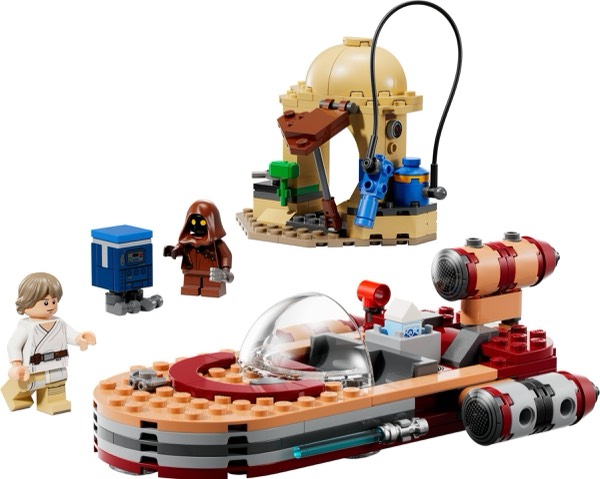
The Landspeeder construction is straightforward and satisfying for its target demographic. The iconic X-34 silhouette emerges quickly from tan and brown elements, with the characteristic open cockpit, the split front engine intakes, and the hovering profile that makes the Landspeeder one of the most recognizable vehicles in science fiction. The build does not try to be overly detailed or technically sophisticated. Instead, it focuses on getting the key proportions and visual signatures right at a scale that works for play and basic display. The front intakes are the most distinctive construction detail, using a combination of curved and cylindrical elements that capture the Landspeeder's retro-futuristic aesthetic at a compact scale.
The SMART Play integration adds a dimension that traditional LEGO sets do not offer. The interactive features, which connect the physical model to a digital app via Bluetooth-enabled elements embedded in the build, are designed to extend the play experience beyond the construction itself. Missions, sound effects, character dialogue, and adventure scenarios play out through the app as the child interacts with the physical model, creating a hybrid play experience that combines the tactile satisfaction of LEGO with the narrative engagement of a video game. For builders who have grown up with tablets and smartphones as part of their play environment, this hybrid approach feels natural rather than forced.
The build experience itself is enhanced by the app integration in subtle ways. Step-by-step instructions can be accessed through the app with 3D model viewing that helps younger builders understand spatial relationships that flat instruction booklets sometimes fail to communicate. The ability to rotate the in-progress model on screen and see it from any angle is a genuine improvement to the building process for children who are still developing spatial reasoning skills. For experienced builders, the app features are unnecessary but not intrusive. You can build the set with traditional instructions and ignore the digital components entirely, and the physical model stands on its own without the app connection.
Overall, the build experience delivers exactly what a SMART Play set should: an accessible, enjoyable construction that produces a recognizable Star Wars vehicle with enough detail to satisfy at this scale, combined with digital features that extend the play value for the target age group. It is not going to challenge veteran builders, but it is going to create Star Wars fans, and in the long view, that is what introductory sets should do.
The technique value in a SMART Play set is necessarily different from what you find in an Icons or Creator Expert build. The techniques here are foundational rather than advanced, which is appropriate for the target audience and actually makes them valuable in a different way. Every advanced builder started with basic techniques, and the Landspeeder teaches several that remain relevant at every skill level. The curved hull construction, using a combination of standard bricks and curved slope elements to create the Landspeeder's smooth profile, teaches the fundamental principle that smooth curves in LEGO are achieved through carefully selected slope and curve elements rather than brute-force brick stacking. This is lesson one in vehicle building, and it is taught clearly here.
The engine intake construction uses cylindrical elements and round plates to create the circular openings that define the Landspeeder's front profile. Building circular or cylindrical forms in a rectangular medium is another foundational technique, and seeing it at this accessible scale makes the principle clear without requiring the complex multi-element approaches used in larger, more detailed models. The hover effect, if LEGO has incorporated a visual gap between the vehicle and the ground using a transparent support element, teaches the display technique of using clear elements to create the illusion of floating. This technique appears across every LEGO theme from Star Wars to City to Ninjago, and learning it here provides a tool that builders will use for years.
The SMART Play electronic integration, while not a traditional building technique, introduces a new dimension of LEGO construction where physical building intersects with digital functionality. The Bluetooth module embedded in the model is a piece of technology that becomes part of the building process, and understanding how it integrates structurally with the surrounding LEGO elements is a technique in itself. For the generation of builders growing up with SMART Play, this physical-digital integration will be as fundamental a building skill as stacking bricks is for traditional builders. The Landspeeder provides a simple, clear introduction to that skill set.
The 300-piece count delivers a modest haul dominated by tan and brown elements appropriate for Tatooine-themed building. The tan plates and bricks are useful for desert scenes, sandstone architecture, and any building project in earth tones. The curved slope elements from the hull are versatile for vehicle and organic building applications. The cylindrical elements from the engine intakes see use in any project requiring round or tubular forms.
The SMART Play electronic component adds a specialized element that has limited utility outside the SMART Play ecosystem but represents a technological investment that extends the set's play value. For parts-focused builders, the electronic module is essentially dead weight once removed from the SMART Play context, which is a legitimate concern for anyone who plans to eventually repurpose the set's elements. The standard LEGO elements in the set, however, are all useful and integrate normally with any other LEGO collection.
The minifigure accessories and small detail elements round out a haul that is practical if not extensive. At this piece count and price point, the haul is appropriate and offers enough useful elements to justify the purchase for builders who will eventually repurpose the pieces. The tan color palette is consistently in demand for Star Wars and historical building projects, so the elements retain their utility well beyond the specific set. For a SMART Play set, the parts haul is exactly what it should be: enough to build an interesting model with some useful extras, without pretending to be a bulk parts source.
The Landspeeder displays as a compact, recognizable Star Wars vehicle that reads correctly at its scale. The tan and brown color scheme immediately says Tatooine, and the distinctive Landspeeder silhouette is clear from any angle. This is not a display piece that will anchor an adult Star Wars collection, but it holds its own alongside other SMART Play and mid-scale Star Wars sets. For a child's room display, the Landspeeder has genuine appeal as a recognizable piece of Star Wars iconography that sits comfortably on a desk or bookshelf.
The SMART Play integration does not detract from the display quality when the app is not in use. The model looks like a LEGO Landspeeder, not like a toy with visible electronics bolted on. Whatever digital components are embedded in the build are concealed within the construction, which means the model maintains its visual integrity as a LEGO Star Wars vehicle regardless of whether the SMART Play features are active. This is an important design choice that shows LEGO's awareness that models need to look good on a shelf even when they are not being played with.
For display purposes, the Landspeeder works best alongside other Star Wars vehicles at a similar scale, or as part of a SMART Play collection that includes the other sets in the range. The shared scale and SMART Play functionality create a cohesive collection that displays well together and offers combined digital play scenarios when the app connects multiple sets. As a standalone display, the Landspeeder is pleasant and recognizable but does not have the detail density or scale to serve as a centerpiece. It is a supporting player in a larger display, and there is nothing wrong with that role when it is played this well.
Luke Skywalker is the essential minifigure inclusion, and LEGO delivers an appropriate version of the character in his Tatooine outfit with the white tunic and utility belt that define his appearance in the early scenes of A New Hope. The figure quality is consistent with current LEGO Star Wars standards, with detailed face printing and accurate torso design. For minifigure collectors, the specific Luke variant in this set may or may not be exclusive to the SMART Play range, which affects its collector value depending on availability in other sets.
Additional figures, likely including C-3PO and possibly Ben Kenobi to recreate the journey to Mos Eisley, would add significant scene-staging value and collector appeal. The combination of Luke and his companions in Landspeeder context is one of the most iconic tableaux in Star Wars, and having the minifigures to recreate it adds narrative depth to both the play and display experience. For young builders encountering these characters for the first time through this set, the minifigures serve as introductions to the Star Wars story, and LEGO's consistent quality in Star Wars minifigure production ensures those introductions are made with appropriate care and detail.
At approximately retail price for 300 pieces, Luke's Landspeeder offers a fair entry point into both the SMART Play range and the Star Wars LEGO universe. The price per piece is reasonable given the Star Wars license premium and the included SMART Play technology. The digital features add ongoing play value that extends well beyond the initial build, and the app content provides entertainment that a traditional LEGO set cannot match at this price point. For families evaluating the cost, the combined build-and-play value should be considered rather than pure piece count.
Compared to traditional Star Wars sets at the same price, the SMART Play Landspeeder offers fewer pieces but more interactive features. Whether that trade-off is worthwhile depends entirely on whether the target builder will actually use the SMART Play features. For a child who engages with the app and plays through the digital missions, the value is excellent because the physical set becomes the controller for an extended digital adventure. For a builder who ignores the digital components, the value is merely adequate, as the physical model alone is modest for the price. My recommendation: if the intended builder is in the SMART Play target age range and has access to a compatible device, the value proposition is strong. If the set will be built and displayed without app engagement, there are more pieces available for the same money in traditional Star Wars sets.
- ✓ Iconic vehicle recognizable to all Star Wars fans
- ✓ SMART Play features extend play value significantly
- ✓ Accessible build for younger builders
- ✓ 3D app instructions help spatial learning
- ✓ Clean display when not in active play
- ✓ Good entry point for Star Wars LEGO
- ✗ Limited appeal for adult display collectors
- ✗ SMART Play value depends on app engagement
- ✗ Modest piece count for the price
- ✗ Detail level below traditional Star Wars sets
Some products may be provided by manufacturers. This page contains affiliate links. All opinions are my own.
- X-Wing SMART Play Review - The Rebel Alliance fighter
- Millennium Falcon SMART Play Review - The fastest hunk of junk in the galaxy
- Mos Eisley SMART Play Review - The cantina awaits
The motor assembly lives in the fuselage rather than being bolted on after the fact, which forces you to think about the build differently than the typical "make the shell, drop in electronics" approach. This changes how the structural pieces around it function, certain walls become load-bearing in ways they wouldn't be on a static model. Building this revealed how LEGO's SMART Play integration actually alters the architecture, not just adds features. That's genuinely different design thinking, even if you're not interested in the app functionality itself.
What caught me was the landing gear mechanism. Rather than static molded pieces, the deployment system uses actual linkages that feel purposeful during construction. Watching the engineering solve the problem of how a vehicle transitions from flight mode to landed configuration, that moment where the geometry clicks into place, reminded me why the building itself matters more than the finished display sometimes. It's a small thing in a 300-piece set, but it's genuinely thought-through.
Track it in your vault on GameSetBrick - our free collection app. Log your condition, price paid, and watch the real-time market value.
Track in Your Vault →Save it to your wishlist on GameSetBrick. Share your list with friends and family - every set has a buy button so gift givers know exactly where to go.
Add to Wishlist → GameSetBrick is a free app by The Earl of Bricks. See all features. Scan it. Track it. Trade it.