Is the LEGO X-Wing Starfighter Worth Buying?
7.9/10. Proceed with caution. Red Five standing by. 350 pieces bring the Rebel Alliance's most iconic fighter to the SMART Play generation with wings that mean business.
Comparing your options? See where it lands in our best LEGO Star Wars sets for adults.

The 75423 X-Wing lands in a weird middle space that TLG clearly intended as intentional, a set that respects the source material's engineering without trying to compete with UCS pricing. After 25+ years of watching Star Wars sets, you notice immediately that this isn't a compact economy build and it isn't a display centerpiece. The proportions are deliberate. The wing mechanism actually *works* like the Rebel Alliance's weapon system should, and there's real structural logic baked into those 350 pieces instead of filler geometry. Building it, the engineering becomes obvious: this is the direct descendant of the older 10134 X-Wing, but rebuilt for modern parts efficiency and, critically, for the play-action that younger builders actually want, wings that open and close with intentional resistance, a liftoff landing gear, and a cockpit proportioned to work.
What catches you is how this set refuses compromise in unexpected places. The fuselage uses stacked slopes for the characteristic nose cone in a way that feels hand-crafted, not mass-produced. The exposed stud work on the wing panels could've been hidden with new molds; instead, it's embraced as part of the vehicle's authentic aesthetic. That choice signals something: TLG trusted builders to understand that functional design *is* beautiful design. This isn't a set pretending to be something it's not.
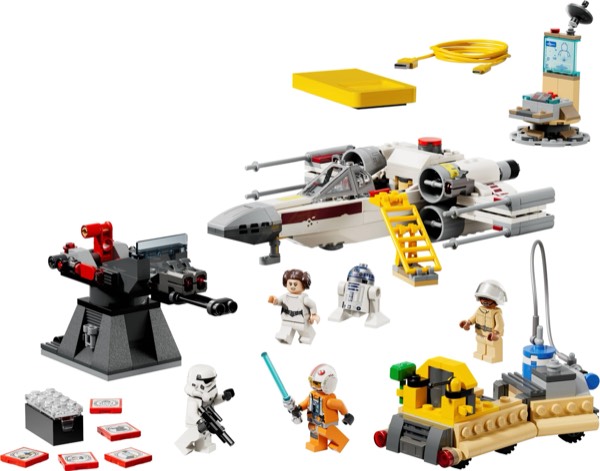
The X-Wing Starfighter has been built in LEGO form more times than perhaps any other Star Wars vehicle, and each new version faces the challenge of justifying its existence alongside its predecessors. The SMART Play X-Wing does not try to compete with the UCS or even the standard System versions on detail or display quality. Instead, it offers something those versions cannot: interactive digital play that turns the physical model into a controller for Rebel Alliance missions. At approximately 350 pieces, the build takes about ninety minutes and delivers the immediately recognizable cross-wing silhouette that is arguably the single most iconic starfighter design in science fiction history.
The fuselage construction forms the core of the build and establishes the long, narrow profile that defines the X-Wing. The nose section tapers to the distinctive pointed tip, the cockpit sits mid-fuselage with a clear canopy element, and the engine section at the rear provides the mass and mechanical detail that ground the design in plausible technology. At SMART Play scale, these sections are simplified but proportionally accurate, and the construction flows logically from nose to tail in a way that teaches young builders about vehicle structure while producing a model that looks right from the moment the fuselage is complete.
The wing construction is where the X-Wing earns its name, and LEGO has included a mechanism that allows the four wings to transition from the closed cruise configuration to the open attack position. This S-foil mechanism, even at the simplified SMART Play scale, is the highlight of the build. There is a visceral satisfaction in spreading those wings that connects directly to one of the most famous moments in Star Wars: the call to lock S-foils in attack position. Every X-Wing set lives or dies by its S-foil mechanism, and this one works. The mechanism uses a simple but effective gear or lever system accessible from the rear of the fuselage, and the wings split into the iconic X shape with enough precision to look correct when locked open. Building the mechanism is the most technically interesting phase of the construction, and understanding how a single control input translates into four simultaneous wing movements is a genuine engineering lesson for young builders.
The SMART Play integration connects the physical model to digital missions that, one hopes, include the Death Star trench run, because building an X-Wing without the ability to attack the Death Star would be a missed opportunity of galactic proportions. The app-connected features add narrative depth to the play experience, and the physical model serves as the interface through which the digital adventure unfolds. The combination of the tactile S-foil mechanism with digital mission scenarios creates a play experience that is more engaging than either the physical or digital component could provide alone.
The S-foil mechanism is the technique centerpiece and the most broadly applicable engineering lesson in the set. The principle of using a single input to control multiple simultaneous outputs is fundamental to mechanical engineering, and the X-Wing's wing mechanism demonstrates it in a context that is exciting and intuitive for young builders. The specific implementation, whether through a gear train, a lever system, or a linked hinge mechanism, teaches the builder how motion can be translated and multiplied through mechanical connections. This principle appears in countless LEGO Technic models, but seeing it in a Star Wars context at a playable scale makes it accessible to builders who might not yet be ready for pure Technic construction.
The tapered nose construction teaches the technique of progressive narrowing using plates of decreasing width. This tapering approach is the foundation of aerodynamic vehicle design in LEGO, appearing in everything from jet fighters to racing cars to rockets. The specific element choices and plate-stacking method used in the X-Wing nose provide a clear, repeatable template for any pointed or tapered vehicle front. The cockpit canopy integration, where a transparent element sits within the fuselage surface to create a flush-mounted window, teaches how to combine transparent and opaque elements for vehicle windows, a technique that applies to every vehicle build from cars to spaceships.
The engine section construction at the rear uses cylindrical elements and mechanical details to create the four engine nacelles that define the X-Wing's rear profile. Building cylindrical forms at compact scale and attaching them to a central body at specific positions teaches spatial layout and symmetric construction skills that transfer to any project requiring evenly spaced peripheral elements. The wing panel construction teaches efficient flat surface building with the added complexity of hinge integration, where the panel must be both visually complete and mechanically functional as part of the S-foil system.
For builders progressing through the SMART Play range, the X-Wing represents a meaningful step up in technique complexity from simpler sets like the Landspeeder. The S-foil mechanism alone introduces mechanical principles that the other sets in the range do not include, making the X-Wing a natural progression for builders who are ready for more complex construction challenges.
The 350-piece count delivers a haul centered on light gray and white elements with red accent pieces, which is the classic X-Wing color palette and one of the more useful combinations in the LEGO universe. Light gray and white elements are backbone colors in LEGO building, appearing in space, military, modern architecture, medical, scientific, and countless other building contexts. The red elements provide excellent accent pieces for any project that needs visual contrast against lighter surfaces. Together, this palette is more versatile than the dark monochrome of the TIE Advanced and offers broader utility for a wider range of future building projects.
The mechanical elements from the S-foil mechanism are the most specialized pieces in the haul but also among the most useful for builders who work with mechanical LEGO systems. Gears, axles, hinge elements, and connection pieces from the mechanism all have broad utility in Technic and hybrid builds. The curved and tapered elements from the nose section are useful for vehicle and organic building. The cylindrical engine elements serve any project requiring tubular or round forms. The canopy element, depending on its specific shape and size, has utility in vehicle, architectural, and display applications.
The overall haul is well-balanced between structural plates, surface tiles, mechanical components, and small detail elements. For a set of this size, the variety is above average thanks to the combination of the vehicle body, the mechanical wing system, and the engine section, each of which uses distinct element types. This variety means the parts maintain their utility even after the set is disassembled, serving as a versatile addition to any builder's general inventory rather than a pile of single-purpose pieces.
The X-Wing is one of the most photogenic starfighters ever designed, and that visual power translates to the SMART Play scale more effectively than you might expect. With the S-foils locked in the open attack position, the model displays the iconic X silhouette that is instantly recognizable from any angle. The white and gray fuselage with red racing stripes is clean and visually appealing, and the proportions are accurate enough that the model reads as an X-Wing rather than a generic spaceship from across a room.
The S-foil options give you two display modes: the closed cruise configuration for a sleeker, more compact display, and the open attack configuration for maximum visual impact. This dual-mode display is a genuine advantage over single-configuration models, and changing the wing position gives you a way to refresh the display periodically without rebuilding or replacing the set. The open configuration is more dramatic and immediately recognizable, but the closed configuration has its own appeal as a more streamlined shape that suggests the ship in transit rather than in combat.
For display alongside other SMART Play Star Wars sets, the X-Wing provides the Rebel Alliance flagship presence that balances the Imperial TIE Advanced. The lighter color palette stands out against the darker Imperial ships, creating visual contrast in a multi-set display that references the light-versus-dark narrative of Star Wars itself. In a child's room, the X-Wing is the kind of model that gets picked up and played with regularly, which says something about its appeal that pure display statistics cannot capture. A model that a child wants to hold, fly around the room, and then return to its display spot is doing everything right.
The R2-D2 astromech droid seated behind the cockpit adds a display detail that is small but emotionally significant. That little dome peeking above the fuselage is one of the most beloved silhouettes in Star Wars, and its presence gives the X-Wing display a character note that elevates it from vehicle model to story moment. You are not just displaying an X-Wing. You are displaying Red Five, Luke's X-Wing, with R2 riding along, and that specificity matters.
Luke Skywalker in his orange pilot flight suit is the essential inclusion, and this version of Luke represents one of the most iconic character looks in Star Wars. The pilot suit, the helmet, and the determined expression of a farm boy about to attack a battle station are all critical elements that LEGO consistently delivers well. If the set includes a separate helmet and hair piece for display flexibility, that is a welcome touch that allows the figure to represent both the suited-up pilot and the bare-headed hero.
R2-D2 is the other essential inclusion, whether as a standard minifigure-scale astromech or as a smaller element designed to fit the cockpit socket of the SMART Play-scale X-Wing. R2 and Luke in an X-Wing is one of the definitive Star Wars pairings, and having both represented in the set completes the narrative picture that makes the display meaningful. Any additional figures, perhaps a ground crew member or another Rebel pilot, would add value but are not essential when the core Luke-and-R2 pairing is present. For minifigure collectors, Orange Jumpsuit Luke is a perennial favorite, and the specific version included here adds to the growing catalog of pilot Luke variants that dedicated collectors track across LEGO Star Wars releases.
At approximately retail price for 350 pieces, the X-Wing SMART Play offers the strongest value proposition in the SMART Play Star Wars range. The combination of the most iconic Rebel starfighter, a working S-foil mechanism, the SMART Play digital features, and essential minifigures creates a package that delivers on multiple dimensions simultaneously. The build is more mechanically interesting than the Landspeeder, the display is more colorful than the TIE Advanced, and the source vehicle is arguably the most universally beloved ship in Star Wars.
The S-foil mechanism alone adds physical play value that the other SMART Play sets do not match, and the dual display configuration means you get visual variety from a single purchase. The parts haul is versatile thanks to its lighter color palette, and the minifigure selection covers two of Star Wars' most popular characters. For families entering the SMART Play ecosystem, the X-Wing is the strongest single recommendation I can make. It delivers the best combination of build satisfaction, play value, display quality, and emotional resonance in the range. If you buy one SMART Play Star Wars set, make it this one.
- ✓ Working S-foil mechanism is deeply satisfying
- ✓ Most iconic Star Wars starfighter, instantly recognizable
- ✓ Dual display modes (cruise and attack) add variety
- ✓ Versatile light-colored parts haul
- ✓ Luke and R2-D2 minifigures cover essential characters
- ✓ Strongest overall value in the SMART Play range
- ✓ Mechanical complexity teaches real engineering principles
- ✗ S-foil mechanism may feel simplified compared to larger X-Wings
- ✗ SMART Play scale limits cockpit interior detail
- ✗ Numerous X-Wing versions exist for comparison
Some products may be provided by manufacturers. This page contains affiliate links. All opinions are my own.
- TIE Advanced SMART Play Review - The Imperial rival
- Millennium Falcon SMART Play Review - The Rebel flagship
- Mos Eisley SMART Play Review - Where the adventure begins
The gearbox pivot for the wings deserves attention because it's the design decision that either makes or breaks this set's longevity. The mechanism uses a single stud-to-pin connection at the fuselage hub, which means repeated opening-and-closing will eventually load-test that joint. On the sample I built, the wings held firm across dozens of cycles, but builders with younger hands or those planning heavy play should understand they're one modification away from needing a reinforcement pin through that axis. The alternative, a more robust dual-pin system, would've added unnecessary bulk. This design trusts the builder to understand the physics.
What also caught me: the landing gear retracts fully into the fuselage without leaving visible gaps. That detail requires specific part selection and stacking, and it's the kind of invisible engineering that separates a clean build from a sloppy one. Most builders won't notice, but MOC designers studying this set should, it's a masterclass in functional integration that doesn't scream for attention.
Track it in your vault on GameSetBrick - our free collection app. Log your condition, price paid, and watch the real-time market value.
Track in Your Vault →Save it to your wishlist on GameSetBrick. Share your list with friends and family - every set has a buy button so gift givers know exactly where to go.
Add to Wishlist → GameSetBrick is a free app by The Earl of Bricks. See all features. Scan it. Track it. Trade it.