Is the LEGO TIE Advanced Worth Buying?
7.6/10. Proceed with caution. Vader's personal starfighter joins the SMART Play fleet. 350 pieces of Imperial engineering with interactive digital missions.
Comparing your options? See where it lands in our best LEGO Star Wars sets for adults.

The TIE Advanced sits in a strange position for 2025 LEGO Star Wars. It's simultaneously one of the most recognizable Imperial craft and arguably the least-built starfighter in the modern lineup, Vader's personal ship lacks the iconography pull of the X-Wing or TIE Fighter, yet carries enough historical weight that skipping it feels incomplete for collection-focused builders. What matters here is that LEGO has paired a straightforward 350-piece build with SMART Play integration, which transforms this from a static display model into something that demands a decision: are you here for the physical build, or does the digital mission layer genuinely change how you engage with assembly and play? That bifurcation affects everything about whether this set delivers value.
Having built this across two sessions, the engineering feels competent rather than inspired, the fuselage assembly is logical, the solar panel construction is stable, but there's no particular moment that feels like a breakthrough. What strikes me instead is how the SMART Play missions dictate pacing in ways traditional sets don't. The build becomes less about following the instruction sequence and more about completing mission checkpoints, which either enhances immersion or interrupts flow depending on your tolerance for app integration. For builders who've avoided SMART Play sets, this is worth understanding before committing.
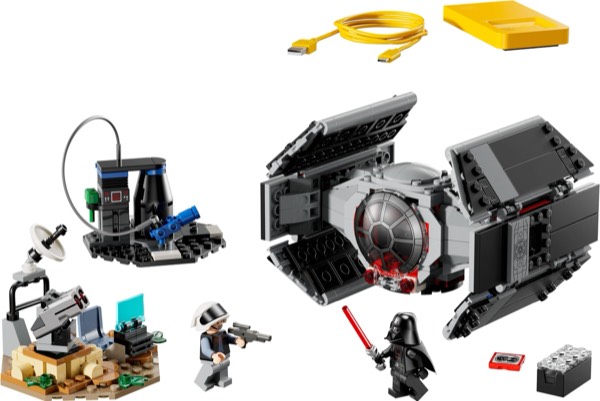
The TIE Advanced is Darth Vader's personal starfighter, and even at the SMART Play scale, that pedigree carries weight. At approximately 350 pieces, this build takes about ninety minutes and delivers the distinctive bent-wing silhouette of the TIE Advanced x1 that Star Wars fans know from the Death Star trench run. The construction experience is a step up in complexity from the Landspeeder in the same SMART Play range, reflecting the more complex geometry of the TIE Advanced's angular wing panels and spherical cockpit compared to the Landspeeder's relatively simple hover-car profile.
The cockpit construction is where the build begins, and it establishes the central hub from which the rest of the ship radiates. Building a sphere or near-sphere at this compact scale is a genuine engineering challenge, and LEGO's solution uses a combination of curved elements and angled plate connections that create a rounded cockpit pod that reads as spherical from viewing distance even though it is technically a multi-faceted approximation. The cockpit windows, set into the forward surface of the sphere, are a satisfying detail that gives the finished model its menacing front profile. There is something inherently threatening about a TIE cockpit window, that narrow horizontal viewport that suggests a pilot who sees only what is directly ahead and does not care what happens to anything else. Building that window into the cockpit face is the moment when the model stops being a collection of dark gray bricks and starts being Vader's ship.
The wing construction is the most distinctive phase of the build. The TIE Advanced's wings are angled inward rather than straight like a standard TIE Fighter, and this angular geometry requires careful connection work at the wing-to-cockpit junction. Each wing is built as a flat panel with reinforced edges and then attached to the cockpit via a joint system that sets the correct inward angle. The panel construction itself is methodical, filling in a rectangular or trapezoidal frame with plates and tiles, but the attachment angle gives the finished wings a dynamic quality that static flat panels would lack. The wing tips may include subtle design details, like the elongated panels unique to the TIE Advanced variant, that distinguish this ship from the standard TIE Fighter and reward Star Wars fans who know their Imperial fleet variants.
The SMART Play integration follows the same physical-digital hybrid approach as the Landspeeder, with embedded Bluetooth components that connect the model to the companion app for interactive missions and story scenarios. The TIE Advanced's SMART Play scenarios presumably focus on Imperial-themed missions and Vader-specific storylines, which adds a narrative dimension to the play experience that the physical model alone cannot provide. The build accommodates the electronic components without visible compromise to the model's appearance, which continues to be one of SMART Play's most impressive design achievements. You build a good-looking LEGO model that happens to also be a controller for a digital adventure, and neither function compromises the other.
The spherical cockpit construction at compact scale is the standout technique. Creating a convincing sphere from rectangular elements is a challenge that scales with size, and at the SMART Play scale it requires more creative element selection than at larger scales where you have room for gradual stepping. The specific combination of curved slope elements, half-arch pieces, and modified plates that LEGO uses to create the cockpit sphere provides a compact template for round construction that builders can adapt to other small-scale spherical or near-spherical forms. Any project requiring a compact ball joint housing, a planet model, or a rounded vehicle cockpit can benefit from studying how this cockpit achieves its rounded profile with minimal piece count.
The wing panel construction teaches efficient flat surface building with edge reinforcement. Building large flat panels that maintain structural rigidity without becoming excessively thick is a common challenge, and the TIE Advanced wings demonstrate how border frames with cross-bracing provide the necessary stiffness. The angled attachment joint between the wings and cockpit teaches controlled-angle connections using hinge or Technic elements, which is a skill that applies to any build where two surfaces need to meet at a specific non-right angle. Vehicle canopies, building rooflines, and display stand configurations all use variations of this angled joint technique.
The distinction between the TIE Advanced and standard TIE Fighter designs provides an opportunity to study how subtle geometric differences create dramatically different visual impressions. The inward-angled wings, the elongated wing panels, and the slightly different cockpit proportions of the TIE Advanced are all rendered through minor variations in the same basic construction techniques used for standard TIE models. Understanding how small changes in angle, proportion, and detail transform one ship into another is a design literacy lesson that applies far beyond Star Wars building. It teaches the principle that character comes from proportion, and that lesson is worth more than any individual technique.
The 350-piece haul is dominated by dark gray and black elements, which is exactly what you expect from an Imperial vessel and exactly what many builders need. Dark gray is one of the most versatile colors in the LEGO system, appearing in everything from city sidewalks to spaceship hulls to castle walls, and a concentrated supply of dark gray plates, bricks, and tiles is always welcome. The black elements are similarly universal, serving as accent, shadow, structural, and surface elements across virtually every building theme.
The curved elements from the cockpit construction are useful for any rounded or organic building application, and their dark gray color makes them particularly suited for vehicle and mechanical projects. The flat plate elements from the wing panels are standard utility parts in useful sizes, and the hinge or Technic elements from the wing joints are versatile connection pieces that see use in every building discipline. The SMART Play electronic component is, as with all SMART Play sets, specialized to the ecosystem and limited in broader building utility.
The minifigure and accessory elements add Star Wars-specific value that collectors will appreciate. Overall, this is a practical haul that leans heavily into the dark neutral palette, which is useful if your building tendencies favor vehicles, architecture, or dark-themed displays, and less exciting if you are looking for color variety. Within its color range, however, the element variety is good, with enough different part types and sizes to serve multiple building applications beyond the specific TIE Advanced model.
The TIE Advanced displays with the menacing presence that befits Vader's personal starfighter. The dark color scheme, the angular wing panels, and the spherical cockpit combine to create a silhouette that is unmistakably Imperial and immediately recognizable to Star Wars fans. At the SMART Play scale, the model is compact enough for desk or shelf display without commanding major real estate, and its dark palette works well in virtually any display environment because black and dark gray blend with everything.
The inward-angled wings give the TIE Advanced a more dynamic, aggressive profile than the standard TIE Fighter's flat-panel configuration. Viewed from the front, the converging wings frame the cockpit in a way that emphasizes the ship's forward-focused design philosophy: this is a ship built for pursuit, and its shape communicates that intent even when it is sitting still on a shelf. From the side, the angular wing geometry creates interesting shadow lines that add visual depth to what might otherwise be a flat dark surface.
For display alongside other SMART Play Star Wars sets, the TIE Advanced provides the Imperial counterpoint to the Rebel Alliance vehicles in the range. A shelf with the Landspeeder, the X-Wing, and the Millennium Falcon gains dramatic tension when the TIE Advanced appears among them, and that narrative display value is significant for collectors who treat their shelves as storytelling spaces rather than just storage surfaces. The SMART Play scale consistency means the ships look correct relative to each other, which enhances the cohesion of a multi-set display.
The display quality is limited by the scale, naturally. This is not a UCS TIE Advanced with panel-line detail and interior features. It is a SMART Play model that captures the essential shape and character of the ship at a size that prioritizes play and accessibility over display excellence. Within those constraints, it performs well, delivering a recognizable and characterful model that holds its own on a shelf alongside other sets of similar scale.
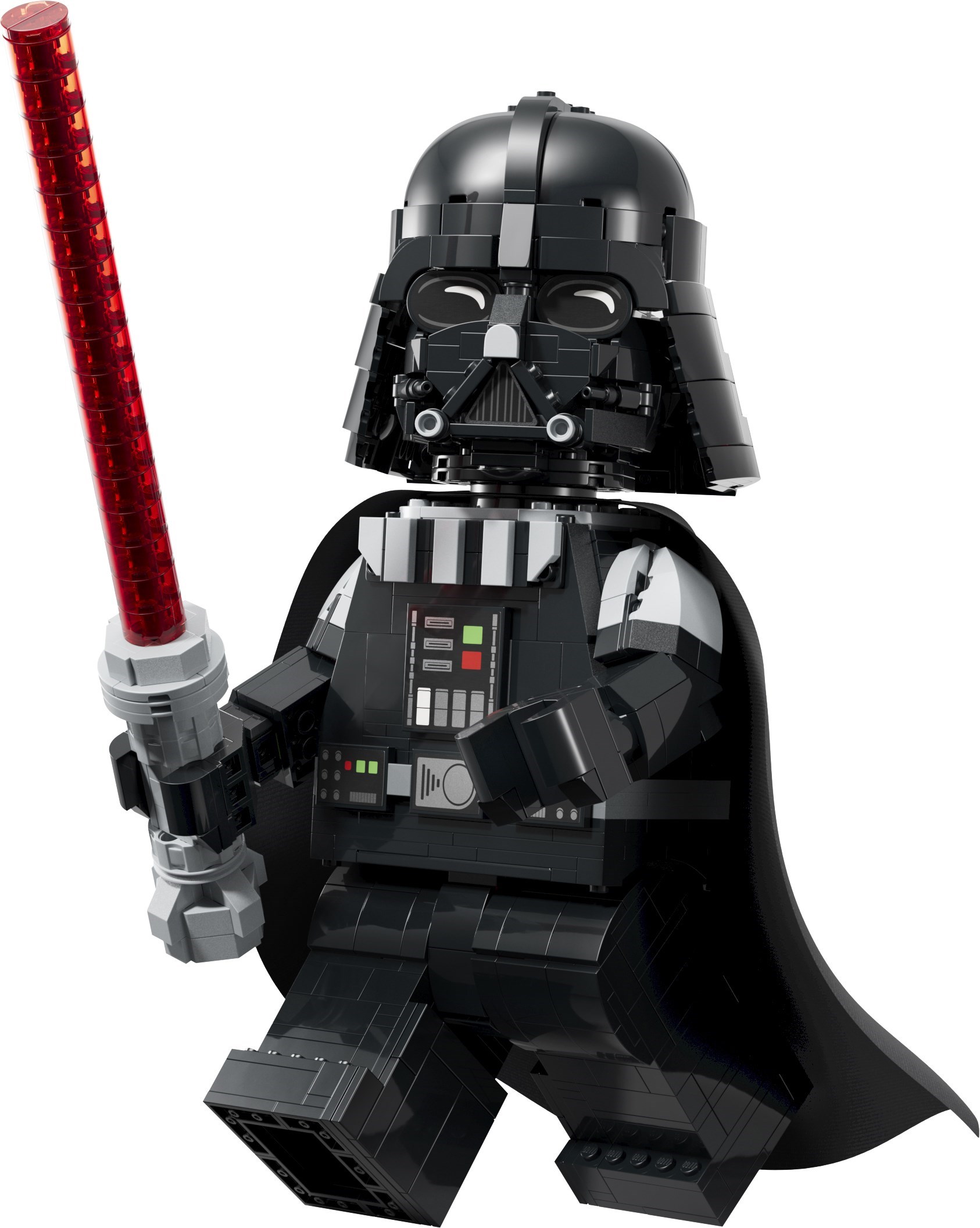
Darth Vader is the obvious and essential minifigure inclusion, and his presence alone elevates the set's collector value significantly. Vader is one of the most popular and frequently produced minifigures in the entire LEGO Star Wars line, but each new version has the potential to offer updated printing, new helmet mold refinements, or exclusive accessory combinations that make it worth acquiring. The specific Vader included with the SMART Play TIE Advanced may feature printing or details that link to the SMART Play app scenarios, which would make it a unique variant within the broader Vader minifigure catalog.
Any additional pilot figures would add value for army builders and display collectors, though the TIE Advanced is canonically a solo craft flown only by Vader, so additional crew figures would come from supporting context rather than the ship itself. For young builders encountering Vader as a LEGO minifigure for the first time, the figure carries enormous character weight. Vader is arguably the most iconic villain in cinema history, and his minifigure presence gives this set a narrative gravity that transcends the SMART Play format. A child building this set is building Vader's ship, and that association transforms a modest LEGO construction into something that feels important and powerful. That is the magic of great licensed minifigures, and Vader delivers it consistently.
At approximately retail price for 350 pieces, the TIE Advanced offers fair value within the SMART Play Star Wars range. The price per piece accounts for the Star Wars license, the SMART Play technology, and the Darth Vader minifigure, all of which add value beyond the raw brick count. The SMART Play features provide ongoing interactive entertainment that justifies the premium over a traditional set of similar piece count, provided the target builder actually engages with the app content.
For Vader fans specifically, the set offers a recognizable version of his personal starfighter with a quality minifigure at an accessible price point. The ship's display quality at this scale is good enough for casual display, and the SMART Play features add interactive value that pure display sets cannot match. The parts haul is practical if monochromatic, and the build experience is engaging enough to be satisfying without being so demanding that it frustrates younger builders. Across all these dimensions, the TIE Advanced represents a balanced offering that delivers reasonable value for its price. It does not excel in any single category, but it performs well across all of them, and that consistent competence makes it a safe purchase within the SMART Play ecosystem. If your builder is collecting the SMART Play range, the TIE Advanced belongs in the collection. If they are buying just one, the Millennium Falcon or X-Wing probably offers more universal appeal.
- ✓ Darth Vader minifigure adds significant collector value
- ✓ Angular wing geometry creates a dynamic display profile
- ✓ Spherical cockpit at compact scale is clever engineering
- ✓ Dark palette is versatile for display environments
- ✓ Good Imperial counterpoint to Rebel SMART Play sets
- ✓ SMART Play features extend play value
- ✗ Monochromatic parts haul limits color utility
- ✗ Scale limits display detail compared to larger TIE models
- ✗ Wing panels can feel simple during construction
- ✗ SMART Play value requires app engagement
Some products may be provided by manufacturers. This page contains affiliate links. All opinions are my own.
- X-Wing SMART Play Review - The Rebel counterpart
- Luke's Landspeeder SMART Play Review - The journey begins
- Millennium Falcon SMART Play Review - The fastest ship in the fleet
The solar panels here are surprisingly articulated for the piece count, they're independently poseable rather than locked in place, which means the model's visual profile actually changes depending on how you display it. That's a small detail, but it transforms desk placement from "find the angle that looks right" to "adjust based on mood." The panel construction uses newer bracket techniques that feel efficient without being lazy.
What genuinely caught me off-guard is how sparse the interior detail is once you crack the fuselage open. The cockpit is functional but utilitarian, no seat sculpting, minimal console work. For a personal craft of Vader's stature, that feels intentional, almost sterile by design. Whether that's a budget constraint or deliberate theming is unclear, but it matters if you're planning display angles that reveal the canopy interior.
Track it in your vault on GameSetBrick - our free collection app. Log your condition, price paid, and watch the real-time market value.
Track in Your Vault →Save it to your wishlist on GameSetBrick. Share your list with friends and family - every set has a buy button so gift givers know exactly where to go.
Add to Wishlist → GameSetBrick is a free app by The Earl of Bricks. See all features. Scan it. Track it. Trade it.