Is the LEGO Throne Room and A-Wing Worth Buying?
7.7/10. Proceed with caution. The Emperor awaits. 450 pieces deliver both the Imperial Throne Room and a Rebel A-Wing in one SMART Play package that spans the saga's climax.
Comparing your options? See where it lands in our best LEGO Star Wars sets for adults.

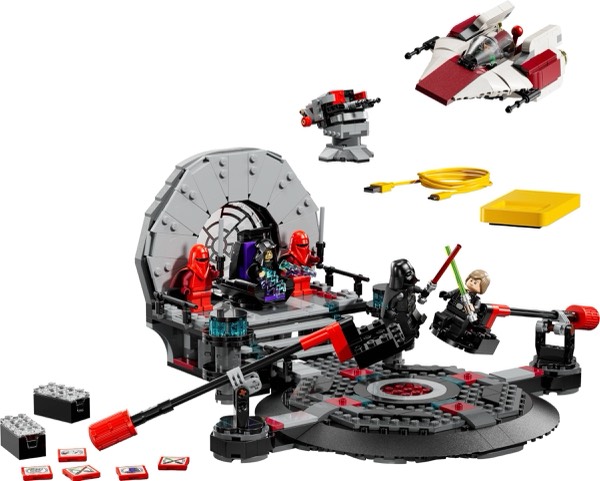
The Throne Room and A-Wing pairing sits in uncomfortable territory, it's neither a focused playset nor a proper vehicle display. Building it feels like TLG hedged its bets between two competing visions of what 450 pieces should deliver in 2025. That tension is actually the set's defining feature, and whether you find it clever or frustrating will determine if this lands on your shelf or your regret pile. The throne room itself commands respect: the architectural bones are solid, the symmetry reads immediately, and the obsidian/red color blocking creates genuine visual weight. Then the A-Wing arrives mid-build and the entire energy shifts. Suddenly you're not building a room anymore, you're juggling two entirely separate experiences that share a box but almost nothing else.
What makes this worth understanding before you open it: this is a set designed for a specific kind of builder who lives in the crossover space between display collector and vehicle constructor. If you want a showstopping throne room OR a sleek A-Wing, there are better single-focus options elsewhere in the catalog. But if you're the type who rotates displays by saga, who enjoys the conversation piece of "two builds, one box," or who actually uses the A-Wing in a larger diorama setup, the math shifts considerably. That 7.7 score reflects a set that executes both ideas well enough without mastering either one, which is exactly what it was designed to do.
The Throne Room and A-Wing is the most ambitious set in the SMART Play Star Wars range from a conceptual standpoint, because it attempts to deliver both a location build and a vehicle build in a single package. At approximately 450 pieces split between two distinct models, this is a set that offers variety at the cost of scale. Neither the Throne Room nor the A-Wing is as large as it would be in a dedicated single-model set, but the combination provides a dual build experience that covers both the space and ground aspects of the Battle of Endor climax from Return of the Jedi. That thematic ambition is admirable, even if the practical execution involves compromises that single-model sets avoid.
The Throne Room construction comes first and delivers a compact but atmospheric representation of the Emperor's chamber aboard the second Death Star. The circular viewport window, the Emperor's chair, and the elevated walkway are the essential elements that LEGO includes to establish the setting, and each one carries significant narrative weight. Building the viewport window is the most satisfying construction moment because it establishes the scale and context of the scene, looking out through that window at the stars, or at the Battle of Endor raging below, is what gives the Throne Room its dramatic power in the film. The chair construction is simple but important, providing the central prop around which the entire final confrontation revolves.
The A-Wing construction shifts the build from architecture to vehicle engineering, and the contrast is welcome. The A-Wing is one of the sleekest Rebel fighter designs, with a wedge-shaped profile that is all speed and aggression. At the compact SMART Play scale, the A-Wing builds quickly, perhaps thirty to forty-five minutes, and the construction focuses on capturing the ship's distinctive arrowhead silhouette and the rear engine section that gives it its characteristic speed. The transition from building a dark, interior space to building a bright, angular starfighter provides welcome variety within a single set, and the tonal contrast between the two models, dark and ominous versus bright and dynamic, mirrors the narrative contrast between the Emperor's scheming and the Rebel fleet's desperate attack.
The SMART Play integration presumably connects both models to scenarios from the Battle of Endor, alternating between the Throne Room confrontation and the space battle above the forest moon. This dual-scenario structure could make this the most narratively complex SMART Play experience in the range, as the user switches between two interconnected storylines that converge at the saga's climax. The physical models serve as interfaces for their respective storylines, and the act of shifting between them mirrors the film's cross-cutting between the Throne Room, the space battle, and the ground assault on Endor.
The Throne Room construction teaches interior scenic building, a discipline that differs significantly from the architectural building of the Mos Eisley Cantina. Where the Cantina is a complete building with exterior and interior, the Throne Room is purely an interior set piece, a stage for a specific dramatic scene. Building a convincing interior without the context of surrounding walls teaches the theatrical skill of suggesting a complete environment through carefully chosen set pieces. The viewport window, the chair, and the walkway are enough to establish the Throne Room because they are the elements that matter for the story. This principle of selective detail, including only what is essential for recognition and narrative, is a design skill that applies to every LEGO scene or diorama build.
The viewport window construction is the technique highlight for the Throne Room section. Creating a large, curved window frame that suggests the Death Star's vast interior spaces uses a combination of arch elements and curved plates that form an imposing circular or semi-circular frame. The transparent elements within the frame create the illusion of looking out into space, and the contrast between the dark frame and the clear window produces the dramatic backlighting effect that defines the Throne Room's visual identity. This backlit window technique, using transparent elements within a dark frame to create a focal point, applies to churches, lighthouses, skyscraper observation decks, and any building where a window is meant to be the visual centerpiece.
The A-Wing construction teaches wedge-shaped vehicle building, where the entire profile tapers from rear to front in a continuous angle. The specific plate-stacking method that creates this wedge, using progressively shorter plates or angled elements to produce the forward taper, is applicable to any arrowhead or delta-wing vehicle design. The A-Wing's symmetry along its central axis makes it a clear demonstration of mirror-image construction, where each side of the vehicle is built identically and the two halves combine into a unified form. This mirror construction approach is standard for symmetric vehicles but seeing it at compact scale makes the principle very clear.
The engine construction at the rear of the A-Wing uses cylindrical elements to create the twin engine nacelles that define the ship's rear profile. The attachment of these round elements to the angular wedge body teaches the technique of blending geometric forms, specifically how round meets flat in a way that looks intentional rather than clumsy. This round-to-flat transition appears in virtually every vehicle build that has cylindrical engines or thrusters attached to an angular body, making it one of the most frequently needed techniques in vehicle construction.
The 450-piece count is split between two distinct color palettes: the dark grays and blacks of the Throne Room and the lighter grays with red or green accents of the A-Wing. This dual palette provides more color variety than single-model sets in the range, which is a genuine advantage for builders who will eventually repurpose the elements. The dark elements from the Throne Room are excellent for space interiors, gothic architecture, dark vehicles, and any build that needs a somber or menacing aesthetic. The lighter elements from the A-Wing complement the gray inventories from other sets and the red or green accents add useful pops of color.
The transparent elements from the viewport window are valuable for any project requiring windows, light effects, or translucent surfaces. The arch elements from the window frame serve architectural projects that need curved openings. The curved and angled elements from the A-Wing's wedge profile are useful for vehicle and spacecraft building. The cylindrical engine elements have broad utility for mechanical and vehicle applications.
The split between two models means neither contributes a concentrated haul in any single element type, which can be seen as either a limitation or a benefit depending on your building needs. If you need a large quantity of a specific part, single-model sets are more efficient sources. If you want variety and flexibility, the dual-model approach provides a broader selection of useful elements across more categories. For most builders, the variety approach serves general building needs better, and the Throne Room plus A-Wing combination covers both interior scenic building and vehicle construction in a single purchase.
The dual-model format creates unique display opportunities and challenges. Displayed together, the Throne Room and A-Wing tell the story of the Battle of Endor's climax: the confrontation in the Emperor's chamber while the Rebel fleet fights to destroy the Death Star. This narrative display, where two separate models combine to tell a larger story, is something that single-model sets cannot achieve, and for Star Wars fans who want their display to convey specific moments from the saga, this dual approach is compelling.
The Throne Room section, while compact, displays with genuine atmosphere. The viewport window creates a dramatic backdrop, the Emperor's chair provides a focal point, and the dark color scheme communicates menace and power. Populated with the appropriate minifigures, the Throne Room becomes a stage for one of cinema's greatest confrontations, and that narrative weight gives the display emotional significance that pure visual assessment cannot measure. The scene you create is the scene where Vader turns against the Emperor, where Luke faces the dark side, where the galaxy's fate is decided. That is a lot of drama for a compact LEGO display, and it works because the essential elements are present and the viewer's imagination supplies the rest.
The A-Wing displays as a sleek, aggressive little fighter that holds its own alongside the other SMART Play vehicles. The wedge profile is distinctive and recognizable, and the red or green color accents give it more visual personality than the predominantly gray Falcon or the dark TIE Advanced. For display alongside the fleet, the A-Wing adds variety to the Rebel fighter roster and fills a role that the larger X-Wing does not cover. It is the nimble interceptor to the X-Wing's all-around fighter, and that fleet composition adds visual interest to a multi-set display.
The challenge of displaying both models is that they require different contexts. The Throne Room is an interior scene that benefits from being viewed up close. The A-Wing is a vehicle that reads best at a slight distance where its silhouette can be appreciated. Placing them side by side can feel disjointed unless you position them as related-but-separate elements of the same display, perhaps with the Throne Room elevated on a riser and the A-Wing positioned below as if flying past the Death Star. With thoughtful display arrangement, the two models enhance each other. Without it, they can feel like two halves of a set that could not decide what it wanted to be.
The minifigure selection for this set must cover two of the most important scenes in Star Wars: the Throne Room confrontation and the space battle. Emperor Palpatine is the essential Throne Room figure, and his presence alone gives the set its dramatic weight. The Emperor is one of the most iconic villains in cinema, and his minifigure, with the hooded cloak, the aged face, and the lightning accessories, carries the menace and power that defines the character. Luke Skywalker in his Return of the Jedi black outfit is the other essential figure, representing the hero at his most tested and ultimately his most triumphant.
Darth Vader would complete the Throne Room trio, creating the triangle of conflict that drives the saga's conclusion. For the A-Wing, a Rebel pilot figure provides the flight context and adds variety to the display. The specific pilot identity matters less than the presence of someone in the cockpit, though a named character like Arvel Crynyd would add lore value for dedicated fans.
The minifigure combination in this set, if it includes Palpatine, Luke, and Vader, would make it one of the most narratively significant figure packs in the SMART Play range. These three characters at this specific moment represent the emotional climax of the original trilogy, and their minifigures together carry storytelling potential that exceeds any other character grouping in the range. For collectors, an Emperor Palpatine figure is always desirable, and the Throne Room context gives it specific display value that generic Palpatine figures lack. The minifigures may ultimately be the strongest reason to buy this set, which is unusual for a SMART Play offering but entirely appropriate given the source material.
At approximately retail price for 450 pieces across two models, the Throne Room and A-Wing offers a unique value proposition in the SMART Play range: two builds for the price of one. Whether that translates to good value depends on what you prioritize. If you want the largest possible single model, the Millennium Falcon offers more at a slightly higher price. If you want building variety and narrative depth, the dual-model approach here provides an experience that no single-model set can match. You get both a location and a vehicle, both an interior scene and a spacecraft, both a dark side setting and a light side ship. That variety has genuine value for builders who want their SMART Play collection to cover the broadest possible range of Star Wars experiences.
The SMART Play integration presumably benefits from the dual-model format, with scenarios that switch between the Throne Room and space battle storylines creating a more complex and engaging digital experience than single-model scenarios. If the app content leverages both models effectively, the interactive play value of this set could exceed that of the individual vehicle sets despite its lower piece count per model. The minifigure selection, if it covers the Throne Room trio, adds significant collector and display value that enhances the overall proposition.
My assessment is that this set offers good value for buyers who want narrative variety and do not need either the Throne Room or the A-Wing to be full-sized models. The compromise in scale is real, and both models would benefit from additional pieces, but the dual-model approach provides a breadth of experience that justifies the trade-off. Within the SMART Play range, this is the set for the storyteller, the builder who wants to recreate a specific chapter of Star Wars history rather than just fly a cool ship. For that audience, the Throne Room and A-Wing delivers exactly the right tools.
- ✓ Two distinct builds provide variety in a single set
- ✓ Throne Room viewport window is atmospherically stunning
- ✓ A-Wing's wedge profile is sleek and aggressive
- ✓ Potentially the strongest minifigure selection in the range
- ✓ Narrative depth spans the saga's climactic battle
- ✓ Dual color palette offers good parts variety
- ✗ Split piece count means neither model feels full-sized
- ✗ Throne Room and A-Wing display awkwardly side by side
- ✗ A-Wing is less iconic than X-Wing or Falcon
- ✗ Throne Room detail limited by compact scale
Some products may be provided by manufacturers. This page contains affiliate links. All opinions are my own.
- Mos Eisley Cantina SMART Play Review - Another SMART Play location
- X-Wing SMART Play Review - The Rebel Alliance flagship
- Millennium Falcon SMART Play Review - The fleet's centerpiece
- Star Wars Logo Art Review - The franchise in bold graphic brick form
- Best LEGO Sets for Adults 2026 - Our complete ranking for grown-up builders
The throne room's modular construction makes it dangerous in the best way. Those palace walls are simple enough to reverse-engineer and expand, the stacked plate technique used for the elevation creates obvious extension points. Serious builders will immediately spot how to flatten this into a wider throne hall or stack it vertically into a multi-level Imperial stronghold. The color palette (dark tan, black, dark red, metallic gold) is restrictive enough to maintain cohesion but versatile enough to blend with existing palace MOCs without feeling forced.
Where this set genuinely earns its price: the A-Wing fuselage is economical without looking skimped. The geometric slope from cockpit to engine uses fewer pieces than you'd expect, which means the part count left over is pure potential. Serious builders have already identified this as a viable donor set for custom starfighter frames, the internal ribbing structure translates directly to other original spacecraft builds. It's not a parts explosion, but for MOC work, the constraint breeds creativity rather than frustration.
Track it in your vault on GameSetBrick - our free collection app. Log your condition, price paid, and watch the real-time market value.
Track in Your Vault →Save it to your wishlist on GameSetBrick. Share your list with friends and family - every set has a buy button so gift givers know exactly where to go.
Add to Wishlist → GameSetBrick is a free app by The Earl of Bricks. See all features. Scan it. Track it. Trade it.