Is the LEGO Hogwarts Herbology Plants Worth Buying?
6.86/10. Proceed with caution. Mandrakes, Venomous Tentacula, and the rest of Professor Sprout's most temperamental students, rendered in brick without a single one screaming.
Comparing your options? See where it lands in our best Harry Potter display sets.

LEGO's botanical line has quietly become one of its most consistent themes, and applying that same single-subject plant philosophy to Harry Potter's magical flora is a genuinely good idea on paper. Hogwarts Herbology Plants delivers on the concept without quite reaching the polish of LEGO's best pure botanical releases like the Orchid or Bonsai Tree, and that gap is worth being honest about rather than glossing over.
What works here is the variety. Rather than a single hero plant, this set spreads its 817 pieces across several distinct magical botanical specimens, giving you a genuine cross-section of Hogwarts greenhouse life rather than one oversized centerpiece. What holds it back slightly is that the individual plant builds, while charming, do not always reach the same level of technical sophistication that made LEGO's standalone botanical sets so impressive. It is a good set. It is not quite an essential one.
The build is organized around several distinct plant assemblies rather than one continuous structure, which changes the pacing considerably compared to most Harry Potter sets. You essentially build a series of smaller botanical projects in sequence, each with its own container, base, and foliage construction, before arranging them together on a shared greenhouse-style display base at the end.
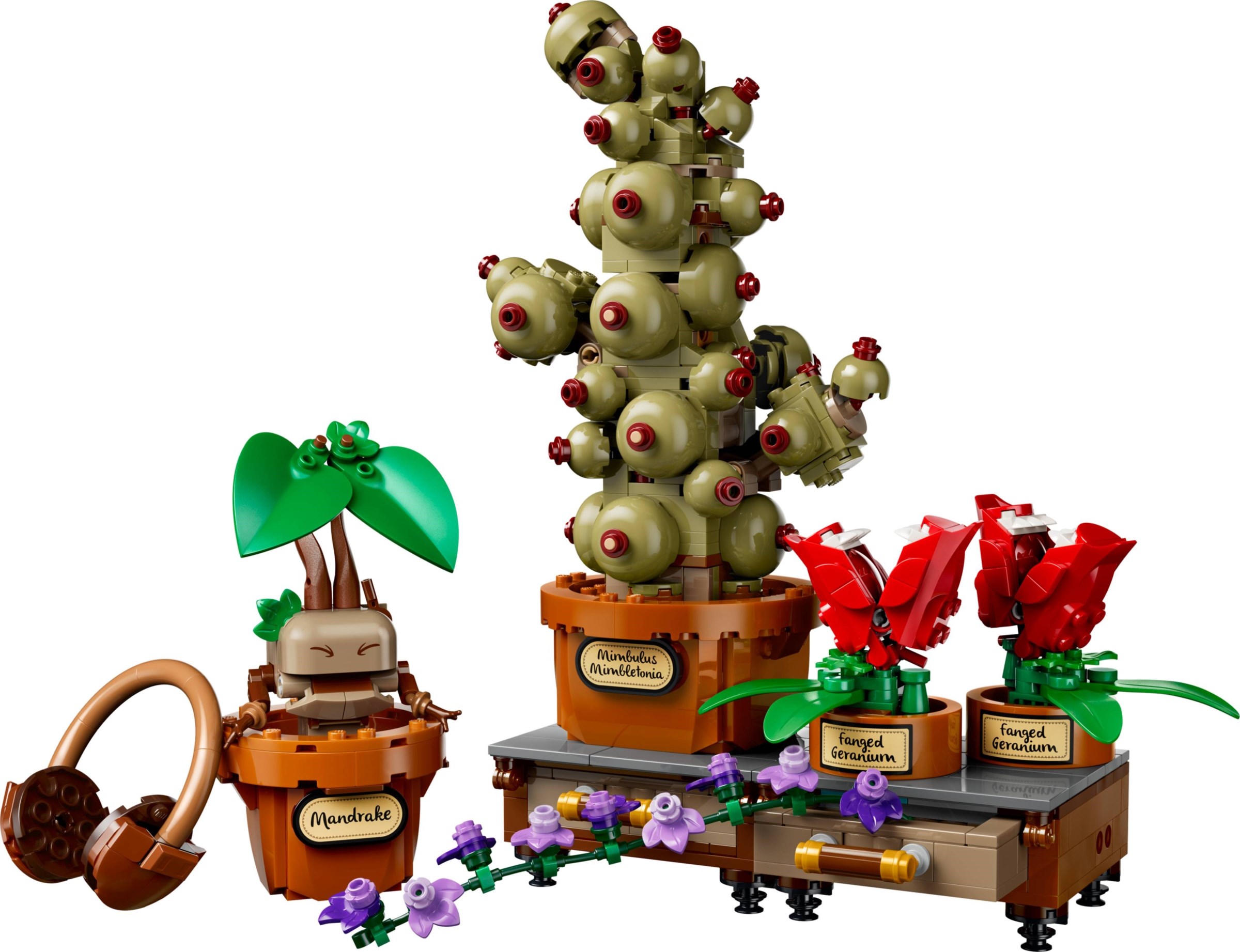
This modular approach has real upsides. Each plant section delivers a satisfying, self-contained sense of completion, and the variety keeps the build from feeling repetitive despite the shared botanical theme running throughout. The Mandrake-style root vegetable plant is the clear technical highlight, using a clever pot-and-root assembly that gives the impression of something straining to emerge from the soil, appropriately unsettling given the source material's famously loud reputation.
Other plant sections lean more decorative than technically demanding. A climbing vine assembly and a smaller flowering specimen round out the set, and while both are pleasant to build, neither reaches the inventive technique level of the Mandrake section or of LEGO's standalone botanical releases. This is where the set's ambition slightly outpaces its execution: the idea of a magical greenhouse collection is stronger than some of the individual plant builds that make it up.
Total build time runs roughly three to four hours across the various plant sections, comfortably an afternoon project. Instructions are clear throughout, with each plant section clearly delineated in its own instruction chapter, making it easy to build in short sessions without losing track of progress.
No minifigs are included, which keeps the focus entirely on the botanical subjects. For a Harry Potter set specifically built around Professor Sprout's teaching subject, the absence of Sprout herself as an included minifig is a noticeable gap that some Harry Potter collectors will feel keenly.
Arranged together on the included greenhouse-style base, the finished set reads clearly as a magical botanical collection, with enough variety in plant shape, color, and container style to avoid feeling repetitive. The color palette leans into deep greens, earthy browns, and the occasional unexpected accent, magenta on one flowering specimen, that helps differentiate the individual plants from one another visually.
At roughly 24 cm wide and a modest 9 cm deep, this set has a horizontal, shelf-friendly footprint that works well as a long, low display piece rather than a tall centerpiece. It suits a windowsill or a long shelf section better than a dedicated display cube, which is a reasonable design choice given the greenhouse subject matter but does limit its versatility somewhat compared to more vertically oriented display sets.
Individually, some plant sections display better than others. The Mandrake assembly is genuinely striking and photographs well from multiple angles. The smaller flowering and vine sections, while pleasant, read as slightly less distinctive once separated from the full collection, and their visual impact depends more heavily on being displayed as part of the complete greenhouse arrangement rather than as standalone pieces.
Lighting is less critical for this set than for many others in this batch, since the botanical subjects rely more on color and texture than on dramatic shadow or depth effects. Natural daylight, appropriate given the greenhouse theme, actually suits this set better than dramatic shelf lighting, making a genuine windowsill placement a legitimately good option rather than just a thematic gesture.
At 817 pieces, the price-per-piece here runs on the higher side for what is ultimately a set without minifigs and with a build experience that, while pleasant, does not consistently reach the technical heights of the best botanical or Harry Potter releases. This is the primary factor holding the overall score back from the higher tiers this batch reaches with its flagship entries.
The parts selection is heavy on green foliage elements, brown container and root pieces, and a modest number of specialized botanical elements that have decent but not exceptional crossover value for other plant or garden-themed MOC projects. Builders already invested in LEGO's botanical line will find some familiar element types here, applied to a fantasy rather than realistic subject.
The absence of any minifigs, notably including Professor Sprout herself, is a real value gap for Harry Potter collectors who typically expect character inclusion as part of what justifies a themed set's price point. Without a minifig anchor, this set relies entirely on the strength of its botanical subject matter to carry its value proposition, and while that subject matter is genuinely interesting, it is not quite enough on its own to push this into the same value tier as this batch's stronger entries. See our buying guide for how this compares against other current releases if you are weighing priorities within a Harry Potter collection.
Herbology is taught throughout the Harry Potter series by Professor Pomona Sprout, head of Hufflepuff house, whose greenhouses at Hogwarts house a wide range of magical plants used across the wizarding world's potions and remedies. The subject grounds the series' magic in something closer to a real academic discipline, treating plant care and cultivation with the same seriousness the books give to spellwork and potion-making.
The Mandrake is easily the most memorable plant from the Herbology curriculum, introduced during Harry's second year at Hogwarts, where students learn to repot the screaming root vegetables while wearing earmuffs, since an unmuffled Mandrake's cry is powerful enough to kill. The plant later plays a crucial role in restoring students petrified by the Basilisk, using a Mandrake Restorative Draught brewed from mature specimens, which makes it one of the more narratively significant plants across the entire series rather than simply a memorable classroom moment.
Venomous Tentacula, another notably dangerous greenhouse resident, appears across multiple books as a plant that actively grabs at anyone who gets too close, requiring careful handling during Herbology lessons. Alongside gentler specimens like Devil's Snare, which famously traps Harry, Ron, and Hermione during their first-year adventure into the Philosopher's Stone's protective enchantments, Hogwarts greenhouse life is consistently portrayed as genuinely hazardous, which gives this set's botanical subjects more dramatic weight than the phrase "plant set" might initially suggest.
Harry Potter fans who specifically enjoyed the Herbology and greenhouse elements of the series will get the most out of this set. It is a niche corner of the wider Hogwarts world, and this set treats it with genuine care even where the individual plant builds do not all reach the same technical high point.
Botanical set collectors who already enjoy LEGO's Orchid, Bonsai Tree, or Flower Bouquet releases will find a familiar building philosophy here, applied to fantasy rather than realistic plant subjects. If you have enjoyed that broader botanical line, this set extends it into new thematic territory reasonably well, even if it does not match the technical polish of the strongest standalone entries in that line.
Builders looking for the most impactful Harry Potter purchase in this batch should look toward the Book Nook or Castle East Wing instead. This set is a worthwhile addition to an existing Hogwarts collection, but it is not the strongest entry point for someone new to the theme or working with a limited budget for a single purchase.
Within this batch, pairing this set with Book Nook: Dumbledore's Office creates a nice contrast between indoor academic Hogwarts and the greenhouse's more organic, outdoor energy, giving a themed shelf real variety across the wizarding school experience.
For builders with existing LEGO botanical sets, positioning this alongside the Orchid or Bonsai Tree creates an interesting comparison point between LEGO's realistic and fantasy plant-building approaches, worth doing simply to appreciate how the two philosophies differ in technique and color palette.
If you are building toward a complete Hogwarts curriculum display spanning multiple class subjects, this set fills the Herbology gap well, and it pairs naturally with the larger Hogwarts Castle: East Wing from this same batch as a smaller satellite piece to the main architectural centerpiece.
Pros
- Genuine variety across several distinct magical plant subjects
- Mandrake assembly is a real technical and thematic highlight
- Horizontal footprint suits windowsill and long-shelf display well
- Modular build structure keeps pacing fresh across sessions
- Clear instructions with well-organized plant-by-plant chapters
- Ties into genuinely dangerous and narratively significant Herbology lore
Cons
- No minifigs included, notably missing Professor Sprout
- Higher price-per-piece given the lack of a minifig anchor
- Some individual plant sections read as less distinctive on their own
- Technical ambition does not match the best standalone botanical sets
Hogwarts Herbology Plants is a solid, likeable set that explores a genuinely underserved corner of the Harry Potter world. The variety across its plant subjects keeps the build engaging, and the Mandrake section in particular is a real technical bright spot worth the price of admission on its own.
It settles into A SOLID BUILD rating rather than reaching EARL APPROVED territory because the value proposition is fair rather than strong, particularly given the absence of any minifigs, and because not every plant section reaches the technical bar the best entries in LEGO's botanical catalog have set. This is an honest, likeable set rather than an essential one.
If Herbology was always your favorite class, or if you are rounding out a full Hogwarts curriculum display, this belongs on your list. If you are choosing just one Harry Potter set from this batch, look toward the Book Nook or Castle East Wing first.
- Book Nook: Dumbledore's Office Review - The stronger Harry Potter pick from this same batch
- Hogwarts Castle: East Wing Review - The flagship architectural centerpiece to pair this with
- Best Harry Potter Display Sets - See where this set lands in our full theme ranking
- What to Buy, Skip, and Wait On - How this set compares against current priorities
- All Earl of Bricks Reviews - Browse the full review archive
Track it in your vault on GameSetBrick - our free collection app. Log your condition, price paid, and watch the real-time market value.
Track in Your Vault →Save it to your wishlist on GameSetBrick. Share your list with friends and family - every set has a buy button so gift givers know exactly where to go.
Add to Wishlist → GameSetBrick is a free app by The Earl of Bricks. See all features. Scan it. Track it. Trade it.