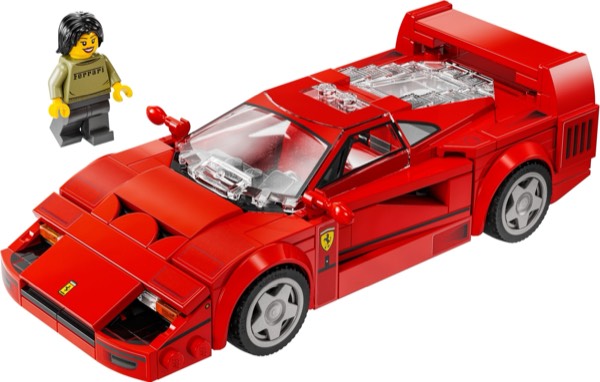
The Ferrari F40 is the poster car that defined an entire generation of automotive obsession, and LEGO has treated it with the reverence it deserves. At 318 pieces, the build takes approximately 45 minutes and unfolds with the kind of attention to detail that suggests the design team spent serious time studying the source material. The 8-wide format gives LEGO's designers room to capture the F40's iconic wedge profile - that low-nose, rising-haunch, flat-deck silhouette that has been pinned to bedroom walls since 1987. From the moment you open the first bag and see the Ferrari red spilling across the table, there is an anticipation to this build that few Speed Champions sets can match.
The curved bonnet is constructed from layered tiles that slope forward convincingly, creating the smooth nose profile that the real F40 achieves through kevlar bodywork. The rear window louvres are formed from 1x1 tiles laid flat in a technique that is both simple and strikingly effective - from normal viewing distance, they read as the slatted vents that are one of the F40's most recognizable details. The trans-clear engine cover at the back gives a peek into the engine bay, suggesting the twin-turbo V8 that made the F40 the first road car to break 200 mph. Small details reward the attentive builder: door mirrors use spoon pieces, the gearstick is a metallic silver microphone element, and there is a hidden Italian flag built from colored plates underneath the exhaust housing - an Easter egg you will never see on the shelf but will appreciate during the build. These hidden details speak to a design team that genuinely loves the car and wanted builders to experience that same affection during the construction process.
The interior includes curved seats, a handbrake, and dashboard dials - more interior detail than most Speed Champions cars attempt. At 318 pieces, the build is brisk but never feels rushed. Every step serves the final silhouette, and the finished model clicks together with a completeness that signals quality design. Most key details use printed elements rather than stickers, which is a welcome decision that gives the F40 a premium feel appropriate to its legendary status. The final moment of placing the completed car on your desk and stepping back to see that unmistakable profile is one of the most satisfying conclusions in the current Speed Champions lineup.
The rear louvre construction is the technique star of this set. Using 1x1 tiles arranged horizontally across a recessed panel, LEGO creates the slatted rear window that is arguably the F40's single most recognizable detail after the color. The technique is deceptively simple - it relies on the visual effect of parallel lines created by tile edges rather than any complex connection method. For MOC builders studying how to create louvred or slatted surfaces at minifigure scale, this is the reference implementation. The same approach works for industrial vents, architectural screens, and any application requiring visual texture through repetition. What makes the technique particularly elegant is that it uses common elements in an uncommon arrangement, meaning you can replicate it immediately from a standard parts collection without hunting for specialty pieces.
The front-to-rear bodywork flow demonstrates wedge-profile construction at its best. The F40's shape is essentially a ramp - rising continuously from a low nose to a high rear deck - and LEGO achieves this through carefully graduated slope heights along the body length. Each section is slightly taller than the one before it, and the cumulative effect is a smooth visual ramp that captures the real car's dramatic profile. The pop-up headlight area presents the set's most notable compromise: open holes where opaque printed tiles representing the closed headlight covers should be. From the front angle, these holes are the single biggest visual flaw on the model. From side and rear angles, however, the F40 is excellent. The engine cover transparency adds depth to the rear view that solid panels cannot achieve, and the exhaust treatment uses dark grey elements that suggest the twin-pipe layout convincingly.
The interior construction method is worth studying for anyone building cockpit details at this scale. LEGO has managed to fit a steering wheel, gear lever, dashboard instruments, and bucket seats into a space barely four studs wide. The seats use curved slope elements that create a convincing bucket shape, and the dashboard instruments are a single printed tile that packs enormous visual information into a tiny footprint. The technique of using printed elements for interior detail rather than brick-built instruments is pragmatic at this scale, and the result reads clearly through the windshield. For builders who want to improve the interiors of their own Speed Champions MOCs, the F40 provides a template for how much personality you can inject into a minifigure-scale cockpit.
318 pieces with a dominant Ferrari red palette. The red element selection is solid - plates, slopes, tiles, and curved elements that any Ferrari MOC builder or red-themed project will consume. Red is LEGO's most iconic color and always in demand, though it is also one of the most commonly available. The value in the F40's red parts lies in the variety of element types rather than the rarity of the color itself. The structural dark grey and black elements are universally useful, and the trans-clear engine cover piece has applications in any build requiring a transparent panel. For builders maintaining a Speed Champions collection, the F40 contributes to a growing inventory of automotive-specific elements that accumulate across multiple sets.
The printed elements are the collector highlight. The hood detail, the rear panel graphics, and the interior dials all use pad printing rather than stickers, which means these elements retain their decoration permanently and hold collector value better than stickered alternatives. The hidden Italian tricolor flag - three colored plates beneath the exhaust - is a charming detail element that adds cultural personality to the parts inventory. The choice to pad-print rather than sticker the key details is a decision that pays dividends over time, as the prints will look exactly the same in ten years while stickers yellow, curl, and peel.
The driver minifigure is functional but unremarkable: a female driver in a Ferrari-branded sweater torso with a wrench accessory. The figure feels like an afterthought compared to the care invested in the car itself, but it serves the basic purpose of populating the cockpit for display. The Ferrari shield on the torso print does have crossover appeal for minifigure collectors and Ferrari-themed diorama builders, making it a useful figure despite its relative simplicity. The wrench accessory is a standard tool element that will find its way into your general accessories bin and serve you well in future builds. Overall, the parts haul is solid for a set at this price point, with the printed elements and the red color variety providing the most lasting value.
The Ferrari F40 is instantly recognizable on any shelf, and that instant recognition is worth more than any piece count or technique analysis can measure. The wedge silhouette, the rear louvres, the flat rear deck with its lip spoiler - every element combines to create a shape that is burned into automotive culture. LEGO has captured enough of that shape at 8-wide scale that viewers identify the car before they read any badge or nameplate. That is the definition of display success. The F40 is one of those rare sets where the finished model generates an emotional response from anyone who sees it, regardless of whether they know anything about LEGO or care about brick building at all.
The rear louvres are the standout display detail and photograph beautifully under any lighting condition. The parallel lines catch and release light in a way that adds visual texture to the entire rear quarter of the car. The trans-clear engine cover adds depth to the rear view, and the overall proportions - low nose rising to high haunches - create a dynamic visual flow that makes the car look fast even standing still. Displayed alongside the Ferrari SF90 XX (#77254), the F40 creates a 40-year timeline of Ferrari supercar evolution that is visually stunning and narratively compelling. Add the Icons F2004 (#11375) and the Speed Champions SF-24 (#77242), and you have Ferrari represented across four decades and four vehicle types. That kind of display storytelling is unique to a brand with Ferrari's heritage, and LEGO has given collectors the tools to tell it beautifully.
The headlight compromise is real - from directly in front, the open holes where covered headlights should be are the model's most visible flaw. The solution is display angle: position the F40 at a three-quarter angle on your shelf, which is the most flattering view for any car, and the headlight issue disappears entirely. From that angle, the F40 is one of the most displayable single cars in the entire Speed Champions catalog. The three-quarter view also happens to be the classic automotive photography angle, which means the F40 looks its best when you instinctively display it the way you would photograph a real car. It is a happy convergence of display common sense and the set's strongest visual profile.
318 pieces at the 2024 Speed Champions price delivers good value for a licensed Ferrari set. The per-piece cost is average for the range, but the printed elements, the interior detail, and the hidden Easter egg flag add quality touches that make the purchase feel more premium than the price suggests. The F40's cultural significance as arguably the most important supercar ever made adds intangible value that extends beyond brick count. You are not just buying 318 LEGO pieces - you are buying a miniature of automotive history. That kind of cultural weight is something LEGO understands well, and they have calibrated the price to make the purchase feel accessible rather than exploitative.
For Ferrari collectors building a comprehensive brand display, the F40 fills the essential classic slot. It sits at the foundation of the Ferrari hierarchy - the car that defined what a modern Ferrari could be - with the SF90 XX as the current pinnacle, the F2004 as the F1 legend, and the SF-24 as the current racer. At the Speed Champions price point, building this complete Ferrari display is remarkably accessible. The F40 is the car that starts the story, and every Ferrari display needs its beginning. See our complete roundup for the full Speed Champions lineup.
The build experience relative to cost is strong. Forty-five minutes of focused, rewarding construction that produces a model you will keep displayed indefinitely is excellent return on investment. The F40 is not the longest build in the Speed Champions range, but it is one of the most satisfying because every element contributes to a recognizable, culturally significant result. For gift-givers, the combination of the Ferrari name, the iconic design, and the printed-not-stickered presentation makes this one of the safest recommendations in the entire LEGO catalog. It is the kind of set that pleases car enthusiasts, LEGO fans, and casual builders equally.
A single driver minifigure is included wearing a Ferrari-branded casual outfit - a sweater torso with the Ferrari shield rather than a formal racing suit. This reflects the F40's identity as a road car rather than a race car, although the real F40 saw extensive track use through the F40 LM and Competizione variants. The casual attire is a reasonable design choice that distinguishes the F40 driver from the uniformed racing drivers in the F1 Speed Champions sets. The choice of a casual outfit also positions the minifigure as an owner rather than a professional driver, which aligns with the F40's legacy as the last Ferrari personally approved by Enzo Ferrari for road use.
The figure includes a wrench accessory, suggesting the hands-on, mechanical relationship that F40 owners have with their cars - this is a Ferrari that was famously stripped of luxury features in pursuit of performance. The torso print with the Ferrari shield works in broader display contexts beyond just this set, making it a versatile figure for Ferrari-themed dioramas or automotive displays. A helmet is not included, which is appropriate for the street car context. The figure is exclusive to the F40 set and represents a different character archetype than the professional racing drivers in the rest of the Speed Champions Ferrari lineup. For minifigure collectors, the casual Ferrari outfit fills a niche that the racing suit drivers cannot, and the exclusivity to this set gives it modest long-term collectibility.
The Ferrari F40 is for anyone who has ever pinned a car poster to their wall. It is for the car enthusiast who wants their passion represented on their desk or shelf in a form that is both playful and respectful. It is for the Speed Champions collector filling out the Ferrari section of their display, knowing that the F40 is the foundation piece that makes every subsequent Ferrari in the lineup more meaningful by comparison. And it is for the parent or partner shopping for a gift who knows the recipient loves cars and wants something that will be built, displayed, and appreciated rather than forgotten in a closet.
For LEGO builders specifically, the F40 appeals most to those who value display quality over build complexity. This is not a challenging build - it is a satisfying one. The distinction matters. If you want a set that tests your skills, look elsewhere. If you want a set that produces a result you will be proud to display, that visitors will comment on, and that captures one of the most important cars ever made in a format that fits on any shelf, the F40 delivers on every count. The printed details and the hidden Easter eggs reward the builder who pays attention, and the finished model rewards the collector who values recognition and cultural significance in their display pieces.
Younger builders aged 9 and up will find the build accessible and the result exciting, especially if they have any interest in cars. The F40 is a gateway set for the Speed Champions theme - simple enough to complete in one session, impressive enough to inspire the purchase of a second car, and recognizable enough that showing it to friends generates genuine enthusiasm. For adult fans of LEGO, the F40 sits in that sweet spot of affordable, quick, and displayable that makes it an easy impulse buy and an even easier recommendation.
- ✓ Instantly recognizable F40 silhouette - proportions are spot-on
- ✓ Rear window louvres are a standout design detail
- ✓ Hidden Italian flag Easter egg under the exhaust
- ✓ Most details are printed, not stickered
- ✓ Trans-clear engine cover adds visual depth to the rear
- ✓ Interior detail exceeds most Speed Champions cars
- ✗ Open headlight holes are the biggest visual flaw from the front
- ✗ Side windows force slightly awkward minifigure arm positioning
- ✗ Minifigure design feels like an afterthought
Some products may be provided by manufacturers. This page contains affiliate links. All opinions are my own.
- Ferrari SF90 XX Stradale Review - Ferrari's modern hypercar at 8-wide
- Ferrari F2004 Icons Review - The greatest Ferrari F1 set ever made
- Ferrari SF-24 Speed Champions Review - Ferrari's current F1 car
- Ferrari Pit Stop City Review - Ferrari in the City F1 range
- Every Speed Champions Set Reviewed - The complete roundup
Track it in your vault on GameSetBrick - our free collection app. Log your condition, price paid, and watch the real-time market value.
Track in Your Vault →Save it to your wishlist on GameSetBrick. Share your list with friends and family - every set has a buy button so gift givers know exactly where to go.
Add to Wishlist → GameSetBrick is a free app by The Earl of Bricks. See all features. Scan it. Track it. Trade it.