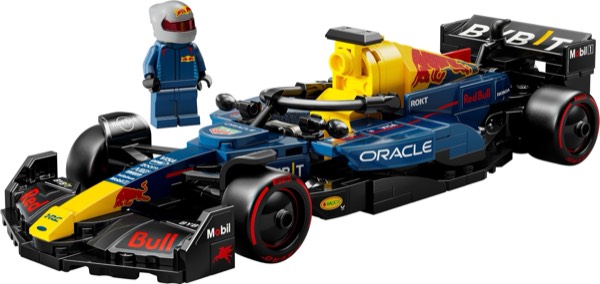
The Red Bull RB20 arrives as the Speed Champions representation of the car that dominated the first half of the 2024 F1 season. At approximately 251 pieces, the build follows the established eight-wide Speed Champions F1 formula, and it executes that formula with confidence. The dark blue livery with red and yellow accents creates a striking build progression as the car takes shape from bare chassis to finished racer.
Construction begins with the central tub and floor structure, establishing the low, wide stance that defined Red Bull's ground-effect era dominance. The sidepod construction is the most engaging phase, where the characteristic Red Bull bodywork shape emerges through careful placement of dark blue slopes and curved elements. The transition from structural grey to livery blue is always a satisfying moment in a Speed Champions build, and the RB20 handles it cleanly.
The rear assembly is particularly well-designed. The engine cover, rear wing, and diffuser area come together in a sequence that captures Adrian Newey's final Red Bull masterwork in miniature. The yellow accent elements for the T-camera and nose tip provide welcome color contrast during the build. A printed driver helmet and minifigure in Oracle Red Bull Racing suit complete the package with appropriate detail. Stickers handle secondary graphics, while the key identity elements are printed.
What distinguishes the RB20 build from other Speed Champions F1 cars in the 2024 lineup is the tightness of the bodywork construction. The real RB20 was famous for its exceptionally compact packaging - Adrian Newey squeezed every aerodynamic advantage from the regulations by minimizing the volume of the sidepods and pulling the bodywork tight around the mechanical components. LEGO's designers have clearly studied this characteristic, because the RB20 build feels more precise and more densely packed than its grid rivals. Where the Ferrari SF-24 build has a certain expansive, flowing quality to its curves, the RB20 is all about compression and efficiency. Every piece serves a structural or aesthetic purpose, and there is almost no wasted volume inside the bodywork. That engineering philosophy translates into a build that feels purposeful from the first brick - you are not padding out space, you are assembling a machine where every element matters.
The RB20 at Speed Champions scale presents an interesting design challenge: the real car's advantage came largely from its floor and diffuser design, elements that are almost invisible at eight studs wide. LEGO's designers have focused instead on capturing the distinctive upper bodywork profile, and they have done it well. The sidepod shape uses a layered slope technique that creates the tapering rear-end characteristic of the RB20's packaging philosophy.
The front wing construction uses minimal elements to suggest the complex multi-element design. The endplates are integrated into the wing assembly with bracket connections that keep everything rigid while allowing the correct visual angle. The nose cone taper from the survival cell forward is handled with a wedge plate combination that captures the narrow, pointed profile of the Red Bull design language.
The rear wing assembly is cleanly executed with the main plane and DRS flap suggested by two parallel plate elements at the correct relative angle. The swan-neck mounting pylons are simplified but present, maintaining the correct visual connection between wing and bodywork. For builders studying how to compress complex aerodynamic forms into minifigure scale, this is solid reference material.
The floor and diffuser area, while largely hidden on display, actually contains some of the most interesting structural engineering in the entire build. The central spine uses a plate-on-plate sandwich construction that creates a rigid backbone for the entire car, and the side skirt elements attach via clip connections that hold them at precisely the right angle to suggest the ground-effect floor edges. The halo safety device over the cockpit is handled with a single curved bar element that slots into two connection points on the roll hoop and the front bulkhead - a simple solution that captures the distinctive look without adding structural complexity. These small technical decisions throughout the build demonstrate a design team that understands both the real engineering of an F1 car and the constraints of translating that engineering into a 251-piece miniature. Each technique employed is the most efficient solution to its particular design challenge, which is fitting for a model of a car that was designed with exactly the same philosophy.
251 pieces in dark blue, dark bluish grey, red, and yellow. The dark blue elements dominate the spread and are always useful for automotive, nautical, or space-themed MOC work. The red accent pieces are limited but welcome, and the yellow elements used for branding details add a splash of color variety. The printed driver helmet has collector appeal for F1 enthusiasts.
The wheel and tire assemblies are standard Speed Champions fare, compatible across the entire range. Small bracket, plate, and slope elements make up the bulk of the structural parts, and these are universally useful building components. The parts haul is functional rather than spectacular, which is typical for Speed Champions at this scale. The value lies more in the finished model than the raw brick inventory.
For builders who collect the entire Speed Champions F1 range, the parts standardization is actually a hidden benefit. The wheel assemblies, chassis plates, and cockpit elements are interchangeable across all the 2024 F1 cars, which means you can create hybrid liveries, custom team designs, or fantasy grid cars using elements from multiple sets. The dark blue slopes and curved elements in the RB20 are among the most useful individual parts, as dark blue curves appear in relatively few other Speed Champions releases. The printed minifigure torso with the Oracle Red Bull Racing suit adds a collectible element that has genuine secondary market value for F1 fans who display minifigures separately. While 251 pieces will never constitute a substantial parts haul in absolute terms, the quality and utility of the individual elements punches above the raw count.
The RB20 in Speed Champions form is a handsome little car. The dark blue livery with red and yellow accents creates a color scheme that photographs well and stands out on a shelf without being garish. The proportions are accurate to the eight-wide standard: low, wide, and aggressive. The characteristic Red Bull nose profile and engine cover shape are immediately recognizable, giving the car an identity that reads clearly even at this scale.
Displayed alongside the Ferrari SF-24 (#77242) and the Mercedes W15 (#77244), the RB20 completes a front-row grid display that captures the competitive dynamic of the 2024 season. The dark blue of the Red Bull contrasts nicely with Ferrari's red and Mercedes' silver, creating visual variety that makes a multi-car display more engaging. Individually, the RB20 has the kind of purposeful, understated presence that suits a desk display or bookshelf vignette.
The dark blue livery presents an interesting display consideration that is worth addressing directly. In well-lit environments - a shelf with LED strip lighting, a desk near a window, or a display cabinet with internal illumination - the RB20 looks superb. The dark blue catches light on its curved surfaces and the red and yellow accents pop against the deep background color with just the right amount of contrast. In dimmer conditions, however, the dark palette can cause the car to recede visually, with surface details becoming harder to distinguish. This is not a flaw in the set design so much as a characteristic of the real car's livery translated to miniature scale. The solution is simple: give the RB20 good lighting and it rewards you with one of the most photogenic Speed Champions models in the range. The dark blue is rich rather than flat, and under directional light it reveals the subtle surface geometry that defines the bodywork in a way that lighter-colored cars simply cannot match.
The Speed Champions formula continues to deliver strong value, and the RB20 is no exception. For a modest investment, you get an engaging build, a display-quality finished model, a licensed minifigure, and a parts spread that tilts toward useful rather than decorative. The Red Bull branding and the car's competitive significance in the 2024 season add collector appeal that extends beyond pure brick value.
If you are collecting the 2024 Speed Champions F1 range, the RB20 is obviously essential. If you are choosing a single car from the lineup, your team allegiance will dictate the choice. On pure build and display merit, the RB20 stands shoulder to shoulder with the Ferrari and Mercedes. The championship-winning pedigree of the real car adds an intangible premium that only matters if it matters to you. And if you are a Red Bull fan, it matters.
Speed Champions occupies a unique position in the LEGO catalogue as the line that delivers the highest ratio of display satisfaction to financial outlay. No other theme consistently produces models that look this good at this price point, and the RB20 exemplifies that equation. You are getting a licensed Formula 1 car with printed identity elements, a detailed minifigure, and a build that captures the essence of a championship-winning machine - all for roughly the cost of a pizza dinner for two. The comparison to die-cast F1 models at similar price points is instructive: those models offer more precise surface detail but zero engagement. The RB20 gives you 45 minutes of focused building pleasure before it ever reaches the display shelf, and that experience has value that a pre-formed metal car cannot match. For F1 fans on any budget, Speed Champions remains the smartest entry point into the hobby, and the RB20 is one of the strongest arguments for that position in the current lineup.
The RB20 speaks to several overlapping audiences, and it serves all of them well. Formula 1 fans who follow the sport closely will appreciate the accuracy of the livery, the printed helmet details, and the faithful bodywork proportions that capture the car's distinctive packaging philosophy. Speed Champions collectors adding to their grid display will find the RB20 an essential addition - the 2024 season is incomplete without the car that started it as the dominant force. Younger builders getting their first taste of the LEGO-F1 partnership will find an accessible build that teaches basic vehicle construction techniques without overwhelming them with piece count or complexity.
The set also works surprisingly well as a gift for people who are not established LEGO builders but who follow Formula 1. The combination of recognized branding, manageable build time, and a satisfying finished product makes it an ideal entry point. Someone who has never built a LEGO set since childhood can complete the RB20 in under an hour and end up with a model they are genuinely proud to display. That conversion potential - turning a casual F1 fan into an active LEGO builder - is one of Speed Champions' greatest strengths, and the RB20 leverages it as well as any set in the range. If the person you are buying for has strong opinions about Max Verstappen, this is the set. No further deliberation required.
There is a dimension to the RB20 that transcends the usual Speed Champions review criteria, and it deserves acknowledgment. The real RB20 was the last Formula 1 car designed under the technical direction of Adrian Newey at Red Bull Racing. Newey is widely regarded as the greatest race car designer in the history of the sport, with championship-winning cars spanning Williams, McLaren, and Red Bull across four decades. His departure from Red Bull after the 2024 season marked the end of an era that produced some of the most dominant F1 machinery ever built.
That historical context gives the RB20 a significance that goes beyond its on-track performance. It is the final chapter of a design lineage that includes the RB6, RB7, RB9, RB16B, and RB19 - each a championship winner, each bearing the unmistakable fingerprints of Newey's aerodynamic genius. When you build the LEGO RB20, you are not just assembling a miniature of a fast car. You are holding a piece of F1 history in 251 bricks, the last expression of a partnership that defined an era. For F1 historians and serious fans, that narrative weight makes the RB20 more than a Speed Champions set - it makes it a monument. And at this price point, it might be the most affordable monument in the sport's history.
- ✓ Dark blue livery with red and yellow accents is immediately recognizable
- ✓ Sidepod tapering technique captures the RB20's packaging philosophy
- ✓ Printed driver helmet and key identity elements
- ✓ Excellent display companion alongside SF-24 and W15
- ✓ Strong value at the Speed Champions entry point
- ✓ Engaging 45-minute build with no filler construction
- ✗ Secondary sponsor graphics require stickers
- ✗ Dark blue palette can make details hard to see in low light
- ✗ No display stand included
Some products may be provided by manufacturers. This page contains affiliate links. All opinions are my own.
- Best LEGO F1 Sets Ranked - Where every F1 set stacks up in our definitive ranking
- Every Speed Champions Set Reviewed - The complete roundup of every SC set we have tested
- McLaren MCL38 Review - Red Bull's fiercest rival on the 2024 grid
Track it in your vault on GameSetBrick - our free collection app. Log your condition, price paid, and watch the real-time market value.
Track in Your Vault →Save it to your wishlist on GameSetBrick. Share your list with friends and family - every set has a buy button so gift givers know exactly where to go.
Add to Wishlist → GameSetBrick is a free app by The Earl of Bricks. See all features. Scan it. Track it. Trade it.