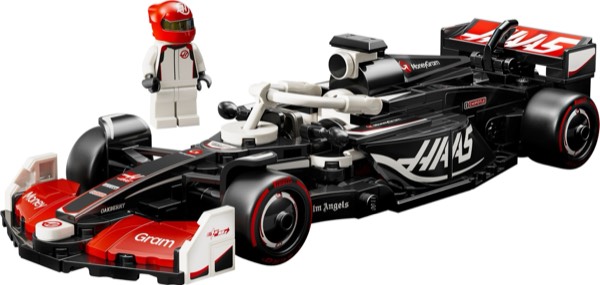
The Haas VF-24 follows the established 2025 Speed Champions F1 formula at around 242 pieces, delivering a build that takes approximately 35 minutes. The white and red livery creates a build experience that is visually clean at every stage. You can see the car's shape emerging clearly because the white elements provide strong contrast against the dark chassis elements underneath. There is a clarity to building with predominantly white pieces that darker cars simply cannot match - every structural decision is visible, every connection point is obvious, and the emerging form of the car is readable from the earliest steps.
Construction follows the standard F1 Speed Champions sequence. The flat monocoque base goes down first, then the sidepods build up on either side with the red accent pieces arriving at specific intervals to create the Haas livery pattern. The nose cone section is particularly clean on this model, with the white elements tapering to a satisfying point. The rear wing assembly is quick and precise, and the halo frames the cockpit properly. The pacing is smooth throughout, with no difficult steps or confusing color management issues that sometimes arise with more complex multi-color liveries.
Where the Haas build differs slightly from its 2025 F1 siblings is in the simplicity of the color scheme. With only white and red to manage, there are fewer color-transition moments that require careful piece placement. This makes the build feel slightly more straightforward than the multi-color liveries like the Alpine or McLaren. That is not a criticism. The clean execution matches the car's real-world aesthetic, and the build flows smoothly from start to finish without any frustrating steps. Sometimes simplicity is its own reward, and the Haas delivers that reward consistently across its 35-minute build time. For builders new to Speed Champions F1 cars, the Haas is an excellent starting point because the construction logic is fully visible through the white bodywork.
The Haas shares the same underlying chassis architecture as the other 2025 F1 Speed Champions, which means you get the same sidepod undercut technique and rear diffuser detailing. The inverted slopes creating the ground-effect tunnel under the sidepods are well executed, and the front wing uses thin plate elements to suggest the multi-element aero surfaces. These are proven techniques that LEGO has refined across the entire 2025 F1 range, and the Haas benefits from the same engineering quality as the championship contenders.
The technique that stands out on the Haas specifically is the livery color blocking. The transition from white body to red accents is handled through strategic plate placement rather than stickers for the major color zones. LEGO has engineered the build so that red elements slot into the white bodywork at natural break points, creating livery lines that look intentional rather than forced. The rear end uses a combination of white and red tiles to capture the Haas color split that runs across the engine cover. This two-color approach is deceptively simple - getting clean, precise transitions between white and red at 8-wide scale requires careful element sizing that the design team has executed well.
The overall technique level is consistent with the 2025 Speed Champions standard. Nothing revolutionary, but solid execution of proven approaches that produce a convincing F1 silhouette. For builders who own multiple Speed Champions F1 cars, comparing the Haas build to the Alpine A524 (#77248) or the VCARB 01 (#77246) reveals how the same fundamental chassis architecture diverges through livery-specific element selections. The white Haas makes the structural choices more visible than darker cars, which is actually an advantage for technique study. If you want to understand how Speed Champions F1 cars are engineered, building the Haas first and then building a dark-liveried car second will illuminate the chassis design in a way that a single build cannot.
Approximately 242 pieces with a heavy emphasis on white elements. This is genuinely useful for builders who need clean white plates, slopes, and tiles, as white is one of those colors that gets consumed quickly in MOC projects. Modular building facades, winter scenes, medical vehicles, modern architecture - white elements disappear from your parts bins faster than any other color, and the Haas provides a useful restock. The red accent pieces add variety, and the chassis elements in dark gray and black are standard Speed Champions fare that integrates into any vehicle or structural project.
The driver minifigure features a printed Haas racing suit and helmet. Wheels and tires are the 2025 Speed Champions standard, fully compatible with every other Speed Champions car in the range. The sticker sheet covers sponsor markings and technical details. For parts buyers, the white element concentration is the main draw here, as most Speed Champions sets skew toward more saturated colors.
If you are sourcing white for a modular building facade, a winter scene, or a medical vehicle MOC, the Haas delivers more clean white than any other Speed Champions set in the current range. The slopes, plates, and tiles are all standard LEGO elements in shapes and sizes that see heavy rotation in architectural and vehicle building. At the Speed Champions price point, the Haas offers practical parts utility that complements its display value - a combination that not every Speed Champions set achieves.
The Haas VF-24 has a clean, understated presence on the shelf. While it may not grab your eye as aggressively as the more colorful F1 entries, the white and red livery has an elegance that grows on you. The white bodywork catches light beautifully and gives the car a crisp, modern look that photographs well from any angle. In person, the white has a brightness that makes the car feel larger and more substantial than its piece count might suggest - white expands visually in a way that dark colors compress.
In a collection of 2025 F1 Speed Champions, the Haas provides essential visual variety. Among the blues, oranges, greens, and reds of the grid, the predominantly white Haas serves as a visual palette cleanser - a moment of rest for the eye that actually makes the surrounding cars look more vivid by contrast. Every good display needs breathing room, and the Haas provides it. The proportions are accurate and the F1 silhouette reads correctly. The red accents prevent the car from looking washed out, providing enough contrast to define the body lines even from a distance.
Displayed at desk level, the car has the low, wide stance that Speed Champions F1 models deliver consistently. It looks like a proper racing car, and the clean livery gives it a certain sophistication that busier color schemes sometimes sacrifice. Under photography lights, the white bodywork creates clean highlights and natural shadows that make the car look exceptionally good in images. If you photograph your Speed Champions collection, the Haas will consistently produce some of your best shots simply because white is the most photogenic color for capturing surface detail and shape.
The Haas VF-24 sits at the standard Speed Champions price point with approximately 242 pieces. The value proposition is equivalent to the other single-car F1 entries in the 2025 lineup. You get a licensed F1 car, quality minifigure, and a display-worthy finished model. The construction quality is consistent with the rest of the range, and there are no compromises in build experience or display finish that would suggest a lesser product.
For Haas fans and F1 completists, this is an obvious buy. The only LEGO representation of the VF-24, this set captures a specific moment in Haas's F1 journey that will not be repeated - next year's car will be different, and the VF-24 will become a historical artifact in miniature. For builders choosing selectively from the 2025 F1 wave, the Haas competes on clean aesthetics rather than visual drama. Its value increases significantly if you are building the complete grid, where its white livery becomes an essential contrast piece that elevates the entire display.
Paired with the City-scale Haas from the Williams/Haas two-pack (#60464), you get the same team at two different scales - a fun display comparison that highlights how LEGO approaches the same livery at different resolutions. The Speed Champions version naturally captures more detail, but the juxtaposition of the two reveals interesting design decisions about what gets prioritized at each scale. For Haas fans specifically, owning both versions creates a complete picture of LEGO's treatment of the team.
The Haas VF-24 is for the F1 fan who roots for the underdog. Haas occupies a unique position in Formula 1 - the only American-owned team on the grid, fighting for relevance against manufacturers with ten times the budget. There is a scrappy charm to Haas that resonates with fans who appreciate effort and determination over guaranteed success, and the VF-24 in LEGO form captures that underdog spirit in a clean, honest package. No flashy livery gimmicks, no excessive ornamentation - just a well-built race car in straightforward colors, ready to compete.
Grid completists will find the Haas non-negotiable. A 2025 F1 display without the American team is incomplete, and the white livery's visual role as a palette cleanser becomes apparent only when you place it among the full collection. Remove the Haas and the grid loses balance - the remaining cars blend together more than they should because the eye has nowhere to rest. Add the Haas back and suddenly every other car looks more distinct. That is the Haas's quiet superpower in a display context.
For builders who prioritize practical parts value alongside display appeal, the Haas offers the best white element haul in the 2025 Speed Champions range. If your parts bins are running low on clean white plates and slopes - and they always are - the Haas solves that problem while simultaneously delivering a display-worthy F1 car. It is a set that works on multiple levels without excelling dramatically at any one of them, which makes it one of the most well-rounded purchases in the range for builders who value versatility over spectacle.
Haas's inclusion in the 2025 Speed Champions F1 wave is significant beyond the individual set. As the only American-owned team on the Formula 1 grid, Haas represents a bridge between F1's traditionally European fan base and the rapidly growing American audience that has fueled the sport's expansion in recent years. Drive to Survive brought millions of American viewers to F1, and Haas is their natural entry point - a team that races under the American flag, operates with American sensibilities, and fights for every point with the determination that American sports culture celebrates.
LEGO's decision to include Haas in the Speed Champions range acknowledges this growing American F1 audience. The VF-24 is not just a building set - it is a statement that American Formula 1 fans deserve representation in the LEGO universe alongside the Ferraris and Mercedes that dominate the headlines. For American F1 fans who have adopted the sport through its recent cultural moment, having their team on the shelf in LEGO form validates that fandom in a tangible way.
The white and red livery, while simpler than some competitors, has a distinctly American quality - clean, direct, and unpretentious. Gene Haas named the team after himself, the livery puts the sponsor branding front and center, and the car goes racing without the hundred-year heritage stories that European teams lean on. That straightforward approach translates well into LEGO form, where the VF-24's clean lines and honest color scheme feel refreshingly unburdened by legacy. It is a race car that looks like it was built to race, not to pose - and on the shelf, that directness has its own kind of appeal.
The set includes a single Haas F1 Team driver minifigure wearing the team's white racing suit with red and black accent printing. The torso features the MoneyGram Haas F1 Team branding, sponsor logos, and the red stripe detailing that defines the team's visual identity. The leg printing continues the racing suit design with additional sponsor graphics. The overall presentation is clean and accurately reflects the real-world Haas race suit design from the 2024 season.
The driver's helmet uses the updated 2025 Speed Champions mold with a printed visor and Haas team branding in the white-and-red color scheme. An alternate hair piece is included for helmetless display. The figure does not represent a specific named driver, but the team-accurate printing means it integrates convincingly into any F1 display. This is a unique figure - the Speed Champions Haas driver does not appear in any other set, making it distinct from the City-scale Haas driver in the Williams/Haas two-pack (#60464) which uses simpler printing at the 4+ detail level.
- ✓ Clean white and red livery looks elegant on display
- ✓ Smooth build with no frustrating color-management steps
- ✓ White elements are genuinely useful for MOC builders
- ✓ Strong visual contrast piece in a full F1 collection
- ✓ American team representation adds collection diversity
- ✗ Predominantly white build may feel less visually exciting during construction
- ✗ Sticker reliance for sponsor details
- ✗ Less distinctive silhouette compared to more colorful F1 entries
Some products may be provided by manufacturers. This page contains affiliate links. All opinions are my own.
- Best LEGO F1 Sets Ranked - Where every F1 set stacks up in our definitive ranking
- Every Speed Champions Set Reviewed - The complete roundup of every SC set we have tested
- Williams and Haas F1 City Review - The City-scale take on the same team
Track it in your vault on GameSetBrick - our free collection app. Log your condition, price paid, and watch the real-time market value.
Track in Your Vault →Save it to your wishlist on GameSetBrick. Share your list with friends and family - every set has a buy button so gift givers know exactly where to go.
Add to Wishlist → GameSetBrick is a free app by The Earl of Bricks. See all features. Scan it. Track it. Trade it.