Is the LEGO NASA Apollo Saturn V Worth Buying?
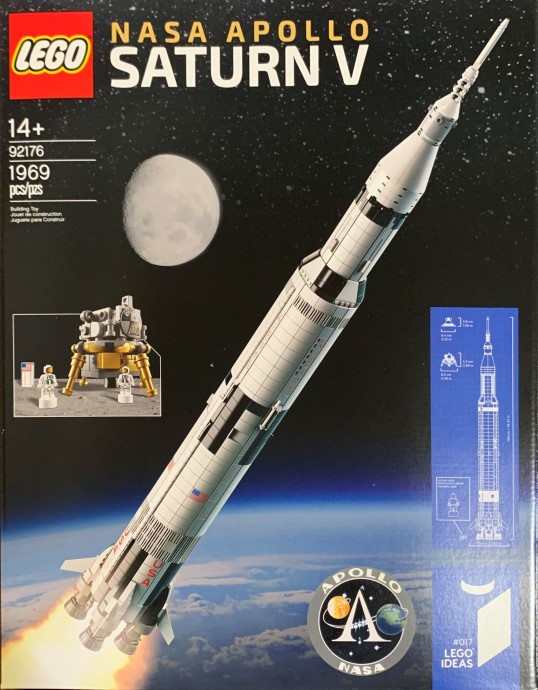
9.1/10. Worth buying. 1,969 pieces, a wink at the 1969 moon landing, standing a full meter tall. Small box, enormous presence.
Comparing your options? See where it lands in our best LEGO Ideas sets ever, ranked.

I have opened a lot of large boxes in my time, and I have opened a lot of small ones, and this is the rare set where the box tells you almost nothing about what is coming. The Saturn V arrives in a modest carton, priced like a weekend build, weighing about what you'd expect for a mid-size set. Then you stack the finished thing on end and it stands a full meter tall, taller than a toddler, taller than most floor lamps, and the entire calculus of the set changes. Value in LEGO is usually measured in piece count and hours. Here it is measured in the *drama* of the reveal, and on that scale the Saturn V is one of the best deals LEGO has ever put a barcode on.
What I love about this one is that the design comes from real fans through LEGO Ideas, not a boardroom, and it shows in the priorities. There is no wasted cleverness, no gimmick that fights you. The 1,969 pieces are a deliberate little salute to the year Apollo 11 landed, and once you know that you cannot unsee it. This is a build about proportion and patience rather than brute technique, and it welcomes newcomers in a way most one-meter display pieces simply do not. Understand that before you buy, because it changes who this set is right for. It is not the hardest rocket you will ever build. It might be the most satisfying to point at.
The Saturn V is a build about rhythm. The rocket is assembled as a stack of stages, and each stage is essentially a cylinder built up in tiers around a central core. That sounds repetitive, and in truth there is repetition here, but it is the good kind - the kind that lets you settle into a groove, put on something to listen to, and watch the tower grow section by section. Expect somewhere in the region of six to nine hours of relaxed building, less if you are experienced and moving with purpose. This is not a marathon. It is a long, pleasant afternoon and an evening.
Construction runs bottom to top, mirroring the real vehicle. You build the enormous first stage with its cluster of five engine bells, then the second stage, then the third, and finally the tapering payload section that carries the lunar module and the command and service module. The genius of the sequencing is that the build gets more interesting as it goes. The lower stages teach you the cylinder technique through repetition, and the upper sections reward that patience with the fiddly, characterful little details - the lander legs, the escape tower, the delicate taper of the nose.
Because the stages separate, you are effectively building four or five smaller models that clip together, and that makes the Saturn V one of the most approachable large-scale display builds in the catalog. A younger or newer builder can complete a stage, feel genuine accomplishment, and set it aside. There is no point where the build becomes intimidating or demands techniques a determined beginner cannot manage. It is ambitious in outcome and gentle in execution, which is a rarer combination than it sounds.
The instruction manual is clear and well-paced, with the LEGO Ideas touch of context notes about the real Apollo program scattered through it. Those notes matter more here than usual, because half the joy of this set is understanding what each section actually did on the way to the moon.
Let me be honest about where this set sits, because it matters for the right buyer. The Saturn V is not a technique showcase in the way a flagship Icons set is. The core method is cylindrical construction using standard bricks and plates arranged in overlapping rings, repeated up the length of the rocket. If you have never built a round shape at scale in brick, you will learn a genuinely useful skill here, and you will learn it thoroughly through repetition. If you are a seasoned MOC builder, you will find the technique competent and clean rather than revelatory.
Where the design earns real respect is in the transitions and the details. The interstage tapers, where a wider stage narrows into the next, are handled with a tidy stepped approach that reads as smooth from a normal viewing distance. The five-engine cluster at the base uses radial symmetry that is satisfying to assemble and structurally sound enough to bear the weight of everything stacked above it. The escape tower and the fine work at the nose show what the fan designers could do with small elements when the scale demanded delicacy.
The most quietly clever decision is the staging system itself. The rocket separates at the correct points into the real stages, plus the lunar lander and the command module, exactly as the actual vehicle did during its mission. That is not a technique in the SNOT-and-brackets sense, but it is a design achievement - engineering the model so it comes apart meaningfully and reassembles securely is harder than making a rocket that is simply glued into one rigid tube. It turns a static model into something you can handle and explain.
At 1,969 pieces the Saturn V is a moderate parts haul dominated by white, with generous supporting quantities of light grey, dark grey, and black. If white bricks and plates are what your projects hunger for, this is a quietly excellent source. The set uses a lot of standard rectangular plates and bricks in the white and grey families, which are the workhorses of any architectural or spacecraft MOC, and having a large single-color reserve of them in one box is genuinely handy.
The curved and rounded elements used to build the cylindrical body are the most interesting parts of the haul. Depending on your projects, the quantity of white curved slopes and the black engine-bell elements can be useful for anything from spacecraft to appliances to abstract sculpture. The three microscale astronaut figures are a charming inclusion rather than a parts-value driver, but they are a lovely touch that gives the finished rocket a sense of human scale.
This is not a set you buy to part out. The BrickLink economics do not point that way, and frankly it would be a small crime to disassemble something this striking. But as a working stock of white and grey basics with a handful of characterful curved pieces, it quietly over-delivers for what the box costs.
This is where the Saturn V stops being a good set and becomes a great one. Standing on end at roughly one meter tall, it is a genuine floor-to-eye-level monument. Almost nothing else at this piece count commands vertical space the way this does. It reads instantly from across a room as *the* rocket, the silhouette everyone recognizes, and it draws the eye upward in a way horizontal display pieces simply cannot.
You have two display modes, and both are legitimate. Stood vertically, the Saturn V is a pure statement piece - dramatic, iconic, and impossible to ignore. The box includes three stands that let you display it horizontally instead, laid on its side like a museum exhibit, which is the safer choice if you have curious pets, small children, or an unsteady shelf. The horizontal presentation also invites you to separate the stages and show the rocket as an exploded diagram of its own mission, which is a wonderful conversation starter.
The three microscale astronauts do real work here. Set beside the towering rocket, they hammer home the sheer scale of the machine that carried them, the same emotional trick the real vehicle plays on anyone who has stood beneath one. It is a small design decision with an outsized effect on how the finished display feels.
One honest practical note: vertical display puts a tall, relatively slender tower on a small footprint, so it wants a stable, out-of-the-way spot. A bump to the shelf is more consequential here than with a low, wide model. Think about where it lives before you stand it up, not after the first wobble.
On raw piece count, the Saturn V looks like an ordinary mid-size set. On display drama per piece, it is one of the best values LEGO has produced. You are not paying for 9,000 pieces of hull plating here. You are paying for a one-meter monument that arrives in a modest box, and the gap between what the set costs and what it delivers on a shelf is enormous. Few sets punch this far above their weight.
The Saturn V has also earned a reputation as a beloved evergreen. It was popular enough as the original 21309 that LEGO re-released it as 92176, which tells you something about demand. Sets with that kind of affection behind them tend to hold interest well, and a rocket this recognizable does not go out of style. For a builder weighing the long game, that history is reassuring, though I would buy this one to display and enjoy rather than to speculate.
If you are new to large display builds and want maximum impact for a sensible outlay, this is close to the easiest recommendation I can make. The value proposition is not subtle. It is a meter of rocket for the price of a fraction of that in shelf presence anywhere else.
The Saturn V is for the space enthusiast, obviously, but its real audience is broader than that. It is for the newer builder who wants their first genuinely impressive display piece without facing a 40-hour flagship. It is for the parent building alongside a child, because the stages let you split the work and share the reveal. And it is for the seasoned collector who wants one perfect, uncomplicated monument to stand in a corner and quietly dominate the room.
It is not for the builder chasing the most advanced techniques LEGO has to offer, and it is not for someone who wants hundreds of hours of construction. This is a set that values outcome over ordeal. If that sounds like a compromise, it is the good kind - the kind that means more people can build something genuinely magnificent.
If you have ever looked up at the idea of the moon landing and felt something, this set puts that feeling on your shelf at a scale that does it justice.
The Saturn V looks superb standing near other space and science builds. The LEGO Ideas International Space Station makes a natural partner, pairing the vehicle that reached the moon with the outpost that keeps us in orbit today. A microscale lunar surface build or any NASA-themed set extends the story from launch to landing, and because the Saturn V draws the eye upward, it happily anchors a shelf of smaller companions arranged around its base.
If you are building a broader collection of iconic real-world subjects, the Saturn V sits beautifully alongside a maritime or architectural centerpiece. Our LEGO Titanic review covers another set where a real machine is rendered at monument scale, and the two together tell a story about human ambition in very different directions - one across an ocean, one to the moon.
Track the current market value of the Saturn V and compare it to other display pieces on GameSetBrick.
- A full meter of vertical display presence from a modest box
- 1,969 pieces with a lovely nod to the 1969 moon landing
- Separates into real Apollo stages, lander, and command module
- Approachable build that welcomes newer and younger builders
- Includes three stands for horizontal display plus three microscale astronauts
- Outstanding display drama for the piece count
- Cylinder construction is repetitive across the lower stages
- Technique is competent rather than groundbreaking
- Tall vertical display wants a stable, out-of-the-way spot
- Not the choice for builders chasing a long, complex marathon
- All Reviews - Browse every set The Earl has put through its paces
- LEGO Investing 101 - Do beloved evergreen sets like Saturn V hold value?
- Retiring Sets Tracker - Which sets are leaving shelves soon
- LEGO Titanic Review - Another real machine rendered at monument scale
- Scale Guides - Understanding how LEGO renders real objects in brick
What genuinely caught me off guard was how much the three little microscale astronauts change the emotional weight of the finished model. I expected to shrug them off as a throwaway inclusion. Instead, once the rocket was standing and I set the tiny figures at its base, the whole thing clicked into a different register. Suddenly you are not looking at a nice white tower, you are looking at the impossible ratio between three fragile humans and the enormous machine required to throw them at the moon. That is the exact feeling the real Saturn V gives anyone standing beneath one, and I did not think a mid-size LEGO set would land it so cleanly.
The other surprise was how much I enjoyed the repetition I had braced myself to tolerate. On paper, stacking ring after ring of white brick up a cylinder sounds like a chore. In practice it became the most relaxing LEGO evening I had spent in months - a low-stakes, meditative rhythm where the tower simply grows under your hands. Not every set needs to fight you to be worth the time. Sometimes the reward is the calm of the building itself, and this one delivers that better than sets three times its size.
Track it in your vault on GameSetBrick - our free collection app. Log your condition, price paid, and watch the real-time market value.
Track in Your Vault →Save it to your wishlist on GameSetBrick. Share your list with friends and family - every set has a buy button so gift givers know exactly where to go.
Add to Wishlist → GameSetBrick is a free app by The Earl of Bricks. See all features. Scan it. Track it. Trade it.