Is the LetBricks City Library with LED Lights Worth Buying?
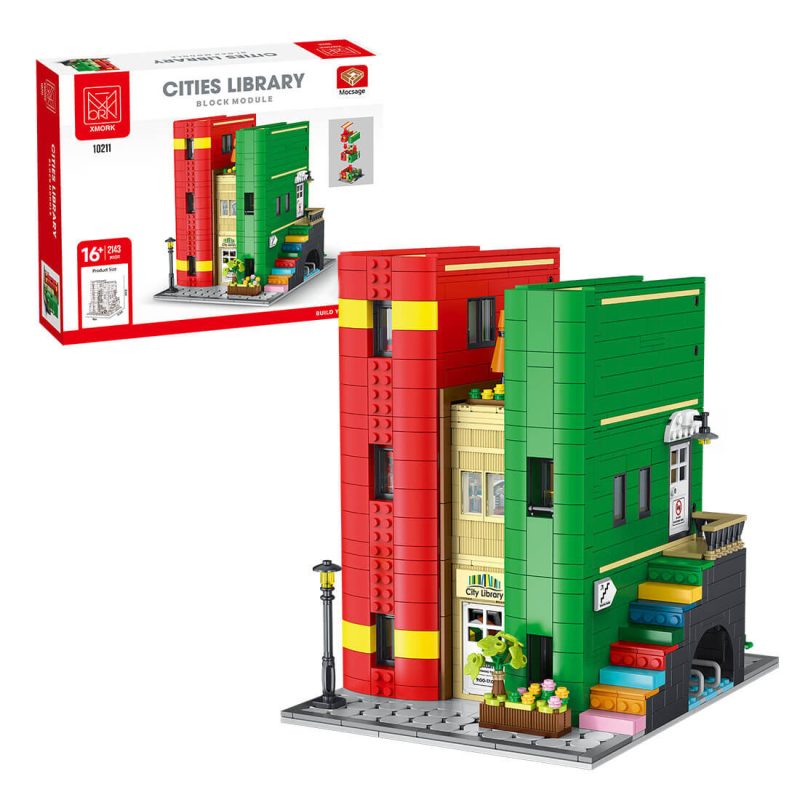
8.4/10. Worth buying. 2,143 pieces, three floors of literary charm, and USB-powered lighting that makes it glow.

LetBricks' City Library lands in that awkward middle territory where third-party MOC instructions occupy, too specialized for casual builders, too niche for display-only collectors, but absolutely essential for people building modular street layouts. The LED integration here isn't an afterthought or a gimmick; it's baked into the architecture in ways that force actual design decisions during construction. You're not slapping lights onto a finished model. You're routing power through floor plates, choosing which rooms get illuminated, and committing to USB dependency from day one. That's a commitment worth understanding before you order the 2,143 pieces.
What matters most: this set has genuine architectural bones. Three stories of readable interior depth, actual wall thickness that supports structure, and a footprint that doesn't embarrass itself next to LEGO's official modulars. The parts count feels honest, no bloated interior voids or decorative padding. Built correctly, the library sits stable enough for regular handling, which matters for display pieces you'll actually interact with. The lighting system works reliably, but it removes the option of building this without planning for permanent power infrastructure on your shelf or table.
At 2,143 pieces, the City Library sits in a sweet spot for modular building fans - substantial enough to deliver a satisfying multi-hour build without demanding an entire weekend. The construction follows the classic modular approach: you build the ground floor first, then stack each subsequent level on top. The ground floor houses a bookstore with shelving, a counter area, and a doorway entrance that establishes the building's street-level identity. The second floor is a reading room complete with tables, chairs, cups, and bookshelves lining the walls. The top floor is an intimate study room with a clever convertible sofa-bed detail.
What elevates the build beyond typical modular fare is the LED integration. The USB-powered lighting system is wired during construction rather than added as an afterthought, which means the light placement is intentional - warm glows from reading lamps, illuminated bookshelves, and window light that spills outward. The instructions handle the wiring clearly, though you will want to test your LED connections at each floor before sealing the level above. At 1.89 kg finished, this is a manageable model that builds quickly once you find your rhythm.
The build pacing deserves recognition because Mocsage has structured it to deliver visual rewards at regular intervals. Completing the ground floor bookstore gives you a finished interior scene you can admire before moving upward. The reading room on the second floor introduces the first LED elements, so you get to see the lights come alive mid-build rather than waiting until the very end. And the top-floor study, with its sofa-bed mechanism and cozy attic proportions, provides a charming finale that feels like discovering a hidden room. Each floor is its own small project within the larger build, and that rhythm of completion and reward keeps the experience engaging from start to finish. The LED wiring is the only point where the build requires extra attention, but the instructions are clear enough that even a first-time lighting kit builder should manage without frustration.
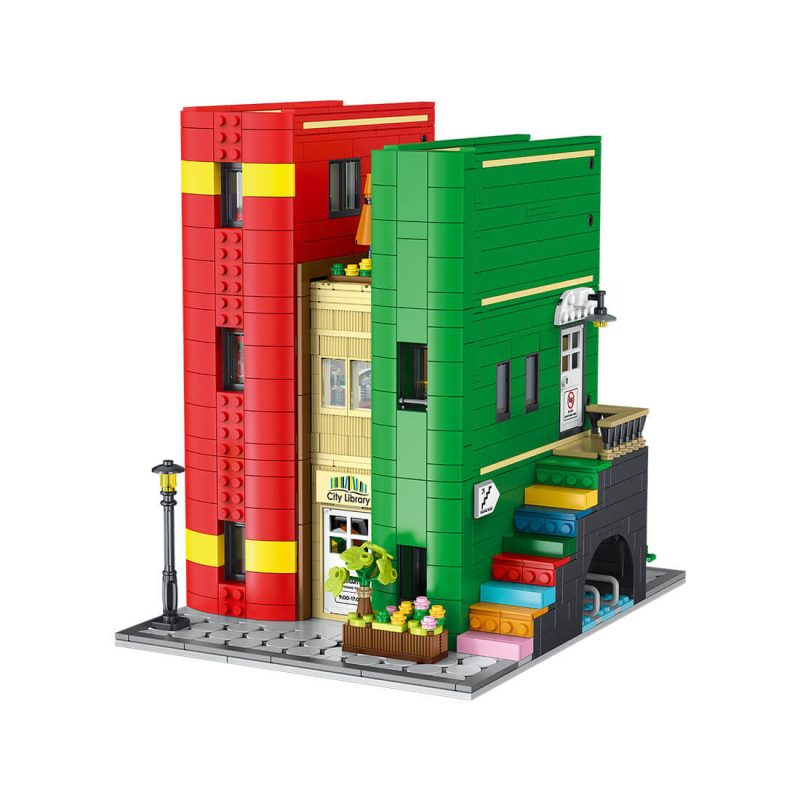
The City Library captures the essential character of a small-town public library with a European flavor. The facade features large arched windows on the ground floor that transition to smaller rectangular windows on the upper stories, creating a visual rhythm that reads as "institutional but welcoming." The architectural detailing includes a decorative cornice line between floors, a recessed entrance, and subtle color blocking that differentiates the ground-floor commercial frontage from the upper residential-style levels.
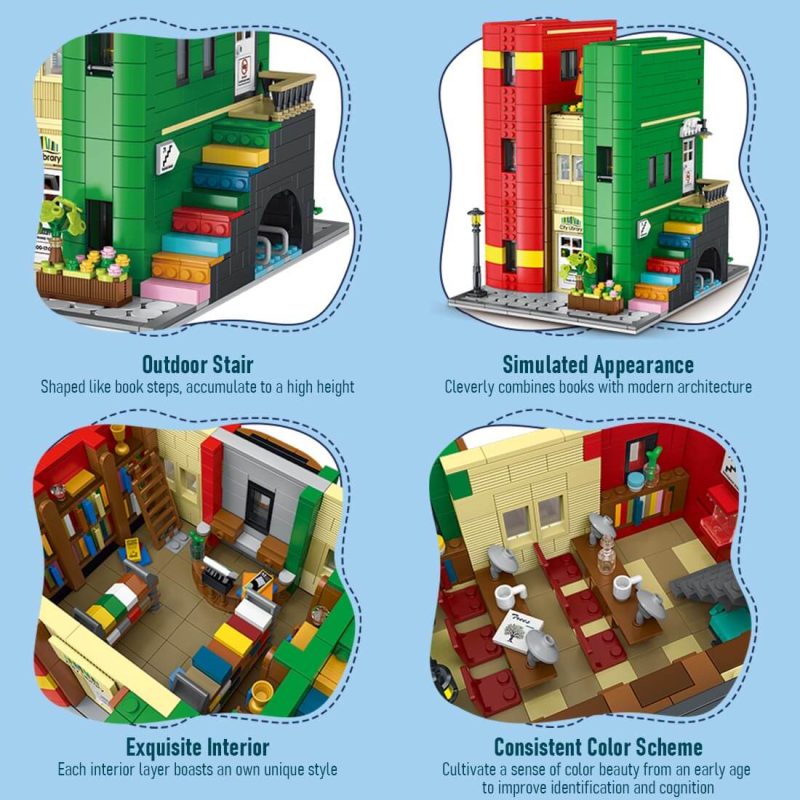
The interior design is where Mocsage's attention to detail really shines. The bookstore level has individual shelving units with tiny book elements arranged in rows, a service counter with a register, and floor tiling that distinguishes it from the reading rooms above. The second-floor reading room features proper furniture arrangements - reading tables with chairs positioned naturally, a staircase connection to the floor above, and wall-mounted bookshelves that create the enclosed, hushed atmosphere of a real library reading room. The top-floor study with its convertible sofa is a charming touch that adds a lived-in quality rare in modular buildings at this scale.
Where Mocsage particularly excels is in creating interiors that tell stories through spatial arrangement rather than relying solely on accessories. The reading room does not just have tables and chairs placed on a flat floor. The furniture is arranged to create distinct zones: a quiet reading area near the windows where natural light would fall, a research section near the bookshelves, and a central circulation path that connects the staircase to the various seating options. This kind of thoughtful interior planning is what separates a good modular building from a great one. You can imagine people using this space, choosing their preferred seat, lingering over a book near the window as the afternoon light shifts. That narrative quality is difficult to achieve at this scale, and Mocsage has managed it with admirable restraint, never overcrowding the rooms but placing just enough detail to spark the viewer's imagination.
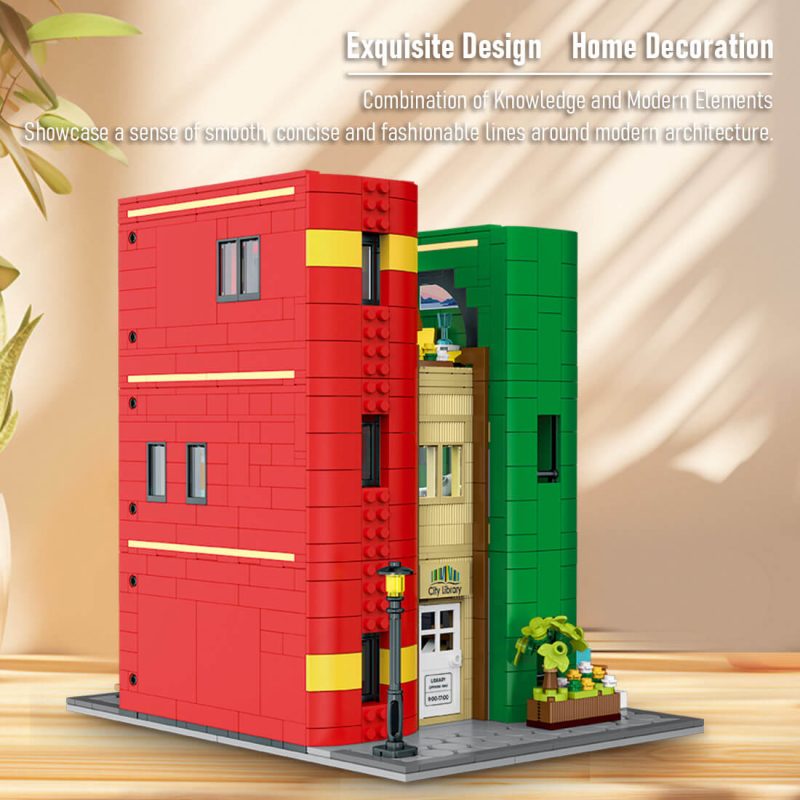
The 2,143-piece inventory is a good mix of standard modular building elements - bricks, plates, tiles, and window frames in cream, tan, dark tan, and olive green that are all directly reusable in other modular or architectural builds. The furniture accessories (tables, chairs, cups, book elements) are useful for anyone who builds interior scenes. The ABS plastic quality is consistent, with good clutch power and clean molding throughout the build.
The LED lighting kit is the standout inclusion. USB-powered and pre-wired with connectors that route cleanly through the building's internal channels, the lighting components are well-made and produce a warm, even glow that avoids the harsh spotlighting effect of cheaper aftermarket LED kits. The USB power connection means you can run the lights from any standard USB port or phone charger, which is far more convenient than battery packs hidden inside the model. The wiring is thin enough that it does not interfere with floor separation if you need to access the interiors.
The window frame elements deserve specific mention because they are central to the building's character and they arrive in excellent condition. The arched ground-floor windows and the rectangular upper-floor windows are clean, consistent, and connect firmly to the surrounding facade construction. Window frames are one of those element categories where poor quality is immediately obvious, because any warping or inconsistency shows as a visible gap in the building's face. Mocsage's selection here is precise, and the resulting facade has the crisp, finished appearance that modular building collectors expect. The olive green accent elements used on the cornice and trim are also notable for their color consistency, a detail that matters when multiple pieces of the same color sit adjacent on a facade where any mismatch would be immediately apparent.
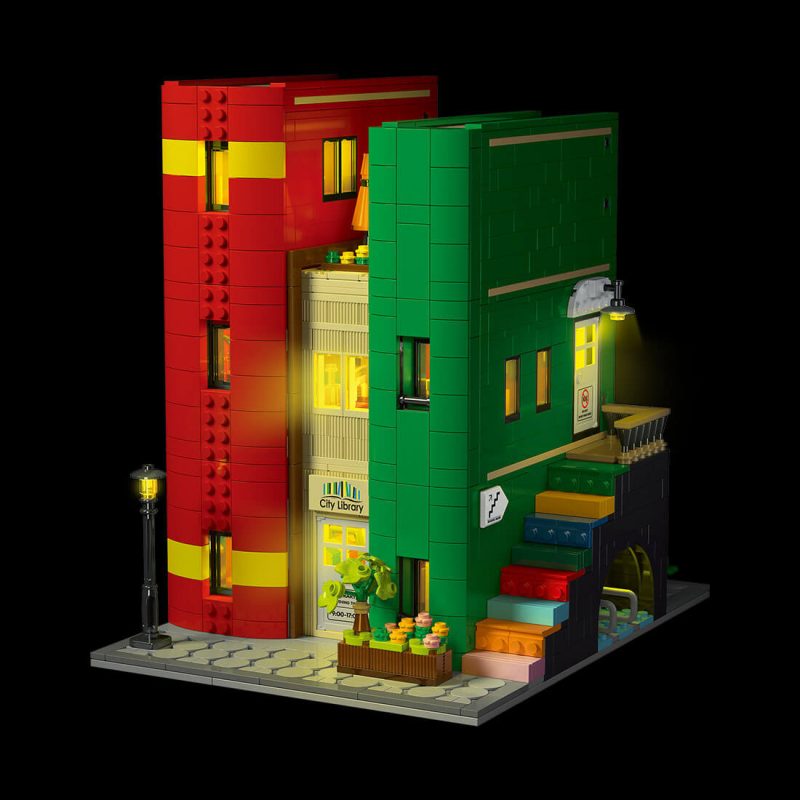
The LED lighting transforms this from a pleasant modular building into a genuine display piece. With the lights off, you have an attractive three-story library with nice architectural detailing and warm earth tones. With the lights on, the building comes alive - the warm interior glow visible through the windows creates the effect of a library on a winter evening, inviting and atmospheric in a way that unlit models simply cannot match. On a modular street display, this building becomes the visual anchor that draws the eye, especially in a dimmed room.
At 40 cm tall and 32 cm wide, the City Library has proportions that work well alongside official LEGO modular buildings if you are integrating it into an existing street layout. The 9 cm depth is slightly slimmer than standard modulars but not noticeably so in a row. The removable floors allow you to showcase the detailed interiors - the reading room and study levels are genuinely worth looking at, with furniture arrangements that tell a story of daily library life. This is a building that rewards close inspection as much as it works at room-viewing distance.
The real display magic happens at night or in a dimmed room. Plug in the USB cable, and the City Library becomes the centerpiece of any modular street. The warm LED glow through the arched ground-floor windows suggests a bookstore that is still open for late browsers. The reading room windows on the second floor cast a softer, more diffused light that implies quiet activity within. And the top-floor study emits just enough light to suggest a lamp left on by a reader who has fallen asleep over a book. This layered lighting effect creates depth and atmosphere that transforms a shelf display into a scene, and it is something that no amount of exterior detailing can replicate on an unlit model. For collectors who display their modular buildings in a dedicated cabinet or along a shelf with ambient room lighting, the City Library's LEDs add a dimension of visual storytelling that justifies the set's presence even among larger, more expensive official LEGO modulars.
For a 2,143-piece modular building with included LED lighting, the City Library represents solid value. The LED kit alone, if purchased separately as an aftermarket add-on for a similar-sized building, would add meaningful cost to any modular set. Having it integrated from the start, with purpose-built light channels and tested positioning, adds significant value compared to buying a building and a lighting kit separately. LEGO's own modular buildings in this piece range do not include lighting of any kind.
The library theme is also underserved in the brick-building world. LEGO has produced bakeries, bookshops, corner garages, and police stations, but never a dedicated public library as a modular building. The combination of unique theme, included LED lighting, and detailed three-floor interior design makes this a strong proposition for modular collectors looking to fill a gap in their streetscape. The 2,143-piece count means this is also an approachable gift for someone who enjoys modular building but might be intimidated by 5,000+ piece sets.
The value calculation also benefits from the set's longevity as a display piece. Unlike builds that impress on completion and then fade into the background, the City Library's LED lighting gives it an active role in your display that refreshes every time you turn the lights on. It is not just a building sitting on a shelf. It is a building that performs, that changes character between day and night modes, and that draws attention every evening when the room lights dim and the warm glow from those library windows catches your eye. Sets that deliver ongoing display engagement like this offer a different kind of value from sets that peak at the moment of completion, and for collectors who invest in their display environment, that ongoing engagement is worth factoring into the price assessment.
The City Library is tailor-made for the modular building collector who wants something official LEGO does not offer. If you have a row of LEGO modulars on a shelf and you are looking for the next building to extend your streetscape, this fills the library gap with warmth, character, and integrated lighting that none of your existing buildings have. The LED system alone makes it a compelling addition, because it introduces a visual element that transforms your entire display when the room lights go down.
Beyond the modular collector, this set speaks to book lovers, cozy aesthetic enthusiasts, and anyone who finds comfort in the idea of a small-town library with warm lights and quiet reading rooms. The build is accessible at 2,143 pieces, making it a reasonable weekend project that does not demand the multi-week commitment of larger architecture sets. It is also an excellent introduction to LetBricks for builders who are curious about the platform but hesitant to start with a massive set. The quality is proven, the design is charming, and the LED integration demonstrates something the third-party building world does that official LEGO has not yet matched at this price point. For anyone who has ever walked past a library at dusk and felt drawn to the warm glow through the windows, this set captures that exact feeling in brick form.
- ✓ USB-powered LED lighting included and integrated during build
- ✓ Three distinct interior floors with detailed furniture and accessories
- ✓ Warm earth-tone color palette suits any modular streetscape
- ✓ Convertible sofa-bed detail on top floor adds character
- ✓ Compatible proportions with standard modular building displays
- ✓ Manageable 2,143-piece build - achievable in a single day
- ✓ Unique library theme not available from LEGO
- ✗ 9 cm depth is slightly slimmer than standard LEGO modulars
- ✗ LED wiring requires careful routing during build
- ✗ No minifigures included - library staff and readers would add life
- ✗ USB cable visible at base needs concealing for clean display
- LetBricks - The Alternative MOC Site - Everything about LetBricks
- Flatiron Building Review - Another LetBricks architecture piece
- LED Lighting Display Guide - Tips for lighting up your builds
The window treatment is where LetBricks made its smartest choice. Rather than using standard LEGO panes and frames, the instructions call for specific stud arrangements that create divided-light effects without custom printing, this reads as authentic library windows from viewing distance, not as LEGO windows pretending to be something else. It's restraint in the MOC world where restraint rarely happens. Second surprise: the roof structure uses minimal internal support precisely where you'd expect it to fail, but the assembly method creates natural load distribution that actually works. Builders skilled enough to follow LetBricks instructions will appreciate the engineering decisions underneath the aesthetic.
Parts inventory reveals another hidden detail, the brick selection heavily favors dark tan and earth tones over the typical modular palette of sandy yellow and brown. This creates visual separation from official LEGO modulars if you're building a mixed street. The color discipline extends to the interior: functional green plants, realistic book-spine colors, actual variation instead of monochromatic decoration. Three floors of build work this way, which is why piece count stays justified rather than inflated.