Is the LetBricks New York Flatiron Building Worth Buying?
9.1/10. Worth buying. 15,076 pieces of Manhattan's most iconic wedge - an architecture MOC of staggering ambition.

The Flatiron exists in that rare space where architecture sets stop being toys and become arguments. Fifteen thousand pieces isn't just a number, it's a commitment statement, especially when those pieces are engineered to recreate one of Earth's most geometrically hostile buildings. That triangular footprint, barely 6.5 feet wide at its apex, has defeated casual builders and confused architects for 126 years. LetBricks didn't simplify it. They engineered it.
What matters here is the wedge problem itself. This isn't a rectangular building you can stack methodically from bottom to top. Every section tapers. Every row gets narrower. Every floor plate demands precision that separates someone who can follow instructions from someone who understands load distribution and brick geometry. After 25 years of building, watching how a set tackles this constraint tells you everything about whether the designer actually built their own design, or worked from theory. The Flatiron doesn't allow theory.
The Flatiron Building is one of those rare MOCs where the build itself teaches you something about architecture. At 15,076 pieces, this is a commitment that stretches across multiple days - possibly a full week of dedicated evening sessions. But the genius of alpha.x.brix's design is in how the triangular footprint forces unconventional building techniques from the very first layer. You are not stacking rectangles here. Every course of bricks negotiates the acute angle at the building's prow, and watching that wedge shape emerge from the baseplate is genuinely thrilling.
The internal structure relies on a combination of Technic frameworks and interlocking plate layers to maintain rigidity across the 79.8 cm height. Each floor is essentially a self-contained module that locks into the one below, which means the build never feels monotonous despite the repetitive nature of a skyscraper. The facade detailing - window surrounds, cornices, and the distinctive rusticated base - changes subtly as you climb, mirroring the real building's Beaux-Arts ornamentation. At 14 kilograms fully assembled, the final stacking of upper floors requires a second pair of hands or at least a very steady table.
There is a psychological dimension to this build that deserves mention. Most large architecture sets train you to think in right angles. Walls are parallel. Floors are square. The Flatiron dismantles that assumption in the first ten minutes and never lets you return to it. Every floor plate is triangular, every wall section tapers, and your spatial reasoning has to adapt to a geometry that feels genuinely foreign in brick form. By the time you reach the midpoint of the build, you have internalized a completely different way of thinking about how bricks connect, and that mental shift is worth the price of admission alone. The upper floors, where the ornamental detailing intensifies and the structure narrows slightly toward the cornice, are where the build reaches its creative peak. You are no longer following instructions mechanically. You are understanding why each piece is placed where it is, and that understanding makes the final assembly deeply satisfying.
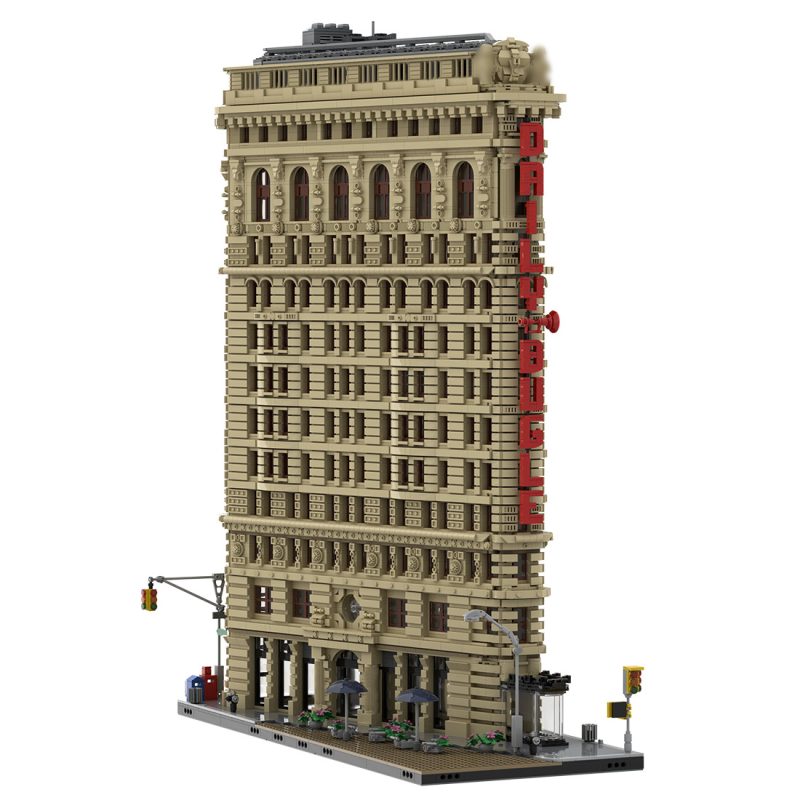
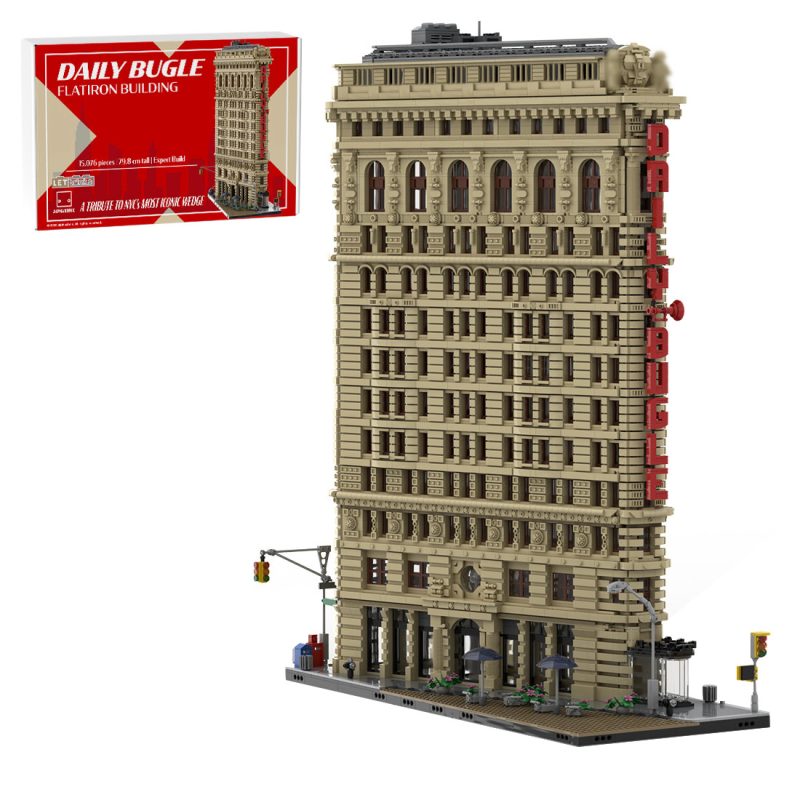
This is where alpha.x.brix's MOC earns its stripes. The Flatiron Building's distinctive triangular floor plan is faithfully reproduced at a scale that allows genuine architectural detail. The 22-story structure's three facades are each treated individually: the Broadway and Fifth Avenue elevations with their different window rhythms, and the impossibly sharp 25-degree prow at the intersection that gives the building its name. The limestone-and-terra-cotta color palette is translated into a carefully chosen mix of tan, dark tan, and reddish-brown elements that read as warm stone from any distance.
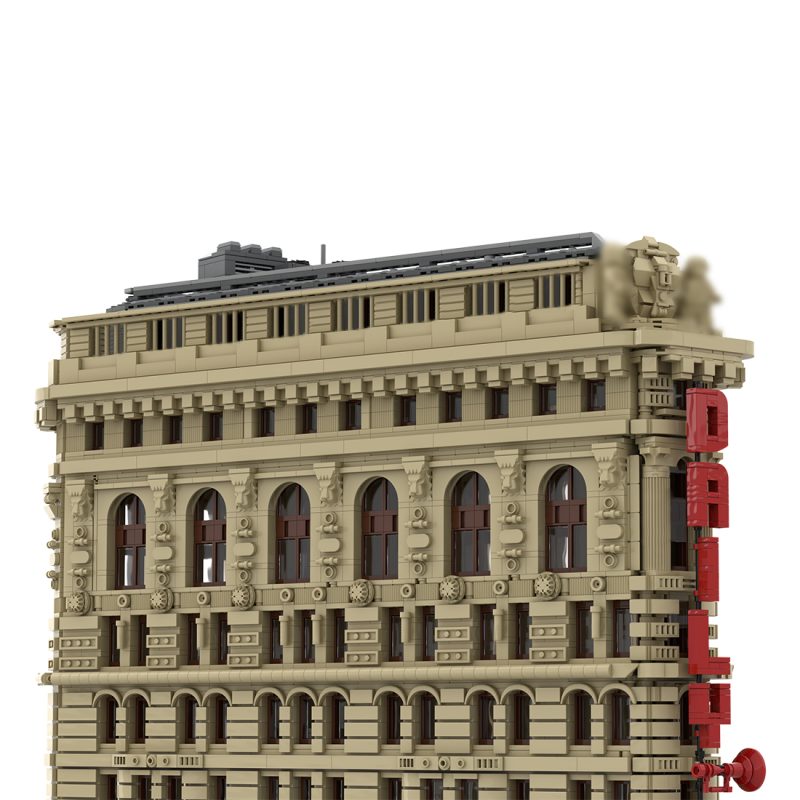
The cornice work at the roofline is particularly impressive. In the real building, Daniel Burnham's design features an elaborate projecting cornice that was actually removed in 1918 and is currently being reconstructed. Alpha.x.brix includes both the original cornice profile and the modernized crown, depending on which stage of the instructions you follow - a thoughtful nod to the building's evolving history. The ground-floor retail frontage, with its arched windows and heavier rustication, is distinct from the upper floors in a way that captures the real building's classical base-shaft-capital composition.
The prow itself deserves special attention because it is the single most challenging element to execute in brick form. The real Flatiron narrows to an angle of approximately 25 degrees at the intersection of Broadway and Fifth Avenue, creating a knife-edge that has fascinated architects and photographers for over a century. Alpha.x.brix resolves this by using a series of progressively narrower plate assemblies that step down to a remarkably thin profile without sacrificing structural integrity. From the front, the prow reads as a sharp vertical edge that catches light and shadow exactly as the real limestone facade does. From the sides, the two street-facing elevations spread outward with their own distinct window patterns and ornamental programs. Getting all three of these relationships correct simultaneously, at a scale where each is individually legible, is an engineering achievement that puts this MOC in genuinely rare company.
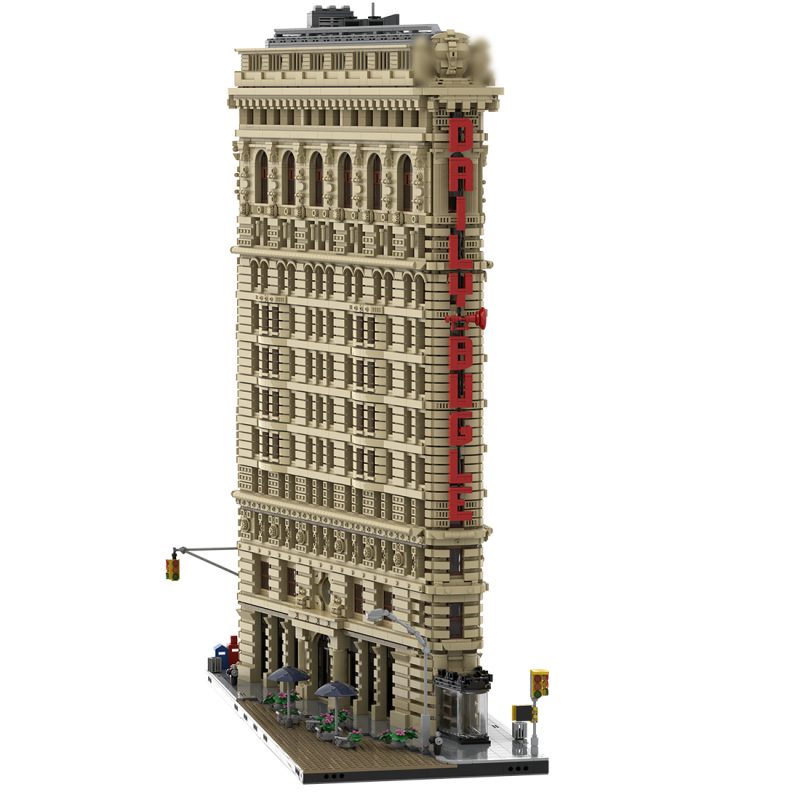
15,076 pieces is a parts count that rivals official LEGO's largest sets, and the sheer volume of tan, dark tan, and reddish-brown plates, bricks, and tiles makes this a goldmine for anyone who builds architecture MOCs. The modified bricks and SNOT elements used for the window detailing are plentiful and in colors that transfer directly to any classical building project. The Technic components used in the internal framework are standard cross-compatible elements that add structural pieces to your inventory.
Clutch power across the 15,000+ elements is consistent - connections feel secure without being impossible to separate if you need to correct a placement. At this piece count, even a small percentage of quality issues would be noticeable, and the build proceeds without any problematic elements. The 14 kg finished weight speaks to the density of the construction; this is not a hollow shell but a substantially built model with real internal structure.
The sorting and packaging of a 15,000-piece set is an operation in itself, and LetBricks handles it competently. The bags are organized by build section rather than randomly mixed, which is essential at this scale. Attempting to sort 15,000 pieces from a random assortment would add hours to the project before you even placed the first brick. The element variety within the tan and brown color families is also worth highlighting. You receive not just standard plates and bricks but a comprehensive selection of modified elements: 1x2 plates with rail, jumper plates, tiles in multiple lengths, corner plates, and bracket elements that enable the SNOT facade construction. This is a working parts library disguised as a building set, and that dual utility adds genuine long-term value to the investment.
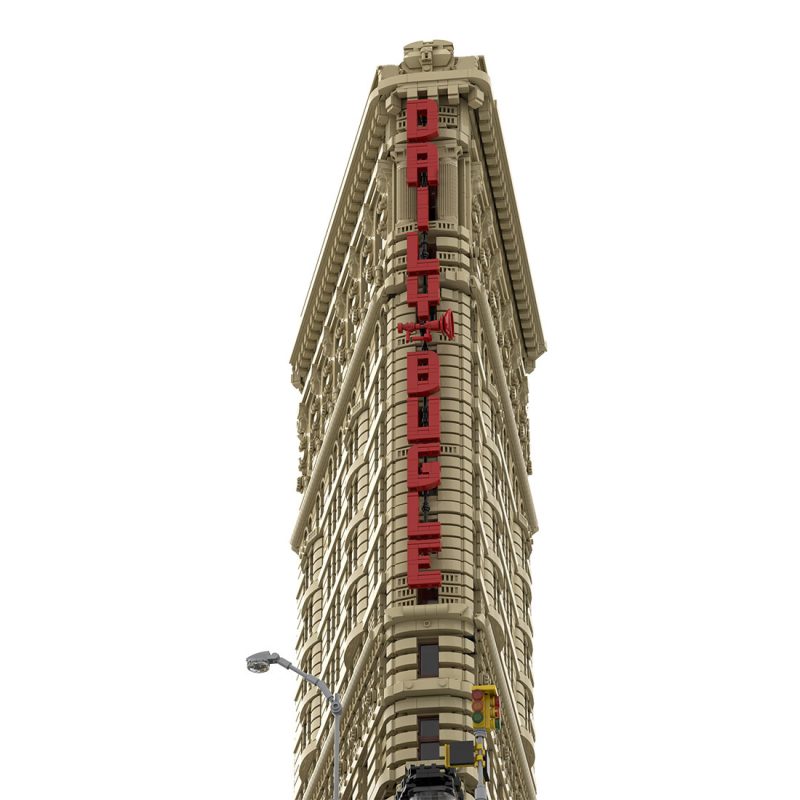
At 79.8 cm tall with a footprint of 64.2 x 40.6 cm, this model does not sit on a shelf - it demands its own pedestal. The Flatiron Building is one of the most recognizable silhouettes in architecture, and at this scale, the triangular form is immediately identifiable from across a room. The warm tan-and-brown color palette gives the model a sophisticated presence that works in any interior, from a home office to a living room bookcase (assuming you have one tall enough).
What sets this apart from smaller architecture models is the level of facade detail visible at normal viewing distance. Individual window frames, floor-by-floor cornice lines, and the textural difference between the rusticated base and the smoother upper stories all register without needing to lean in. Compare this to LEGO's own Architecture line, which achieves recognition through simplified silhouettes - the alpha.x.brix Flatiron achieves recognition through faithful detail reproduction at a scale where that detail is actually visible. It is the difference between a postcard and a photograph.
The model also responds to lighting in ways that smaller architecture sets cannot. Under directional light, the prow casts a sharp shadow that divides the two street-facing facades exactly as the real building does in the Manhattan afternoon sun. The recessed windows create rhythmic shadow patterns along each elevation that change throughout the day if the model is positioned near a window. The cornice projects enough to cast its own shadow line across the upper floor, adding depth that flat-printed facades on smaller models can never achieve. This is a model that is not merely displayed but inhabited by light, and that quality makes it feel less like a replica and more like a presence in the room.
A 15,076-piece architecture set represents a significant investment, and you should approach this as a collector's piece rather than a casual weekend build. The piece-per-dollar ratio is competitive with large-scale third-party architecture sets, and the sheer volume of reusable elements in architecture-friendly colors gives the set secondary value as a parts source. LEGO has never produced the Flatiron Building at any scale, making this the only option for brick-built representations of one of New York's most famous landmarks.
The uniqueness factor is substantial. This is not a set you will see on anyone else's shelf at your local building club. The licensed MOC design from alpha.x.brix carries the credibility of a recognized community designer, and the engineering required to make a 14 kg triangular structure stand securely is non-trivial. If you collect architecture models or have a particular connection to New York City, this delivers something no other manufacturer offers.
When evaluating value, it is also worth considering what the alternative would cost. Commissioning a custom 15,000-piece architecture MOC from a professional designer, sourcing the parts individually through BrickLink, and assembling without optimized instructions would easily cost multiples of the LetBricks price. The integrated package of a tested design, matched parts, and step-by-step instructions represents a significant convenience premium that is easy to overlook until you consider the alternative. For architecture collectors building a New York City skyline display alongside the World Trade Center or other Manhattan landmarks, the Flatiron fills a gap that would otherwise remain permanently empty.
The Flatiron Building is built for the architecture obsessive. Not the casual fan who picks up a LEGO Architecture skyline set as a desk ornament, but the builder who owns books about Daniel Burnham, who has photographed the real building from multiple angles, and who wants a model that honors the original rather than summarizing it. At 15,076 pieces and nearly 80 centimeters tall, this is a statement piece that demands serious commitment in both building time and display space, and it rewards that commitment with a level of architectural fidelity that smaller sets cannot approach.
It is also a strong choice for the experienced builder looking for a genuine challenge. If you have completed every LEGO Architecture set and want something that pushes your skills into unfamiliar territory, the triangular geometry of the Flatiron will force you to think differently about how bricks connect. The week-long build timeline makes it a project rather than a session, and the progressive complexity of the facade detailing as you climb the building ensures you are learning new techniques right through to the final cornice piece. For New York City enthusiasts, transplants, or anyone who has stood at the intersection of Broadway and Fifth Avenue and looked up, this is the definitive brick tribute to one of Manhattan's most photographed buildings.
- ✓ 15,076 pieces at nearly 80 cm tall - genuinely monumental display piece
- ✓ Faithful reproduction of the Flatiron's iconic triangular footprint
- ✓ Three distinct facade treatments matching the real building's elevations
- ✓ Beaux-Arts cornice and window detailing visible at room distance
- ✓ Licensed MOC by respected designer alpha.x.brix
- ✓ Massive parts haul in architecture-friendly tan and brown tones
- ✓ A building LEGO has never produced - completely unique
- ✗ At 14 kg, the finished model requires careful handling and strong shelving
- ✗ Multi-day build commitment not suited to casual builders
- ✗ The 79.8 cm height limits display options in standard bookcases
- ✗ No interior detail - the focus is entirely on exterior accuracy
- LetBricks - The Alternative MOC Site - Everything about LetBricks
- World Trade Center Review - Another LetBricks New York landmark
- Best Architecture Sets Ranked - Official LEGO architecture compared
- City Library with LED Lights Review - Another impressive LetBricks building with lighting
The interior lattice structure is where this set reveals its engineering DNA. Rather than hollow-shell construction (which would make the narrow point structurally questionable at this scale), LetBricks committed to a full internal framework that adds roughly 30% more pieces than the exterior alone would require. Most builders won't see this, it's inside. But it's the difference between a display piece and a set that can actually handle being built once and left on a shelf for years without twist or sag. That decision costs pieces and time. It's not flashy.
The real shock is the section count and modularity. Rather than one 15,076-piece monolith, the build separates into 12 distinct vertical segments that lock together after completion. This is brilliant for transport and for actually finishing the set in stages without your build table becoming a permanent installation. Few MOC designers at this scale think about the physics of assembly for human hands and human patience. LetBricks did.