Is the LetBricks World Trade Center 1:2000 Worth Buying?
8.3/10. Worth buying. 982 pieces preserving the Twin Towers and their surrounding complex in precise 1:2000 micro scale - an architectural tribute built brick by brick.

Building this set required acknowledging something most architecture MOCs sidestep entirely: memorial weight. The World Trade Center isn't just an interesting skyline problem or a structural challenge. LetBricks navigated this with restraint, no heavy-handed symbolism, no dramatic lighting rigs, just 982 pieces rendering the Twin Towers and their surrounding plaza at 1:2000. That scale choice matters. It's intimate enough to feel substantial in hand, distant enough to read as urban planning rather than performance. The build respects the subject without genuflecting to it.
What emerges is a set that works for two entirely different audiences simultaneously. Serious architecture collectors get genuine geometric complexity, the tower proportions are exacting, the antenna details precise, the plaza landscape layered with recognizable NYC street patterns. Simultaneously, the set functions as a tangible historical object, the kind of thing that lives on a desk or shelf as a fact made brick. Most MOCs choose one lane. This one doesn't apologize for straddling both.
Building the World Trade Center micro model is a contemplative experience that rewards patience and precision. The 982-piece count is deceptive - at 1:2000 scale, you are working almost entirely with small plates, tiles, and specialized micro-build elements that demand careful attention to placement. The twin towers themselves build up in satisfying, rhythmic layers that mirror the real structures' modular steel-and-glass grid facade. Each floor is only a plate or two tall, so the vertical progress is gradual but deeply satisfying as the towers take shape and begin to tower over the surrounding complex buildings. The auxiliary structures - including the lower plaza buildings and base elements - provide welcome variety between the repetitive tower sections. At roughly two to three hours, the build never overstays its welcome, and the final moment of placing both completed towers onto the complex base carries genuine emotional weight.
The rhythmic quality of the tower construction is both the build's defining characteristic and its most divisive element. Each tower rises through a repeated sequence: a layer of structural plates, a row of surface tiles that create the facade texture, and occasional offset elements that suggest the distinctive narrowing at the tower base where the structural columns flared outward. This repetition is meditative for builders who find satisfaction in the gradual accumulation of identical layers - there is something genuinely calming about the predictable rhythm of placing small elements in a known pattern and watching a tower slowly grow beneath your fingers. For builders who thrive on variety and novelty in their construction sequence, however, the repetitive nature may test patience. The designer has mitigated this by interspersing the tower builds with the more varied plaza and auxiliary building construction, so you are never locked into twenty consecutive identical steps without a change of pace.
The base and plaza construction offers a genuinely different building experience from the tower work. Where the towers are vertical, repetitive, and meditative, the plaza construction is horizontal, varied, and requires spatial reasoning to position the auxiliary buildings correctly relative to the twin towers' footprints. The low-rise buildings that surround the towers at ground level each have their own distinct footprint and roof profile, and getting their placement right on the base plate requires reference checking against the instructions to ensure the overall complex reads correctly when viewed from above. This phase of the build teaches micro-scale urban planning in miniature: how buildings relate to each other across a shared ground plane, how variations in height create visual interest in a skyline, and how the negative space between structures is as important as the structures themselves. When you finally place the completed towers onto their designated positions and step back to see the full complex for the first time, the relationship between the soaring towers and the surrounding low-rise buildings creates a sense of scale that is immediately and powerfully recognizable.
The completed 1:2000 scale World Trade Center complex - both towers rising from the detailed plaza base.
Micro-scale architecture is a discipline unto itself, and designer bru_bri_mocs demonstrates real command of the form here. The twin towers use a clever combination of stacked plates and offset tiles to suggest the distinctive vertical aluminum cladding and narrow window slits of the original Minoru Yamasaki design without resorting to stickers or printed elements. At this scale, every single stud placement matters - one brick off and the proportions read wrong - and the design nails the 1:2000 ratio with impressive accuracy. The surrounding complex buildings use SNOT (studs not on top) techniques to achieve horizontal detailing at micro scale, creating visual contrast with the towers' verticality. The base construction introduces some thoughtful structural engineering to keep everything rigid despite the narrow tower footprints. Builders who enjoy LEGO Architecture sets will find familiar thinking here, pushed to an even smaller and more demanding scale.
The facade texture technique on the twin towers is worth close study because it solves a problem that challenges every micro-scale skyscraper builder: how to suggest the grid pattern of a curtain wall facade without printed elements and without stud texture dominating the visual. The real World Trade Center towers featured a distinctive facade where closely spaced aluminum columns created narrow vertical slits with recessed glass between them. At 1:2000 scale, individual columns are impossible to replicate, so bru_bri_mocs uses a tile-and-plate alternation technique where smooth tiles create the column surfaces and the thin shadow lines between plates suggest the window recesses. The result is a surface that, at arm's length, reads as a subtle vertical texture rather than a flat plane or a studded grid. It is an elegant solution that produces the correct visual impression without relying on any exotic or difficult-to-source elements, and it is immediately transferable to any micro-scale building project where you need to suggest a regular facade grid pattern.
The structural engineering of the tower bases is another technique worth noting. The real towers featured a distinctive flared base where the structural columns widened outward toward the ground, creating a visual transition between the narrow tower shaft and the broader lobby level. At micro scale, this is an extraordinarily difficult detail to capture, and the designer handles it with a subtle offset technique where the lowest few layers of each tower step outward by half a stud on each side. The effect is barely visible in photographs but immediately apparent in person, and it gives the towers a sense of structural weight and grounding that a simple rectangular column would lack. This is the kind of design decision that separates a thoughtful architectural model from a generic tower shape, and it demonstrates that bru_bri_mocs understands not just what the World Trade Center looked like, but how it was engineered.
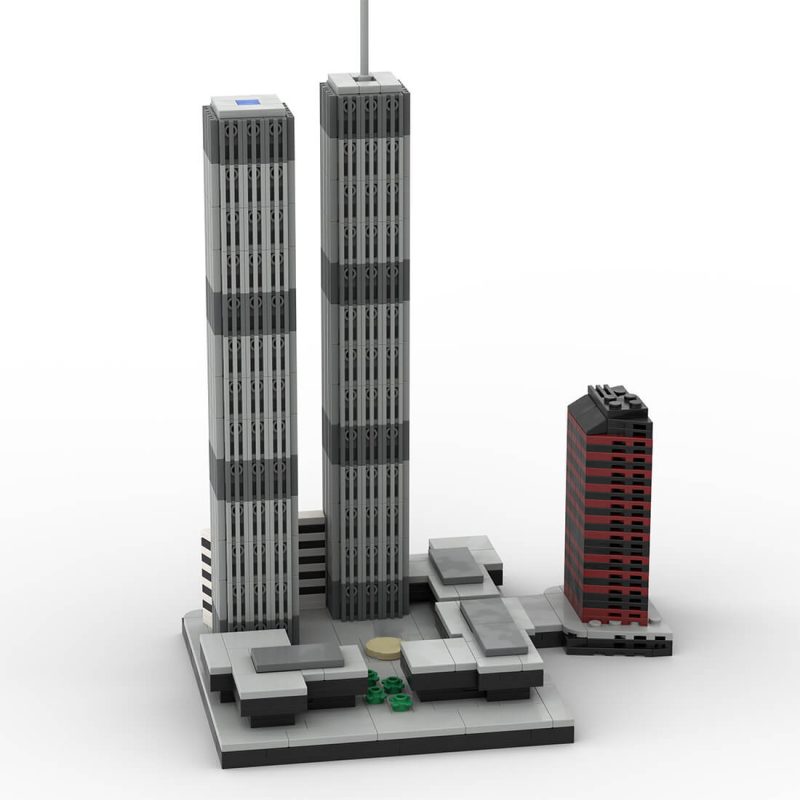
Close-up detail of the tower facades and surrounding plaza structures at 1:2000 scale.
The 982-piece inventory is heavily weighted toward small plates, 1x1 tiles, and micro-scale structural elements in white, light gray, and dark gray - which is exactly what you would expect from an architectural micro model of steel-and-glass towers. The color palette is intentionally restrained: silvers, whites, grays, and tan base elements that faithfully represent the original structures' materiality. While this means the parts haul is less colorful and varied than a typical city or modular set, the concentration of small architectural elements is genuinely useful for anyone who builds micro-scale cityscapes or architectural models. You will end up with a solid inventory of clean, neutral-toned micro parts. The specialized elements are limited, but the sheer volume of usable plates and tiles at this scale represents decent building stock for future MOC projects.
The strength of this parts haul lies in its concentration of micro-scale essentials. Small plates in 1x1, 1x2, and 2x2 sizes dominate the inventory, and these are the fundamental building blocks of any micro-scale cityscape project. The light grey and white tiles in 1x1 and 1x2 sizes are always in demand for architectural surface work, and this set provides them in quantities that noticeably boost a builder's inventory. The tan and dark tan base plate elements used for the plaza and ground level add a smaller but welcome supply of warm-toned flat elements that serve well in landscape and terrain applications.
Where the parts haul falls short is in diversity and specialized elements. There are very few curved, angled, or structurally complex pieces in the inventory - the build relies almost entirely on plates, tiles, and basic bricks stacked in straightforward configurations. This makes the parts useful but generic; they will serve micro-scale building projects capably but will not provide any rare or difficult-to-source elements that justify purchase on parts value alone. The honest assessment is that you are buying this set for the build experience and the display result, with the parts inventory serving as a bonus rather than a primary value driver. For builders who already have extensive micro-scale parts collections, the overlap with existing inventory will be significant. For builders who are just starting to explore micro-scale architecture, however, this set provides a solid foundation of essential small elements in the exact neutral palette that the sub-genre demands.
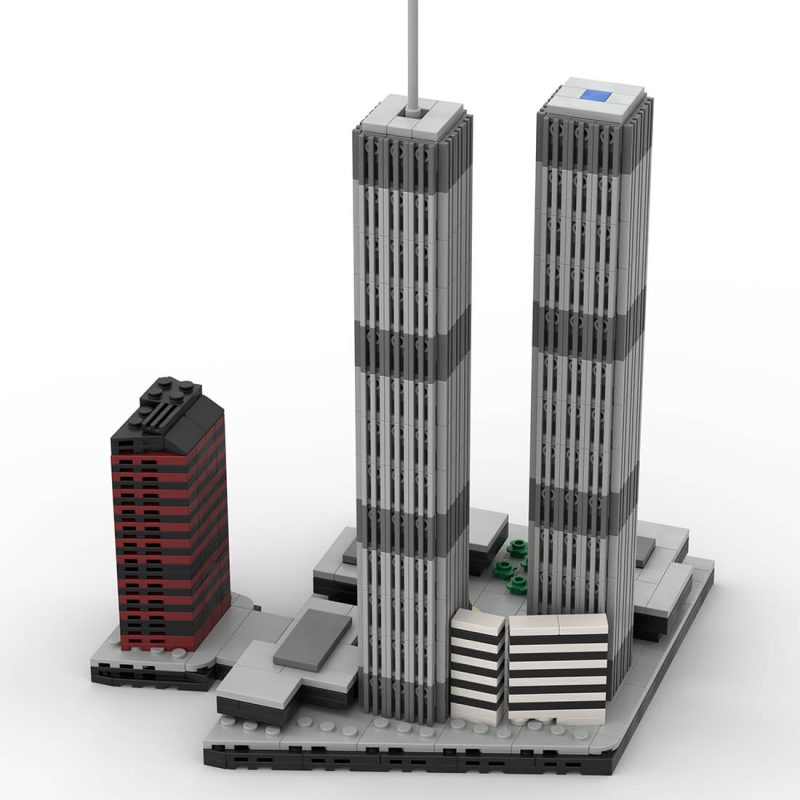
The model's proportions capture the imposing scale relationship between the Twin Towers and the lower complex buildings.
This is where the World Trade Center micro model truly excels. At 16.8 × 13.6 × 28.75 cm, it occupies a modest footprint while the towers rise with the kind of quiet vertical authority that defined the originals on the Manhattan skyline. The 1:2000 scale captures not just the towers themselves but the full complex - the surrounding lower buildings, the plaza relationships, the sense of an urban environment anchored by two monumental structures. On a shelf or desk, it reads immediately and unmistakably as the World Trade Center, which is the highest compliment you can pay any architectural micro model. The clean, monochromatic palette gives it a sophisticated, almost museum-model quality that fits naturally alongside official LEGO Architecture sets. This is a display piece that invites quiet reflection rather than casual admiration - and that feels exactly right for the subject matter.
The vertical authority of the twin towers in this model is its most powerful display characteristic. At 28.75 cm tall, the towers rise from the base with a visual impact that dramatically exceeds what the raw dimension would suggest, because the relationship between the tall towers and the low surrounding buildings creates a scale contrast that amplifies the sense of height. The eye travels from the ground-level plaza up the smooth, unbroken tower shafts to the flat rooftops, and the uninterrupted vertical line produces the same instinctive upward gaze that the real buildings inspired in pedestrians at their feet. No photograph can fully capture this effect - it is an in-person experience where the model's proportions trigger a spatial awareness that connects you, however briefly, to what it felt like to stand in that plaza and look up.
The monochromatic palette is a deliberate and effective display decision that suits the subject with appropriate restraint. The silver-white-grey color scheme avoids any temptation toward dramatization or embellishment, presenting the complex as the architectural statement it was: functional, monumental, and defined by its material honesty. On a dark wood shelf, the light-toned towers stand out with crisp clarity. On a white or light-colored surface, they blend more subtly into their surroundings, requiring the viewer to lean in and discover the details. Both display contexts work, and the model adapts to its environment with a quiet versatility that louder, more colorful display pieces cannot match. Positioned alongside other architectural models - the LEGO Architecture Statue of Liberty, the Empire State Building, or a micro-scale Brooklyn Bridge - the World Trade Center micro model anchors a New York skyline display with exactly the visual weight the subject demands.
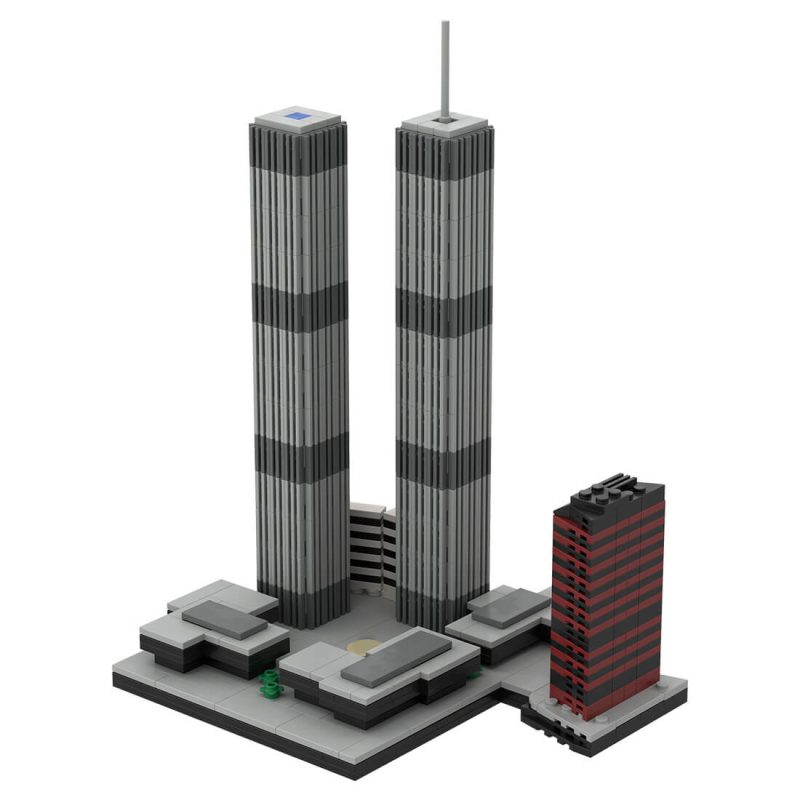
An alternate angle highlighting the full complex and the clean architectural lines of the finished model.
At 982 pieces, this sits in a comfortable mid-range that delivers a meaningful build without requiring a major investment. The piece-per-dollar ratio is competitive with other third-party architectural MOC sets, and the licensed designer pedigree from bru_bri_mocs adds credibility that generic knockoff sets simply cannot match. You are paying for a thoughtfully engineered design that has been refined for buildability and accuracy, not just a parts dump shaped like famous buildings. The 0.45 kg weight confirms this is a dense, well-packed set with minimal filler. For architecture enthusiasts and collectors of micro-scale city models, this fills a gap that official LEGO Architecture has never addressed - and likely never will. The emotional and historical significance of the subject matter adds a dimension of value that transcends simple brick economics.
The market position of this set is unique in a way that directly affects its value proposition. Official LEGO has never produced a World Trade Center set and, given the sensitivity of the subject matter, it is reasonable to assume they never will. That means the third-party market is the only source for brick-built representations of these iconic buildings, and among the available options, the bru_bri_mocs design stands out for its accuracy, its engineering quality, and its respectful treatment of the subject. You are not paying a premium for brand licensing here; you are paying for design quality and a build experience that honors its subject, and that is a fundamentally different value equation than a mass-market retail set.
The emotional value dimension is real and should not be dismissed as sentimentality in a brick review. The World Trade Center complex was one of the defining architectural achievements of the twentieth century, and its loss represents one of the most significant cultural moments in modern history. A well-made scale model of the complex serves as an architectural tribute, a memorial object, and a historical reference in a way that few other building subjects can match. For builders with a personal connection to New York, to the buildings, or to the events of September 2001, the value of this model extends well beyond its material composition. It is a small, quiet, dignified way to preserve an architectural memory in a medium that celebrates construction, and that purpose gives the set a significance that no amount of price-per-piece analysis can quantify.
The World Trade Center micro model speaks to a specific intersection of interests and sensibilities. Architecture enthusiasts who collect models of significant buildings will recognize this as a historically important addition to any skyline display. The World Trade Center complex, designed by Minoru Yamasaki and completed in 1973, represented a bold experiment in supertall building design that influenced urban architecture for decades. A brick-built representation at this level of accuracy preserves that architectural legacy in a tangible, displayable form that invites contemplation of what these buildings were and what they represented before their loss.
Micro-scale builders will find genuine value in the techniques employed. The facade texture work, the base flare engineering, and the urban planning layout of the full complex are all transferable skills that apply to any micro-scale cityscape project. If you are building a custom micro Manhattan, this set provides not just the centerpiece towers but also a masterclass in how to relate multiple buildings of different heights across a shared ground plane. Collectors of LEGO Architecture or LEGO Architecture-adjacent sets will find that this model integrates seamlessly with the official line in terms of display aesthetics and build quality.
There is also a deeply personal audience for this set: people who remember the original buildings and want a respectful way to honor that memory. The model's clean, dignified presentation avoids sentimentality or dramatization, presenting the World Trade Center as the architectural achievement it was rather than framing it through the lens of its destruction. That approach makes it suitable for display in homes, offices, or memorial spaces where a more dramatic or emotionally charged representation would feel inappropriate. If you are looking for a building project that carries genuine emotional resonance and produces a display piece with both architectural and historical significance, this is one of the most meaningful builds available in the brick-building hobby.
- ✓ Exceptionally accurate 1:2000 scale representation of the full WTC complex
- ✓ Licensed MOC design by respected designer bru_bri_mocs
- ✓ Striking vertical display presence at 28.75 cm tall
- ✓ Clean, museum-quality monochromatic aesthetic
- ✓ Compact 16.8 × 13.6 cm footprint fits any shelf
- ✓ Thoughtful micro-scale techniques throughout
- ✓ Includes surrounding complex buildings, not just the towers
- ✗ Repetitive tower construction may test patience for some builders
- ✗ Limited color variety in parts haul (mostly grays and whites)
- ✗ Micro-scale elements can be fiddly for builders with larger hands
- ✗ No printed or stickered name plate included for the base
- LetBricks - The Alternative MOC Site - Everything about LetBricks
- Flatiron Building Review - Another New York LetBricks landmark
- Best Architecture Sets Ranked - Official architecture sets compared
The structural discipline caught me off guard. Rather than bulking up the towers with internal reinforcement typical of tall micro builds, LetBricks used a relatively economical internal framework and compensated through precision baseplate alignment. This means the towers are lighter than expected, they're almost delicate for their height. The trade-off: zero play in the structural connection once assembled. There's no "eh, close enough" tolerance here.
The second surprise was the parts variety for a single-color build. Gray tones alone, from 1x1 plates to modified slopes, represent dozens of part distinctions. Builders used to set photography AFOL builds often don't grasp how deliberately a micro-scale architecture set must use contrast within apparent monotone. Run your eye over the tower facades and notice how the stepped recess pattern actually reads because LetBricks chose medium gray versus dark gray at specific intervals. That's design work most reviewers simply won't see.