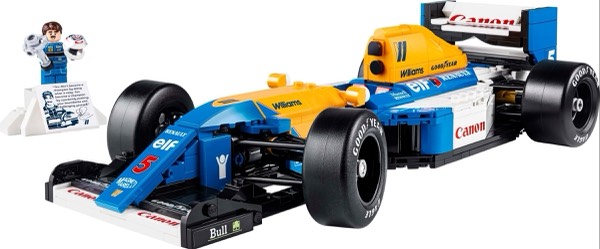
The Williams FW14B is one of the most important cars in Formula 1 history. It introduced active suspension to the grid in a way that worked so well the technology was subsequently banned. Nigel Mansell drove it to the 1992 World Championship in utterly dominant fashion, winning nine of the first ten races. LEGO has given this car the Icons treatment it deserves, and the build experience reflects the engineering ambition of the original machine.
At approximately 799 pieces, the build progresses through a logical sequence: structural chassis, internal detailing, bodywork panels, and finally the display stand. The chassis phase establishes the proportions of the car, and you can feel how different this era of F1 looks compared to modern machinery. The FW14B is narrower, taller, and more angular than today's ground-effect cars, and LEGO's designers have captured that silhouette faithfully.
The bodywork assembly phase is where the iconic Canon/Camel-era livery comes alive. The transition from bare structure to the blue, white, and yellow color scheme is one of the most rewarding progressions in any LEGO automotive build. Each panel placement adds another layer of identity until the car is unmistakably a Williams from the golden era. Expect a solid weekend of building time. Worth every minute.
There is a particular satisfaction in building a car that dominated its era so completely. The FW14B did not just win races - it made the competition look slow, and that engineering superiority is conveyed through the build's precision. Every panel fits with purpose. Every angle serves the overall silhouette. The sense of completeness when the final bodywork piece clicks into position and you step back to see the full car on its stand is among the most rewarding moments in any Icons build I have completed. Mansell would approve of the attention to detail.
The FW14B presents unique design challenges that LEGO has handled with real skill. The raised airbox behind the driver's head is a signature visual element of early-90s F1 cars, and the construction here uses a combination of stacked brackets and angled plates to achieve the correct profile. It is structurally sound and visually accurate.
The front wing construction is notable for how it handles the simpler, less complex aero of the 1992 era. Where modern F1 LEGO sets need to suggest multi-element wings with cascades and endplate slots, the FW14B's front wing is a cleaner, more elegant assembly. LEGO has resisted the temptation to over-detail it, and the result is an honest representation of the original car's aerodynamics.
The rear diffuser area and exhaust detailing use small Technic and plate elements to suggest mechanical complexity without overwhelming the System-brick construction. Printed elements cover the key identity markers: the Mansell helmet, the Williams logo, and the number 5. The combination of printed and structural techniques here is among the best in the Icons automotive range.
Builders who also own the Ferrari F2004 (#11375) will appreciate comparing the two sets' approaches. The F2004 is a wider, lower, more aerodynamically complex car, and the LEGO techniques reflect that. The FW14B is a more angular, mechanical build. Both are excellent. Together they tell the story of how F1 engineering evolved across a decade.
The sidepod construction deserves separate attention. The FW14B's sidepods housed the active suspension system's hydraulic hardware in the real car, and LEGO's designers have given these sections a density and solidity that contrasts with the more sculpted sidepods on modern F1 sets. The radiator intake openings are suggested through recessed dark elements within the blue bodywork, creating shadow lines that add visual depth without requiring specialized molded pieces. This approach - using depth and shadow rather than surface detail - is a technique lesson that applies broadly to any vehicle build where you want to suggest mechanical complexity within a clean exterior shell. The overall technique package makes the FW14B one of the more educational Icons builds, particularly for anyone interested in how LEGO's designers solve the problem of translating different automotive eras into a consistent brick-building language.
799 pieces with a distinctive color palette. The dark blue elements form the backbone of the parts spread, and builders working in blue will find a strong selection of plates, slopes, and tiles. The white upper-bodywork elements are versatile, and the yellow accent pieces (for the Camel livery details) add a color that does not appear in large quantities in many other sets.
The printed pieces are valuable collector items. A printed Mansell helmet with his distinctive mustache silhouette is the standout, but the Williams branding elements and number graphics are also cleanly executed. The display stand components follow the same design language as other Icons automotive sets, meaning they integrate well if you are building a multi-car display shelf.
For parts hackers, the most interesting elements are the blue curved slopes and the structural brackets used for the airbox. These are useful in a wide range of MOC applications, from spacecraft to architectural models. The yellow elements in particular are worth noting because of their relative scarcity in other current sets.
The dark blue concentration here is particularly welcome because it is a color that builders always need more of but rarely accumulate in quantity from a single set. Between the body panels, structural plates, and accent pieces, you come away with a meaningful dark blue inventory that would cost noticeably more to assemble piece by piece through aftermarket channels. The Technic and structural elements from the chassis are universally useful - axles, pins, connectors, and small beams that form the backbone of any vehicle MOC. Considered purely as a parts source, the FW14B competes favorably with any similarly priced set in the current Icons lineup, and the printed elements add collector value that holds up over time as exclusive Icons sets tend to appreciate on the secondary market.
The Williams FW14B is a stunning display piece. The Canon/Camel blue, white, and yellow livery is one of the most recognizable in motorsport history, and LEGO has nailed the color blocking. From across the room, the identity is instant. This is a Williams from the Mansell era, and no other car looks quite like it.
The proportions are faithful to the original. The FW14B sits higher and narrower than modern F1 cars, with a more pronounced cockpit opening and that distinctive raised airbox. LEGO has captured the stance correctly, and on the included display stand, the car presents with a slight elevation that shows off the floor and front wing detail. A printed nameplate identifies the car, driver, and the 1992 championship season.
Placed alongside the Ferrari F2004 (#11375), you get a visual timeline of F1 evolution. The FW14B's angular, mechanical aesthetic contrasts beautifully with the F2004's smoother, more aerodynamically refined lines. For fans building a historical F1 display, these two sets are essential companions. If you also have the Williams FW46 Speed Champions (#76921) on the shelf, you can trace the Williams story from Mansell's dominance to the modern grid. That kind of narrative display is what the Icons line does best.
Under changing light conditions, the FW14B reveals different aspects of its personality. In bright daylight, the blue, white, and yellow livery pops with the vibrancy of a race-day television broadcast - crisp, confident, and unmistakable. Under warm evening lighting, the dark blue deepens and the yellow accents take on a golden quality that gives the car a more timeless, museum-piece character. This responsiveness to ambient light is a sign of well-chosen colors and well-executed color blocking, and it means the car looks different enough across lighting conditions to maintain visual interest over months and years on the shelf. Few display sets reward this kind of sustained attention the way the FW14B does.
Like the Ferrari F2004, the Williams FW14B carries the Icons premium. And like the F2004, it justifies that premium through build quality, display impact, printed elements, and the emotional weight of the car it represents. The piece count delivers substantial build time, the printed details avoid the sticker fatigue that plagues lesser sets, and the display stand is a genuine presentation piece rather than an afterthought.
For Williams fans specifically, this set fills a hole that has existed in the LEGO lineup for years. There has never been a large-scale Williams F1 model until now, and LEGO chose arguably the most important Williams ever built as their entry point. The 1992 season was a masterclass, and this model captures that legacy in a way that feels respectful and complete.
If you are choosing between the Ferrari F2004 and this Williams, the honest answer is: both. They complement each other perfectly. But if the budget demands a choice, your heart knows which team you belong to. Follow it. And if you want Williams representation at every LEGO scale, pair this Icons masterpiece with the Speed Champions FW46 (#77249) and the City-scale Williams from the two-pack (#60464). Three eras of Williams, three scales, one shelf.
The investment value is also worth considering. Icons automotive sets have a strong track record of holding and appreciating in value after retirement, particularly when they represent historically significant cars with passionate fan bases. The FW14B checks every box - a championship-winning car, a legendary driver, an iconic livery, and a first-ever large-scale Williams in LEGO form. Whether you are building to display, building to invest, or simply building because you remember watching Mansell at Silverstone, this set delivers on every level. The price-per-piece is reasonable for the Icons line, and the emotional return on investment is immeasurable.
The set includes a Nigel Mansell minifigure that ranks among the most characterful driver figures LEGO has produced. The torso printing features the Williams Racing suit in the Canon/Camel livery colors of the 1992 season - blue, white, and yellow in the distinctive pattern that defined the FW14B era. The leg printing continues the racing suit with sponsor details and the blue-to-white color blocking. The overall print quality reflects the Icons standard: crisp, detailed, and accurate to the period.
The defining detail is the face print. Mansell's iconic mustache is present and unmistakable, immediately identifying the figure as Il Leone to any F1 fan. The helmet is printed with Mansell's signature red, white, and blue design - one of the most recognizable helmet liveries in F1 history. The decision to print rather than sticker the helmet elevates the collectibility significantly. An alternate hair piece is included for helmetless display, revealing the mustache in full glory. This minifigure is exclusive to the FW14B set and represents a genuine piece of F1 memorabilia in LEGO form. Displayed alongside the Schumacher figure from the F2004, you have two of the sport's greatest champions in minifigure form - a pairing that any F1 fan's shelf demands.
The Williams FW14B is for the F1 fan who understands that the sport's history is as compelling as its present. If the name Nigel Mansell means something to you - if you remember the mustache, the British flag, the Silverstone crowd - this set was built with your memories in mind. It is for the collector who has been waiting for LEGO to acknowledge Williams' place in F1 history with an Icons-scale tribute, and the wait has been worth it.
It is equally compelling for the automotive build enthusiast who wants to study how LEGO translates different F1 eras into brick form. Paired with the F2004, the FW14B creates an educational comparison that illustrates a decade of aerodynamic evolution. For younger builders being introduced to F1 history by parents or grandparents who watched the 1992 season live, this set serves as both a building project and a history lesson - a tangible connection to a sporting era that predates their memory but not their curiosity.
And it is for the display-focused builder who wants a visually distinctive addition to their Icons automotive shelf. The Canon/Camel livery is unlike anything else in the LEGO range - bold, colorful, and immediately recognizable. On a shelf of modern F1 machinery, the FW14B stands apart as a reminder that the sport's visual identity was once even more vibrant than it is today. If any of these descriptions sound like you, stop deliberating and order the car. Mansell never hesitated on the starting grid, and neither should you.
- ✓ Canon/Camel livery is perfectly captured in blue, white, and yellow
- ✓ Printed Mansell helmet and key branding elements
- ✓ Angular 1992-era proportions are faithfully reproduced
- ✓ Display stand with printed nameplate for museum-quality presentation
- ✓ Complements the Ferrari F2004 for a historical F1 shelf
- ✗ Some secondary sponsor details use stickers
- ✗ Active suspension is referenced but not mechanically functional
- ✗ Premium price point - this is a commitment purchase
Some products may be provided by manufacturers. This page contains affiliate links. All opinions are my own.
- Best LEGO F1 Sets Ranked - Where every F1 set stacks up in our ranking
- Ferrari F2004 Schumacher Review - The other Icons-scale F1 masterpiece
- Williams FW46 Review - The modern Williams in Speed Champions form
Track it in your vault on GameSetBrick - our free collection app. Log your condition, price paid, and watch the real-time market value.
Track in Your Vault →Save it to your wishlist on GameSetBrick. Share your list with friends and family - every set has a buy button so gift givers know exactly where to go.
Add to Wishlist → GameSetBrick is a free app by The Earl of Bricks. See all features. Scan it. Track it. Trade it.