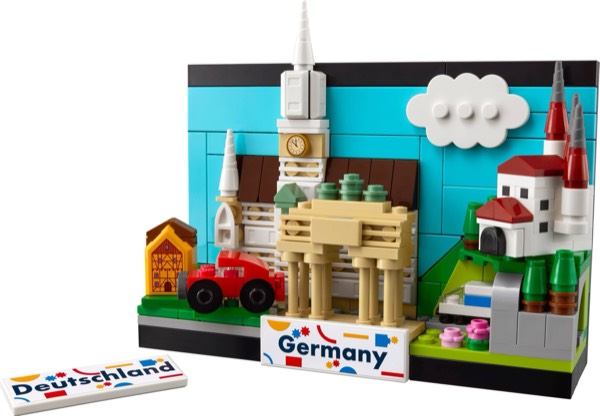
The LEGO Postcard series has quietly become one of the most charming product lines in the entire catalogue, and the Germany Postcard continues that tradition with a build that is compact, clever, and surprisingly satisfying for its modest piece count. At 240 pieces, this is a quick build - forty-five minutes to an hour at a relaxed pace - but the density of detail packed into that small frame means you are rarely just stacking basic bricks. Every few steps introduce a new microscale landmark or detail element that requires a different approach, keeping the build engaging throughout its brief duration.
The build starts with the postcard frame and background, establishing the three-dimensional display format that defines the series. Once the frame is in place, you begin populating it with Germany's greatest hits: the Munich New Town Hall with its ornate Gothic facade, the Brandenburg Gate with its columned silhouette, a fairytale castle perched on a hillside, and a high-speed ICE train streaking across the foreground. Each landmark is a micro-build in itself, requiring just a handful of pieces to capture the essence of structures that span hundreds of metres in real life. That compression is where the fun lives.
The final touches include a small red car on the road and a choice of stickers reading either "Germany" or "Deutschland" - a nice bilingual touch that lets you personalize the postcard for your display or for a gift recipient. The build wraps up quickly and leaves you with a clean, contained display piece that feels complete without overstaying its welcome. For builders who enjoy the microscale building approach, this postcard is a concentrated dose of everything that makes small-scale construction satisfying.
Microscale building is an art form, and the Postcard series is one of LEGO's best showcases for it. The Germany Postcard asks you to represent the Brandenburg Gate's twelve columns and quadriga sculpture using perhaps fifteen pieces total. The Munich New Town Hall's intricate Gothic spires are suggested through a careful stack of small plates and slopes that capture the building's vertical ambition without attempting to replicate its actual complexity. These are exercises in suggestion and abstraction - using the minimum number of pieces to trigger recognition of a real-world structure.
The most instructive technique in the set is the layered depth construction. The postcard is not flat - it builds forward from a back plate through multiple planes, with background elements sitting behind foreground structures to create a genuine sense of depth within a frame that is only about four centimetres deep. This layering technique is directly applicable to any MOC builder working on dioramas, shadow boxes, or display vignettes. Understanding how to create depth through staggered planes is a fundamental skill, and this small set teaches it effectively.
The castle element demonstrates how to suggest complex architecture through silhouette alone. A few well-chosen pieces in light grey and dark grey create a recognizable castle shape that works because your brain fills in the details that the bricks omit. The ICE train in the foreground uses a similar economy - a sleek white shape with a red accent that reads as "high-speed train" without needing to replicate any specific mechanical detail. For anyone interested in microscale technique, studying how these landmarks are distilled to their essential visual elements is more valuable than it might initially appear. Our microscale building guide goes deeper into these principles.
At 240 pieces, this is a small set, and the parts inventory reflects that. The colour palette is driven by the German flag colours - black, red, and gold appear throughout - along with white and grey elements for the architectural landmarks and green pieces for the landscaping details. You get a solid selection of small plates, tiles, and slopes in these colours, all in the 1x1 to 2x4 size range that microscale building demands. For builders who work at small scales, these tiny elements are more useful than they might appear to someone accustomed to larger builds.
The most interesting pieces are the specialty elements used for architectural details: small arch pieces, microscale window elements, and tiny slope pieces that suggest rooflines and spires. These are the kinds of pieces that accumulate slowly in a parts collection but prove invaluable when you need them for a microscale MOC. The sticker sheet includes the Germany/Deutschland text options along with a few decorative elements for the postcard border.
There are no minifigures in this set, which is expected for the Postcard format but worth noting for buyers who prioritize figures in their purchases. The overall parts haul is modest in quantity but focused in utility - if you build at microscale, nearly every piece in this set is immediately useful. If you primarily build at standard minifigure scale, the small elements are less directly applicable but still contribute to a well-stocked parts collection. This is a set where the parts value is proportional to your interest in microscale building.
The Postcard series format is inherently display-friendly: a self-contained frame that can stand upright on a shelf or desk with a minimal footprint. The Germany Postcard measures approximately 11 centimetres tall by 14 centimetres wide by 4 centimetres deep - compact enough to fit literally anywhere you have a few inches of shelf space. The frame creates visual boundaries that make the display feel intentional and complete, like a framed photograph rather than a loose model sitting on a surface.
The layered depth effect gives the postcard a dimensionality that photographs do not fully capture. Viewed from the front, the landmarks arrange themselves in receding planes that create a convincing miniature panorama of German highlights. The colour palette is warm and inviting - the gold and red elements catch light nicely, and the grey architectural elements provide structural contrast. It is a display piece that rewards close inspection while also reading clearly from across a room.
Where the Germany Postcard really shines is as part of a collection. Displayed alongside the New York, London, Japan, and Italy postcards, the set becomes part of a world tour in brick that is genuinely impressive as a grouped display. The consistent frame format means the postcards line up perfectly on a shelf, creating a gallery wall effect that is greater than the sum of its parts. If you have been collecting the Postcard series, Germany is an essential addition. If you have not started yet, this is as good an entry point as any - and fair warning, once you build one, you will want them all.
At $14.99 for 240 pieces, the price-per-piece is approximately 6.2 cents - which is excellent by any standard and outstanding for a themed display set. The Postcard series consistently delivers strong value, and the Germany edition is no exception. Under fifteen dollars for a complete, self-framing display piece with multiple recognizable landmarks is the kind of pricing that makes impulse purchases feel responsible. You could buy all five currently available postcards for less than the price of many single large sets.
The value calculation is further strengthened by the set's gift potential. At this price point, the Germany Postcard works as a souvenir, a stocking stuffer, a desk gift for a colleague, or a small token for any Germany enthusiast or travel lover in your life. The build is accessible to ages nine and up, making it viable for a wide range of recipients. The completed display is charming enough to keep permanently rather than disassemble, which means the value extends well beyond the build session itself.
Compared to other display options in the under-twenty-dollar range, the Germany Postcard holds up remarkably well. You are getting a purpose-built display piece with genuine visual appeal, a satisfying if brief build experience, and the option to integrate it into a broader Postcard collection. For the price of a modest lunch, you get a build that teaches microscale techniques and produces a display piece that will live on your shelf indefinitely. That is excellent value by any reasonable measure.
The box contains 240 pieces in a couple of small bags, a sticker sheet with the choice of "Germany" or "Deutschland" text along with decorative border elements, and an instruction booklet with brief notes on each represented landmark. The landmarks depicted include the Munich New Town Hall, the Brandenburg Gate, a hilltop castle, a high-speed ICE train, and a small red car. No minifigures are included.
The set builds into a self-standing 3D postcard display measuring approximately 11 centimetres tall by 14 centimetres wide by 4 centimetres deep. The frame and background build first, followed by the layered landmark elements that create the three-dimensional scene. Everything needed for display is included - no stand or mounting hardware required.
The Germany Postcard is for Postcard series collectors who want to fill the Central European slot in their growing shelf display. If you already own the New York, London, Japan, or Italy postcards, Germany is the next logical addition, and it fits seamlessly into the visual lineup that the consistent frame format creates. The gallery wall effect of multiple postcards displayed in a row is genuinely impressive, and Germany adds warm tones and distinctive landmarks that complement the existing entries. Each new postcard makes the collection as a whole more interesting.
For gift-givers, the Germany Postcard occupies an unusually sweet spot. At under fifteen dollars, it works as a thoughtful souvenir for someone who has visited Germany, a stocking stuffer for a LEGO-curious friend, a desk gift for a colleague, or a small token for any travel enthusiast. The build is accessible to ages nine and up, the result is charming and display-worthy, and the bilingual Germany/Deutschland text option adds a personalization touch that most gifts at this price point cannot match. If you need a gift that is thoughtful, affordable, and genuinely appreciated, the Postcard series consistently delivers.
For builders interested in microscale technique, the Germany Postcard provides a concentrated exercise in miniature landmark representation and layered depth construction. The techniques are simple enough to complete in under an hour but instructive enough to inform future microscale projects. If you have ever wanted to try microscale building but felt intimidated by larger architecture sets, the Postcard format provides a low-commitment, high-reward introduction. And at this price, there is essentially no risk in discovering whether microscale building appeals to your sensibilities.
- ✓ Outstanding value at under fifteen dollars
- ✓ Five recognizable German landmarks in microscale
- ✓ Self-framing display format with genuine depth effect
- ✓ Bilingual Germany/Deutschland sticker option
- ✓ Perfect companion to other Postcard series sets
- ✓ Excellent gift potential for travel and LEGO fans alike
- ✗ Stickers rather than printed elements for text
- ✗ Very short build time may leave you wanting more
- ✗ No minifigures included
- ✗ Limited parts variety for non-microscale builders
Some products may be provided by manufacturers. This page contains affiliate links.
- New York Postcard Review - The Big Apple in microscale brick form
- London Postcard Review - Big Ben, Tower Bridge, and more in a compact frame
- Japan Postcard Review - Cherry blossoms and temples in miniature
- Italy Postcard Review - The Colosseum and Vespa in pocket-sized brick
- Microscale LEGO Building Guide - Master the art of building small
Track it in your vault on GameSetBrick - our free collection app. Log your condition, price paid, and watch the real-time market value.
Track in Your Vault →Save it to your wishlist on GameSetBrick. Share your list with friends and family - every set has a buy button so gift givers know exactly where to go.
Add to Wishlist → GameSetBrick is a free app by The Earl of Bricks. See all features. Scan it. Track it. Trade it.