Is the LEGO Dodge Viper GTS-R Sports Car Worth Buying?
7.4/10. Worth buying. A V10 with moving pistons, a working differential, and opening doors and hood at 805 pieces. The Le Mans class-winning Viper, engineered as a mid-size Technic build.

There are supercars that got famous for lap times and there are supercars that got famous for being a bit unhinged, and the Viper has always lived firmly in the second camp. A colossal V10, no traction control worth the name for years, and a shape that looks like it wants to bite you. So when Technic reaches for the GT racing version of it, the Viper GTS-R, my worry is always the same: does the model capture the menace, or does it just capture the outline? This one leans into the mechanics, and for a Viper that feels like exactly the right instinct.
At 805 pieces this is a mid-size Technic car rather than one of the big flagship monsters, and I want to be clear about that up front because it shapes everything below. It is not trying to be a 3,000-piece hero model with paddle-shift gearboxes. It is trying to give you a moving V10, a working differential, opening doors and hood, and a shape you recognise from across the room. On those terms it largely delivers, and it does it at a build length that a lot of people will actually finish in an evening.
The Viper builds the way a good mid-size Technic car should: chassis first, then the running gear, then the bodywork panels that give it its shape. The early stages are the most rewarding for anyone who likes to see the mechanics take form, because the engine and drivetrain go in before the body hides them, and there is a genuine satisfaction in watching a recognisable powertrain appear on the bench.
The centrepiece function is the V10 engine with moving pistons, driven off the rear wheels as you roll the car along. It is the standard Technic party trick, but it is a good one, and on a car defined by its ten-cylinder heart it is the single most appropriate feature LEGO could have chosen to include. Seeing the pistons rise and fall through the open hood is the moment the model stops being a static shape and starts feeling like a car.
Underneath, a working differential sends drive to the rear axle, the kind of honest mechanical detail that separates Technic from a shell built for looks. It is not a complicated gearbox, but it is real engineering doing real work, and for a builder aged ten and up it is a clean, legible introduction to how a car actually puts power down.
The bodywork is where patience pays off. The Viper's long hood, short deck and muscular haunches are built up from panels that need correct orientation to hold that unmistakable silhouette, and the opening doors and hood add a layer of finish that rewards careful assembly. Budget somewhere around two hours for the full build. It never drags, and because the mechanics land early, the pace stays engaging throughout.
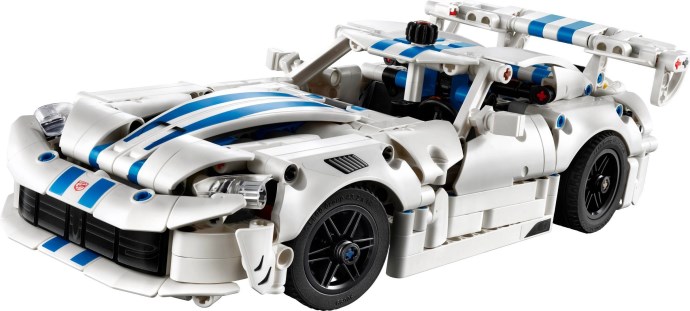
Finished, the Viper measures roughly 30 cm long, 13 cm wide and 8 cm tall, which puts it at a genuinely displayable size without demanding a shelf of its own. That long-hood, cab-back proportion is the whole point of a Viper, and the model gets the stance right, low and wide with the mass pushed toward the rear where the big engine sits.
The GT racing character comes through in the details: the eye-catching rear spoiler that defined the GTS-R on circuit, the aggressive front end, and the purposeful, planted profile. This is not a delicate car and the model does not pretend otherwise. It reads as a Viper from across the room, which for a licensed Technic build is the core job done.
The Technic aesthetic means you get visible mechanical honesty rather than a smooth die-cast finish, and on this car that works in its favour. The exposed structure and the moving V10 under the opening hood give it a display story a sealed model cannot match: you can pose it hood-up to show the engine, doors-open for the pit-lane look, or buttoned down for the clean silhouette.
Photographed from a low three-quarter front angle, with the long hood leading and the spoiler in shot, the Viper carries real presence. It is a car that looks fast standing still, and the model preserves enough of that attitude to earn its place on a Technic shelf.
At 805 pieces this is a solid mid-size Technic haul, and the parts mix leans toward the functional: gears, axles, connectors, panels and the differential components that make the drivetrain work. For a builder growing a Technic parts bin, these are useful, reusable elements rather than set-specific printed pieces with nowhere else to go, which is a quiet point in the set's favour.
The V10 and differential assemblies are instructive references in their own right for anyone learning to build working powertrains, and the body panels in the Viper's colour scheme give you sculpting parts for other low, wide sports car creations. It is not a parts-pack bargain, but nothing here feels wasted.
There is also a modern wrinkle: the set includes instructions to unlock a special LEGO Technic livery in the Forza Horizon 6 video game, though you need a copy of the game to use it. It is a nice bonus for the racing-game crowd and a genuine bit of added value if you already play, but I would not weigh it heavily if you do not. The Viper's real appeal is the build and the badge. Whether a car like this holds interest over time comes down to the strength of the nameplate, a theme our LEGO Investing 101 guide digs into.
The Dodge Viper GTS-R was the racing version of the road-going Viper GTS coupe, developed by Chrysler in partnership with the French squad Oreca and refined into one of the definitive GT racers of the late 1990s. Where the road car was a brutish, 8.0-litre V10 grand tourer, the GTS-R turned that same big-cube character into a genuine circuit weapon, and it did so with remarkable speed.
The results tell the story. The Viper GTS-R took the FIA GT2 championship in 1997, Team Oreca winning the majority of the season's races, then went to Le Mans and delivered. It scored class victories at the 24 Hours of Le Mans in 1998, 1999 and 2000, dominating the GT2/GTS category three years running against serious opposition. Across the FIA GT Championship the Vipers were near-unbeatable in their class through the back half of the decade.
That is what makes the GTS-R the right Viper to immortalise in a racing model. Plenty of people remember the road Viper for its raw, slightly frightening reputation, but the GTS-R is the one that turned all that noise into trophies, class wins at the greatest endurance race on earth among them. It is a homologation-era hero that earned its legend the hard way, on the circuit, and a fitting subject for a Technic build built around a moving V10.
Viper fans and American performance-car enthusiasts are the obvious core audience. If the V10 and the GTS-R's Le Mans record mean something to you, this is an easy pick, a licensed tribute to a genuine GT racing icon at a size that displays well without dominating the room.
It is also a strong fit for a builder who wants working Technic mechanics without committing to a flagship-scale project. The moving V10, the differential and the opening panels deliver the essential Technic experience in an evening-length build, which makes it a friendly step up for a newer Technic builder or a rewarding quick hit for a seasoned one.
Racing-game players get an extra hook in the Forza Horizon 6 livery unlock, bridging the physical build and the digital garage. And for anyone assembling a Technic car shelf, the Viper adds a distinctly American, muscle-bound voice to a lineup that often skews toward European supercars.
The Viper's natural stablemate is the Fast and Furious Dodge Charger R/T (42231), giving you an all-Dodge Technic pairing that spans a muscle-car icon and a Le Mans-winning GT racer, two very different sides of the same American performance story.
Set against a European supercar like the Lamborghini Revuelto (42214), the Viper makes a pointed contrast: big-cube V10 brute force next to precision Italian exotica. It is the kind of shelf conversation that shows off how differently two cultures chase the same goal.
For a dedicated racing display, the Viper sits happily alongside a classic endurance hero like the Ford GT40 Mk II (42223), pairing two American cars that went to the world's biggest circuits and came home with silverware.
Pros
- Moving V10 engine is the perfect signature function for a Viper
- Working differential delivers honest Technic mechanics
- Opening doors and hood add real display flexibility
- Recognisable long-hood Viper silhouette at a displayable 30 cm
- Celebrates a genuine Le Mans class-winning GT racer
- Forza Horizon 6 livery unlock is a fun bonus for gamers
Cons
- Mid-size scale, not a flagship-tier Technic hero model
- No advanced gearbox or steering headline function
- Forza unlock needs a copy of the game to use
- Body panels need careful orientation to hold the shape
The Dodge Viper GTS-R is a well-judged mid-size Technic car that spends its 805 pieces exactly where a Viper deserves them: a moving V10, a working differential, and a recognisable silhouette with opening doors and hood. It does not reach for flagship complexity, and it is better for knowing what it is, an evening-length build that captures the menace of one of the great GT racers.
It earns EARL APPROVED status on the strength of that focus. The engine function is the right one, the differential gives it mechanical honesty, and the subject matter, a car with class wins at Le Mans in 1998, 1999 and 2000, gives the whole thing a story worth displaying. It is held just short of the higher tiers by its mid-size scale and the absence of a marquee gearbox or steering function.
Available now, and an easy recommendation for Viper fans, American performance enthusiasts, and any Technic builder who wants a working V10 on the shelf without clearing a weekend to build it. The GTS-R turned V10 noise into trophies, and this model remembers exactly why that mattered.
- Fast and Furious Dodge Charger R/T Review - The Viper's all-Dodge Technic stablemate
- Lamborghini Revuelto Review - European exotica as a counterpoint to the V10 brute
- Technic F1: McLaren vs Ferrari vs Red Bull - How Technic handles serious racing machinery
- LEGO Investing 101 - Why sets tied to genuine racing legends tend to age well
Track it in your vault on GameSetBrick - our free collection app. Log your condition, price paid, and watch the real-time market value.
Track in Your Vault →Save it to your wishlist on GameSetBrick. Share your list with friends and family - every set has a buy button so gift givers know exactly where to go.
Add to Wishlist → GameSetBrick is a free app by The Earl of Bricks. See all features. Scan it. Track it. Trade it.