Is the LEGO KIT Worth Buying?
7.1/10. Worth buying. A posable cat-riding mech with a spinning motorcycle wheel and a Power Claw Pickaxe. Big character in a compact build.

Character-figure sets are a strange category for me to review, because they live somewhere between the buildable-figure lineage LEGO has been refining since the BrickHeadz era and the fully posable action-figure builds that have gotten genuinely sophisticated over the past few years. KIT sits closer to the latter camp, and I went in curious whether a single-minifig set at over a thousand pieces could justify its own weight in engineering rather than just sheer part count.
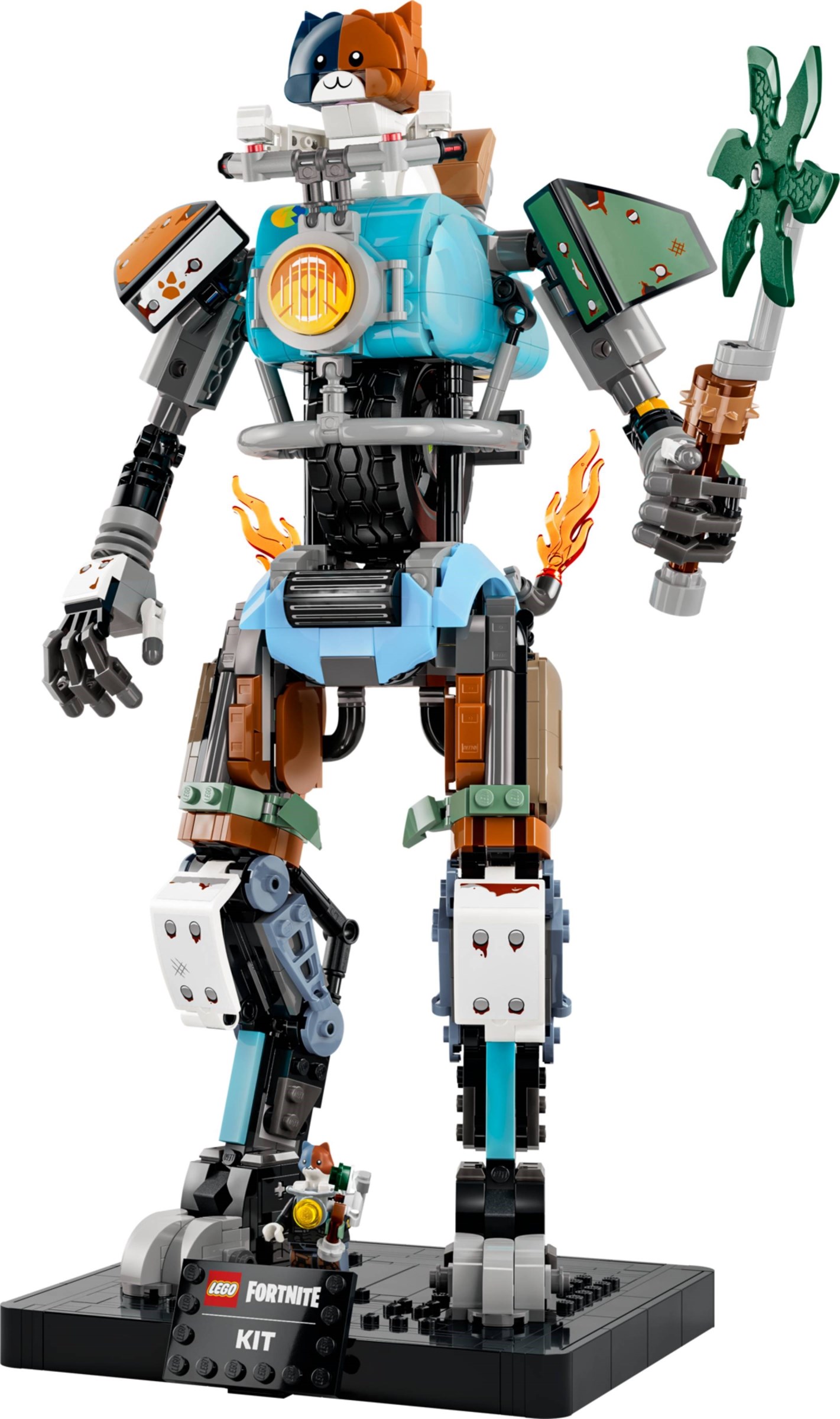
It mostly does. The motorcycle mechanism tucked into the base of this mech, where a crank on the back rotates through internal gearing to spin the front wheel, is a small but satisfying piece of engineering that elevates this above a static statue. It will not blow away anyone who has built a full-scale Technic vehicle, but for a display-figure set, it is a thoughtful inclusion that says the designers were not content to just stack panels around a minifigure and call it done.
KIT comes in at 1,230 pieces, and the build divides cleanly into three phases: the motorcycle base, the mech torso and leg assembly, and the arm and weapon detailing. The motorcycle base is the most mechanically interesting section, using an internal gear train that connects an external crank to the front wheel so it spins freely once assembled. It is a small mechanism, but it is the kind of detail that separates a considered character build from a pile of decorative panels.
The torso and leg construction relies heavily on ball-joint and click-hinge connections, which is standard practice for posable LEGO figures but still satisfying to build when the proportions come together correctly. The shoulder and hip joints in particular use a layered construction that gives the finished mech a wide range of articulated poses without the joints feeling loose or floppy, a common failure point in lesser posable builds.
Where the build simplifies is in the surface detailing. Large panel sections of the mech's body are built from flat plates and tiles rather than more complex greebled surfaces, which keeps the piece count from ballooning but also means some sections assemble quickly without much technical variety. This is a reasonable trade-off for a set at this price and scale, but builders expecting Technic-level complexity throughout should recalibrate expectations.
The included KIT minifigure, essentially a small cat character who "drives" the mech from within, is a nice narrative touch that ties the build together. Removing the minifigure and mech separately, then reassembling them, is part of the intended play pattern, and the connection points are engineered to make that swap quick and satisfying rather than fiddly.
Total build time lands around three to four hours for most builders, making this a solid single-session project. Instructions run through the LEGO Builder app.
Finished, KIT measures roughly 28 x 43 x 9 cm, a compact but tall footprint that works well as a standalone shelf piece rather than a centerpiece requiring dedicated real estate. The proportions read clearly as a stylized mech figure straddling a motorcycle, with enough silhouette clarity that it reads well even at a glance from across a room.
The posability is the real display strength here. Unlike a static licensed statue, KIT can be arranged in a genuinely wide range of dynamic poses, crouched over the bike, standing with the Power Claw Pickaxe raised, or leaning into a turn. For anyone who enjoys rearranging their display shelf periodically, that flexibility adds ongoing value that a fixed-pose set cannot match.
The color palette leans into dark purples, blacks, and cyan accents that match the broader Fortnite aesthetic without being garish. It photographs well under warm shelf lighting, and the cyan highlights on the mech's joints and visor catch light in a way that gives the model some visual pop without relying on stickers or printed panels for the effect.
At 1,230 pieces built around a single minifigure and mech assembly, this set carries a real licensing premium, and the value case depends heavily on how much you value the character itself. Compared to a generic system build of similar piece count, you are paying for IP recognition and specialized molds rather than raw brick volume, which is standard for any licensed figure-focused set but worth being clear-eyed about.
The parts selection is reasonably specialized to this build. A meaningful portion of the piece count goes toward curved panels and mech-specific elements that have limited crossover use outside similar humanoid or vehicle-mech MOC projects. For builders who enjoy mech-style MOCs, these parts will hold genuine value on the secondary market. For general system builders, this is not a parts-pack purchase.
The single-minifigure ratio is worth flagging directly against the price. Sets that include multiple minifigures generally offer a stronger per-figure value proposition, and KIT's appeal rests almost entirely on this one character being one you specifically want. If KIT is a character that matters to you or the young builder you are buying for, the value case closes easily. If you are shopping purely on piece-count efficiency, this is not the strongest option in the current Fortnite lineup.
KIT belongs to a growing category of Fortnite cosmetics built around anthropomorphic animal characters riding or piloting vehicles, a design language the game has leaned into as its cosmetic catalog has expanded well beyond the original battle-royale soldier archetypes. These characters tend to skew toward a younger, more playful audience within the broader Fortnite fanbase, which explains the brighter color choices and the cartoonish proportions compared to some of the game's grittier combat skins.
The choice to pair KIT with a functional motorcycle rather than a static pedestal or plain stand mirrors how these characters are typically shown in the game's promotional artwork and in-game animations, in motion rather than posed still. Translating that sense of movement into a LEGO build through the crank-driven wheel mechanism is a smart bit of design fidelity, even if the mechanism itself is modest in scope.
LEGO's Fortnite line has increasingly split its releases between location-based builds like Rave Cave, reviewed separately on this site, and character-focused figure builds like this one. That dual strategy mirrors how LEGO has historically split its licensed lines between vehicles or sets and standalone minifigure or buildable-figure collectibles, giving fans multiple entry points at different price tiers.
The clearest audience is fans of the KIT character specifically, or Fortnite players who gravitate toward the game's animal-companion cosmetic line. For this group, the appeal needs no further justification, and the posability and included bonus in-game outfit redemption add extra value beyond the physical build itself.
Builders who enjoy posable mech and figure construction more broadly, independent of the Fortnite license, will find genuine technical interest in the joint engineering here, even if the overall complexity is more modest than a full Technic vehicle. If you have built LEGO's Marvel or Star Wars buildable figures and enjoyed the articulation systems, KIT's mechanisms will feel familiar and satisfying in a similar way.
This is a harder recommendation for pure investment-focused collectors or builders chasing piece-count value, given the single-minifigure ratio and specialized parts selection. Buy this one for the character and the build experience, not as a value play.
KIT pairs most naturally with Rave Cave (#77082), also reviewed on this site, giving you both a character-focused and a location-focused Fortnite build on the same shelf. The color palettes complement each other well, with KIT's purple and cyan mech tones echoing the neon accents throughout Rave Cave's dance floor and DJ vault.
Outside the Fortnite line, builders who enjoy the posable mech format should look at LEGO's Marvel buildable figures or the Star Wars Icons-scale character builds for comparable articulation systems executed at a larger scale. Seeing how different licensed lines solve the same "posable action figure" engineering problem is a useful comparison if you build or collect in this category regularly.
For a display corner built around dynamic posed figures rather than static vehicles or dioramas, KIT works well as an anchor piece, especially arranged mid-pose alongside other articulated builds rather than displayed standing flat and static.
Pros
- Genuinely posable with a wide, satisfying range of dynamic display positions
- Crank-driven spinning motorcycle wheel adds real mechanical interest
- Solid joint engineering that holds poses without sagging
- Compact footprint fits easily on a crowded display shelf
- Purple and cyan color palette photographs well under shelf lighting
- Bonus in-game outfit redemption adds value for active players
Cons
- Single minifigure limits value versus multi-figure alternatives
- Surface detailing simplifies in several large panel sections
- Specialized parts have limited reuse outside mech-style MOCs
- Appeal is heavily dependent on caring about this specific character
KIT is a well-engineered character build that does more with its mechanisms than most single-figure licensed sets bother to attempt. The posability is genuinely good, the crank-driven wheel is a smart small touch, and the finished piece looks sharp on a shelf. It does not try to be more than it is, a compact display figure with real play value, and it succeeds cleanly within that scope.
The value case is the main hesitation. At this price for a single minifigure and specialized parts selection, this is a set you buy because you want KIT specifically, not because you are optimizing for piece-count efficiency. That is a fine reason to buy a LEGO set, but it is worth knowing going in.
Available now. For KIT fans or builders who enjoy posable mech engineering, this earns a clean EARL APPROVED.
- LEGO Fortnite Rave Cave Review - The companion location-based Fortnite release from the same wave
- New LEGO Sets, July 2026 - See the full lineup this set launched alongside
- Best LEGO Sets for Adults, 2026 - How character-focused figure builds stack up against display-first sets
- LEGO Investing 101 - What actually drives long-term value in licensed collectibles
- All Reviews - Browse the full archive of Earl of Bricks set reviews
Track it in your vault on GameSetBrick - our free collection app. Log your condition, price paid, and watch the real-time market value.
Track in Your Vault →Save it to your wishlist on GameSetBrick. Share your list with friends and family - every set has a buy button so gift givers know exactly where to go.
Add to Wishlist → GameSetBrick is a free app by The Earl of Bricks. See all features. Scan it. Track it. Trade it.