Is the LEGO The Fast and The Furious Toyota Supra MK4 Worth Buying?
6.82/10. Proceed with caution. Brian O'Conner's orange Supra shrinks to 292 pieces without losing the Nuclear Gladiator graphic that made it famous.
Comparing your options? See where it lands in our Speed Champions buying guide.

The 2001 Toyota Supra from the original Fast and the Furious is one of the most recognized movie cars ever put on screen, and I'll give LEGO credit for finally getting around to it in Speed Champions scale. This is a small set at 292 pieces, and I want to be upfront about that before anything else - you're paying for the license and the recognizable orange livery as much as you're paying for build complexity. That's fine, as long as you go in with the right expectations.
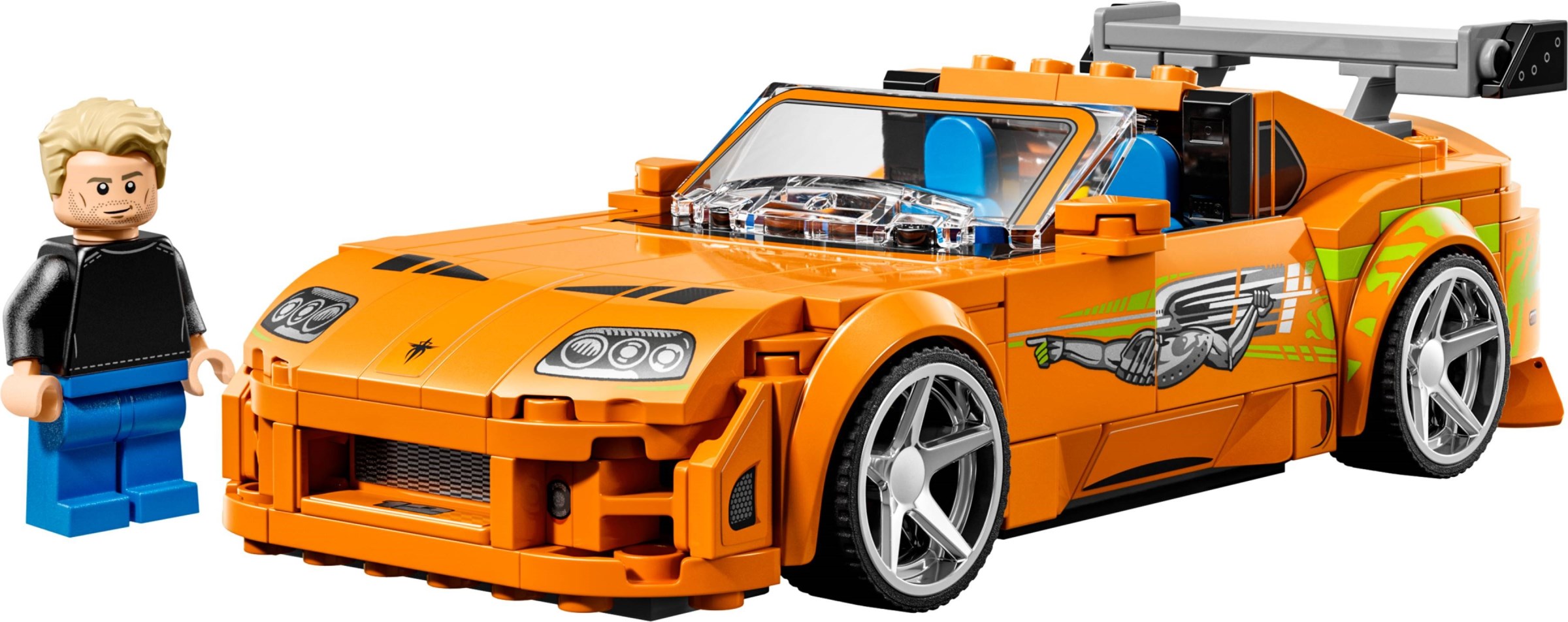
Where this set works is in the details it chooses to nail. The Nuclear Gladiator graphic by Troy Lee, the rear wing profile, the stance - these are the elements that make this instantly readable as Brian O'Conner's car rather than a generic orange sports car, and LEGO gets them right within a genuinely tight piece budget. Where it works less well is everywhere a bigger Speed Champions set would introduce more mechanical build interest. This one is quick, and it knows it.
At 292 pieces, the Toyota Supra MK4 is a short, focused build that most builders will finish in a single sitting of forty-five minutes to an hour. Construction follows the standard Speed Champions format: the chassis plate first, then the body panels layered on in sections, followed by the rear wing, wheels, and final trim details that establish the car's identity.
The distinctive Supra roofline is achieved through a combination of angled plates and a few specialized curved elements, and getting the greenhouse silhouette to read correctly in such a compact scale is a genuine small achievement of the design. The rear wing assembly is the most mechanically interesting sub-build in the set, using a simple but effective bracket technique that holds the wing at the correct rake angle without wobble.
The orange body panels with the printed Nuclear Gladiator graphic are the centerpiece of the whole build, and applying them correctly to match the real car's asymmetrical graphic placement takes a bit of care. This is one of the rare Speed Champions builds where getting a printed panel oriented correctly actually matters to the finished result, rather than being interchangeable with its neighbors.
There isn't much technique variety here beyond what Speed Champions builders will already recognize from other sets in the theme - wedge plates for the hood slope, small brackets for the wheel arches, and a straightforward four-wheel chassis. For experienced builders, this is a relaxing, familiar build rather than a challenging one. For newer builders or kids introduced to LEGO through the Fast and Furious license, it's an approachable and satisfying first car build.
At roughly 15 cm long, the finished model sits comfortably in Speed Champions scale alongside the rest of the theme's roster. The proportions are solid - the long hood, the compact greenhouse, and the aggressive rear stance all read as unmistakably Supra, and the orange and black color combination pops on a shelf next to less flamboyant liveries.
The rear wing is the visual signature of this build, angled correctly to match the real car's aftermarket-style aero setup rather than a generic factory wing. Combined with the four chrome-look novelty rims, the finished model captures the tuner-car aesthetic that defined the entire early Fast and Furious franchise, right down to the slightly lowered stance.
The Brian O'Conner minifigure adds narrative context that a standalone car model wouldn't have. Positioned beside or seated in the Supra, it turns a static car display into a small scene from the film, particularly for fans who remember the specific races and street scenes this exact car appeared in.
This is a set built to be part of a collection rather than a standalone centerpiece. Its modest scale means it reads best displayed alongside other Speed Champions cars, where the small footprint and instantly recognizable livery let it hold its own in a lineup without demanding a shelf of its own.
At 292 pieces, this is one of the smaller entries in the current Speed Champions lineup, and the price-per-piece reflects the licensing cost that comes with any Fast and Furious tie-in. The parts selection is functional rather than generous - enough orange body panels and specialized elements to build this specific car, without much surplus for other projects.
The printed panels carrying the Nuclear Gladiator graphic are the standout specialty pieces, and they're specific enough to this build that their reuse value outside a Supra recreation is limited. That's typical for licensed Speed Champions sets, where the value proposition rests on recreating a specific recognizable vehicle rather than supplying generically useful parts.
The Brian O'Conner minifigure carries real collector value for Fast and Furious fans, since character-accurate minifigures from this specific franchise era are relatively uncommon. If you're weighing this purchase primarily on parts economy, it's a modest set; if you're weighing it on franchise completeness for a movie car collection, the calculation looks considerably better. Our LEGO Investing 101 guide covers how licensed small-scale sets like this one tend to hold value differently than flagship builds.
The 1993 Toyota Supra MK4 that Brian O'Conner drives in 2001's The Fast and the Furious became one of the most iconic movie cars of its generation almost overnight. Built around Toyota's legendary 2JZ-GTE engine, a twin-turbocharged inline-six renowned in tuning circles for its ability to handle massive power increases well beyond factory output, the Supra was already a favorite in the import tuning scene before the film cemented it in pop culture permanently.
The film's specific Supra was modified with a widebody kit, a large aftermarket rear wing, and the now-legendary orange paint job featuring Troy Lee's Nuclear Gladiator graphic, a design that has since become almost as recognizable as the car itself among car culture fans. The Supra appears in the film's climactic street race sequence, a scene that helped launch the broader tuner car movement into mainstream American culture at the turn of the millennium.
The MK4 Supra's real-world reputation only grew after the film. Genuine examples, particularly those modified in a similar style to the movie car, have become significant collector items, with the 2JZ engine's tuning potential keeping the platform relevant in performance circles decades after production ended in 2002. LEGO recreating this specific car acknowledges just how deeply this one vehicle shaped an entire generation's relationship with car culture.
Fast and Furious fans are the clear target audience, and particularly those with affection for the original 2001 film rather than the franchise's later, more spectacle-driven sequels. If the orange Supra with the Nuclear Gladiator graphic is burned into your memory from that first street race scene, this set delivers a faithful, if compact, recreation.
Younger builders or those newer to LEGO who are drawn in through the movie license will find this an approachable, quick, and satisfying build. The straightforward construction and short build time make it a good entry point that doesn't demand the patience a larger flagship set requires.
Speed Champions completionists building out a full theme collection will want this for the roster alone, even if the build itself doesn't break new technical ground. For collectors prioritizing pure build complexity or technique variety over licensed recognition, this is a lower priority pick within the current Speed Champions wave - the Ferrari and Hoonicorn releases from the same wave offer more build engagement for a similar footprint.
The natural companions here are the other two Speed Champions releases from the same 2026 wave: the Ferrari 499P (77261) and Ken Block's Hoonicorn V1 (77262). Displayed together, the three cover an unusually wide range of car culture - a movie tuner icon, a modern Le Mans hypercar, and a legendary rally-bred drift machine - which makes for a genuinely varied small-scale shelf despite all three sharing the same compact format.
For a deeper Fast and Furious display, pairing this Supra with other movie-licensed vehicles from LEGO's broader catalog rounds out a franchise-specific shelf. The orange livery and rear wing silhouette are distinct enough that this model holds its own visual identity even surrounded by other tuner-styled builds.
If your Speed Champions shelf leans toward real-world racing rather than movie cars specifically, the Ferrari 499P is the strongest complement in this particular release wave, offering a visual and thematic contrast between fictional street racing and genuine top-tier endurance competition.
Pros
- Instantly recognizable orange livery and Nuclear Gladiator graphic
- Accurate greenhouse silhouette achieved within a tight piece budget
- Brian O'Conner minifigure adds genuine franchise value
- Quick, approachable build good for newer builders or kids
- Rear wing assembly is a small but satisfying mechanical detail
- Fits naturally into a Fast and Furious or Speed Champions collection
Cons
- Limited technique variety compared to other 2026 Speed Champions releases
- Small piece count means a short build with little challenge for veterans
- Printed panels have narrow reuse value outside this specific car
- Weakest value proposition of the three cars in this release wave
The Toyota Supra MK4 delivers exactly what it promises - a faithful, compact recreation of one of the most recognizable movie cars of the last twenty-five years, built quickly and displayed easily. It doesn't reach for more than that, and within that modest scope, it succeeds cleanly.
This lands as A SOLID BUILD rather than an EARL APPROVED pick because the build itself, while pleasant, doesn't offer much technical ambition beyond what Speed Champions builders have seen many times before, and the piece count limits both the challenge and the parts value relative to its price. It's an honest, well-executed small set rather than a standout one.
Available now, and worth picking up if the license matters to you specifically. Fast and Furious completionists and fans of the original film will get real satisfaction from this one. Builders shopping purely for engagement per dollar should look toward the Ferrari or Hoonicorn from the same release wave instead.
- Ferrari 499P Review - The stronger build in this Speed Champions wave
- Ken Block's Hoonicorn V1 Review - The most characterful of the three new releases
- Best LEGO Racing and Speed Champions Sets, Ranked - See how this Supra stacks up against the rest of the theme
- New LEGO Sets, July 2026 - What else launched alongside this Speed Champions wave
- LEGO Investing 101 - How licensed small-scale sets hold value differently than flagships
Track it in your vault on GameSetBrick - our free collection app. Log your condition, price paid, and watch the real-time market value.
Track in Your Vault →Save it to your wishlist on GameSetBrick. Share your list with friends and family - every set has a buy button so gift givers know exactly where to go.
Add to Wishlist → GameSetBrick is a free app by The Earl of Bricks. See all features. Scan it. Track it. Trade it.