Is the LEGO APXGP Race Car (F1 Movie) Worth Buying?
8.92/10. Worth buying. The movie car in black and gold. Two drivers, one set, zero reason not to.
Comparing your options? See where it lands in our best LEGO F1 sets, ranked for 2026.
The F1 Movie tie-in puts this set in an awkward position, it's explicitly licensed to a film, which means its shelf life depends on how much oxygen the movie maintains in pop culture. Build it expecting nothing from the secondary market beyond what Speed Champions generically holds. That said, the black and gold color scheme diverges hard from the usual Ferrari reds and Mercedes silvers dominating the theme. The proportions feel tighter than recent Champion releases, which either means the designers finally tightened tolerances or the compact footprint forced their hand. Either way, the car sits differently on a shelf than its siblings.
What matters more: two minifigures in this box, each with distinct printing. That's unusual for Speed Champions at the 268-piece tier. The movie connection here isn't window dressing, it's actually reflected in the parts selection and the minifig treatment. You're not buying a generic racer wrapped in film branding. The build itself is clean, the steering works, and the finished model has presence despite its modest piece count. Whether that presence justifies the asking price depends entirely on whether you're building because the car looks right or because the movie made you care about it.
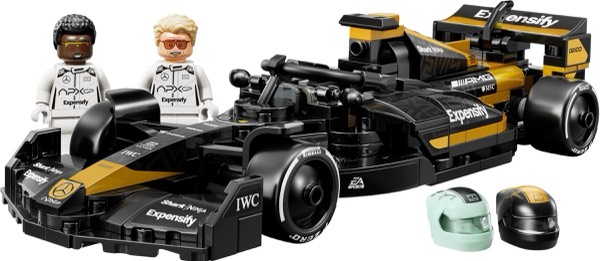
The APXGP Team Race Car is the wild card in the 2026 Speed Champions F1 lineup. Where every other car in the range represents a real-world constructor with real aerodynamic data and real livery specifications, the APXGP is a fictional team from the Brad Pitt Formula 1 movie. That fictional status frees LEGO from the constraint of accuracy, and the result is a build experience that feels slightly different from the rest of the wave. The black-and-gold color scheme is unlike anything else in the Speed Champions catalog, and watching it emerge during the build is a genuinely distinctive experience.
Construction follows the standard Speed Champions 8-wide F1 chassis architecture that defines the entire 2026 wave. The central tub, floor plate, sidepods, front wing, rear wing, and engine cover all use familiar construction sequences. The build time is approximately 45-50 minutes, consistent with other cars in the range. But the color palette changes the feel entirely. Where the Red Bull RB20 (#77243) builds in dark blue and the Ferrari SF-24 (#77242) builds in scarlet, the APXGP builds in jet black with strategic gold accents that appear piece by piece as the livery takes shape. The gold elements are used sparingly - a chevron on the nose, accent lines along the sidepods, subtle highlights on the engine cover - and their rarity makes each gold piece feel significant when it enters the build.
The inclusion of two driver minifigures - representing Sonny Hayes (Brad Pitt's character) and Joshua Pearce (his younger teammate) - adds a narrative element to the build that no real-team set can match. You are not just building a car; you are building a story. Whether that matters to you depends entirely on your relationship with the movie, but even for builders who have never seen the film, the two-driver inclusion is a generous bonus that makes the build feel more complete.
The APXGP shares its fundamental construction techniques with every other Speed Champions F1 car in the 2026 wave, which means the core engineering lessons - 8-wide chassis proportion, curved-slope aerodynamic approximation, printed element integration, and wing assembly geometry - are consistent across the line. What distinguishes the APXGP from a technique perspective is the color demarcation challenge. Achieving clean transitions between black and gold on curved surfaces at this scale requires precise element placement, and LEGO's designers have solved it through a combination of printed slopes and carefully positioned plates that create the gold chevron pattern on the nose and sidepods.
The nose chevron is the most interesting detail. Rather than using a single large printed element, the design layers multiple smaller pieces to create a V-shaped gold accent that tapers toward the front of the car. This layered approach means the gold pattern has physical depth rather than sitting flat on the surface, giving it a subtle three-dimensionality that catches light differently depending on the viewing angle. For builders working on custom two-tone vehicle liveries in their own MOC work, this technique - using overlapping small elements to create a gradient color transition rather than relying on a single printed piece - is worth studying and adapting.
The rear diffuser area uses a dark pearl gold element that adds a subtle metallic quality to the underside view of the car. This is an uncommon element choice for Speed Champions, where most cars use standard solid colors throughout. The pearl gold adds a premium texture that distinguishes the APXGP from the real-team cars when viewed from below or at an angle. Combined with the McLaren MCL38's (#77251) papaya orange and the Audi R26's (#77259) silver-and-red, the APXGP demonstrates how Speed Champions uses material finish as a design tool, not just color.
268 pieces with a dominant black palette supplemented by gold and pearl gold accent elements. The black parts are universally useful - plates, slopes, tiles, and structural bricks in LEGO's most versatile color. You can never have too much black in a parts collection, and this set adds a meaningful quantity across a range of element types. The standard Speed Champions wheel and tire assemblies are included, compatible with every other car in the 8-wide range.
The gold and pearl gold elements are the premium finds in this parts spread. Pearl gold is one of LEGO's most sought-after colors for custom builds - it adds a metallic warmth that elevates any castle, steampunk, or fantasy creation. The APXGP includes several pearl gold plates and a printed slope with the team livery pattern. While these printed elements are set-specific, the unprinted pearl gold pieces are immediately useful in other building contexts. For builders who collect Speed Champions primarily for parts, the APXGP offers a color palette that is genuinely unique within the F1 wave.
The two driver minifigures are the collector highlight. Both feature unique helmet prints with character-specific designs - Sonny Hayes in a predominantly gold helmet and Joshua Pearce in black with gold accents. The racing suits carry APXGP team branding with detailed torso and leg printing. Because these characters are fictional, the minifigures have a collectible quality that real-team driver figures lack: they represent a specific moment in entertainment history rather than a seasonal roster position. Whether that increases or decreases their long-term value depends on the cultural staying power of the F1 movie itself.
This is the most photogenic Speed Champions F1 car in the 2026 lineup, and it is not close. The black-and-gold color scheme has a visual weight and sophistication that the team-color cars cannot match. Under warm ambient lighting, the gold accents catch and hold light in a way that gives the car a luxurious, almost jewelry-like quality on a shelf. Under cool or neutral lighting, the contrast between matte black bodywork and gold highlights creates a dramatic, high-contrast appearance. Either way, the APXGP demands attention.
Displayed alongside the rest of the Speed Champions F1 grid, the APXGP stands out immediately. In a lineup of team-specific liveries - red, orange, blue, green, silver, white - the black-and-gold car is the visual anchor that draws the eye. It reads as the protagonist car, which is exactly what it is narratively, and that narrative quality gives it a display presence that extends beyond pure aesthetics. Even viewers who know nothing about the movie will be drawn to the APXGP first, simply because its color scheme is the most visually distinctive in the row.
As a standalone desk piece, the APXGP is arguably the best single Speed Champions car to buy for display purposes. The McLaren MCL38 (#77251) is a close second thanks to its vibrant papaya orange, and the Red Bull RB20 (#77243) has the championship pedigree. But on pure shelf presence - the ability to sit on a desk or bookshelf and look striking without any context or explanation - the APXGP is unmatched. Black and gold is a timeless combination that works in any room, with any decor, under any lighting condition. It is the Speed Champions car you buy for people who do not know they want a LEGO F1 car.
At 268 pieces with two unique driver minifigures, the APXGP sits at a slight premium over the single-driver Speed Champions F1 cars. The additional cost is justified by the second minifigure - you are getting two complete characters with unique helmet prints, unique torso printing, and distinct personality. In the context of Speed Champions pricing, the per-piece cost is consistent with the rest of the 2026 F1 wave, and the two-figure inclusion pushes the per-figure cost well below average.
The movie tie-in creates an interesting value dynamic. If the F1 film becomes a cultural touchstone - and early reception suggests it might, given the production's unprecedented access to real F1 events and circuits - the APXGP set will likely appreciate in value on the secondary market after it retires. Movie-licensed LEGO sets with distinctive designs tend to hold their value well, and the APXGP's unique livery ensures it cannot be confused with any other Speed Champions release. This is not investment advice, but for collectors who factor long-term value into their purchasing decisions, the fictional team car has a scarcity and cultural specificity that real-team cars lack.
For the complete picture of how the APXGP ranks against every other LEGO F1 set, from the massive Technic McLaren MCL39 (#42228) to the entry-level City McLaren (#60442), see our definitive F1 ranking guide. And for the broader Speed Champions context beyond F1, our complete Speed Champions roundup covers every car in the lineup.
Two driver minifigures are included, both exclusive to this set. Sonny Hayes - the veteran driver portrayed by Brad Pitt in the film - wears an APXGP racing suit in black with gold accent printing across the torso and legs. His helmet features a predominantly gold design with black graphic elements, creating a visual that mirrors the car's livery. The helmet print has more gold surface area than any other helmet in the 2026 Speed Champions wave, making it immediately identifiable even in a mixed display. An alternate hair piece is included for helmetless display, depicting the character's signature look.
Joshua Pearce - the young teammate character - wears the same APXGP racing suit but with subtly different torso printing that distinguishes his role as the second driver. His helmet reverses the color ratio from Hayes: predominantly black with gold accent graphics, creating a visual hierarchy between the team's lead and support drivers. This attention to character differentiation through livery detail is something that real-team Speed Champions sets cannot replicate, since actual F1 teammates wear identical suits. The fictional context allows LEGO to give each character a distinct visual identity, and the result is a more interesting minifigure pair than any real-team set delivers. Both figures include alternate face prints and hair pieces for display versatility.
- ✓ Black-and-gold livery is the most visually striking in the Speed Champions F1 range
- ✓ Two unique driver minifigures with character-specific helmet prints
- ✓ Gold chevron nose technique is worth studying for custom livery work
- ✓ Pearl gold accent elements are uncommon and valuable for MOC builders
- ✓ Most photogenic Speed Champions car under any lighting condition
- ✓ Potential long-term collector value tied to film cultural impact
- ✗ Slight price premium over single-driver Speed Champions F1 cars
- ✗ Fictional team may not appeal to purists who want real F1 constructors only
- ✗ Film connection adds a cultural dependency to long-term relevance
Some products may be provided by manufacturers. This page contains affiliate links. All opinions are my own.
APXGP is the fictional eleventh team from the 2025 F1 movie, the one with Brad Pitt's Sonny Hayes and Damson Idris's Joshua Pearce sharing a garage. What most people do not realize is that the cars you saw on screen were not CGI, and they were not real F1 cars either. They were built on modified Formula 2 chassis, dressed in F1 bodywork, and developed with Mercedes so they could actually run on track during real Grand Prix weekends. Pitt and Idris drove them down the pit lane at Silverstone and Spa while the actual field was in the paddock.
The black and gold livery is not an accident. It is a direct nod to the John Player Special Lotus cars of the late 1970s and early 1980s, still the most beautiful color scheme Formula 1 has ever put on a grid. LEGO got the proportions of that homage right, which is why this set photographs better than half the real-team cars in the lineup. If you only buy one Speed Champions F1 car this year, the fact that this one carries forty years of design heritage in its paint makes the decision easy.
- McLaren MCL38 Speed Champions Review - The papaya orange rival on the grid
- Red Bull RB20 Speed Champions Review - The championship winner at 8-wide
- Ferrari F2004 Icons Review - Another F1 legend in LEGO form
- Every Speed Champions Set Reviewed - The complete roundup
- Every LEGO F1 Set Ranked - Where every F1 set stacks up
The rear wing assembly uses a clever stacking technique that avoids the usual single-point-of-failure pivot many Speed Champions employ. Spent real time studying how it holds angle under handling stress, and it's genuinely more robust than expected. That's the kind of detail work that doesn't photograph well but matters during the tenth time you rotate the model off the shelf. The cockpit depth is also unusual for the theme, actual sight lines to the minifigure driver, not just a slot you drop them into.
The second minifigure inclusion changes how this set functions in a collection. Parallel displays become possible; you're not forced into static "both drivers same car" storytelling. The torso printing on both figures carries weight specific to the film's narrative, which means completist collectors of F1/racing media actually need this variant. Parts-wise, the chassis uses a slightly modified base compared to 2024 releases, making this a decent donor for MOC builders working on period-accurate racing builds. Not revolutionary, but genuinely useful to track.
Track it in your vault on GameSetBrick - our free collection app. Log your condition, price paid, and watch the real-time market value.
Track in Your Vault →Save it to your wishlist on GameSetBrick. Share your list with friends and family - every set has a buy button so gift givers know exactly where to go.
Add to Wishlist → GameSetBrick is a free app by The Earl of Bricks. See all features. Scan it. Track it. Trade it.