Is the LEGO BMW M3 (E30) Worth Buying?
7.62/10. Worth buying. Forty years on from the homologation special that terrorised Group A, the E30 M3 arrives at 358 pieces with an anniversary livery and the boxiest fenders in the theme.
Comparing your options? See where it lands in our Speed Champions buying guide.

Some cars earn their place in a display case, and some cars earn their place in a history book first and the display case second. The E30 M3 is squarely the latter. This is the car BMW built in 1986 for the sole reason that the rules said you had to sell road versions of the thing you wanted to go racing, and the thing they wanted to go racing turned out to be the most successful touring car in history. So when LEGO puts an anniversary badge on a Speed Champions box, my first reaction is usually to raise an eyebrow. This time I didn't. This car has earned the fuss.
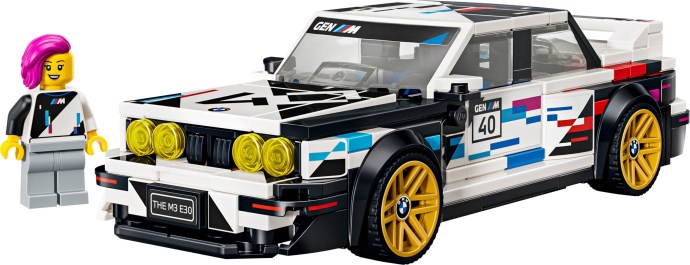
What I appreciate most is that LEGO leaned into the boxiness rather than trying to smooth it over. The real E30 M3 is all flat planes, blistered arches, and that unmistakable tall rear wing, and this little 358-piece version gets the proportions right where a lot of Speed Champions cars would have rounded the corners off. It reads as an E30 M3 from across the room, and for me that is the whole job.
At 358 pieces the M3 sits at the larger end of the single-car Speed Champions bracket, and the extra parts are spent exactly where they should be. Construction runs the familiar route of chassis plate, drivetrain suggestion, body panels, and glass, but the panel stage is where this one earns its keep, because the E30's flared arches and squared-off shoulders demand a body that steps outward rather than curving.
The rear wing is the signature moment of the build. The real E30 M3's tall boot-mounted wing is one of the most recognisable silhouettes in motorsport, and LEGO recreates it with a bracket-mounted assembly that stands proud of the boot lid at the correct aggressive angle. Getting it seated square is a small, satisfying step, and it transforms the profile the instant it clicks on.
The blistered wheel arches are handled with angled plates that push the fender line outward over the wheels, mirroring the way the real homologation car had to widen its bodywork to cover racing rubber. It is a tidy piece of parts usage that keeps the boxy character intact instead of softening it into a generic hatchback shape.
Livery is where a first-time builder should slow down. The black, blue and white anniversary scheme is applied through printed panels that need to be oriented correctly to line up across the doors and bonnet, and the BMW roundel wheel prints add a level of finish that the theme did not always bother with a few years ago. Take your time on the stickers-free printed elements and the payoff is a genuinely crisp finish.
Expect somewhere around an hour to ninety minutes of building. It never drags, and the wing and arch work give it more character than its modest piece count suggests.
Finished, the M3 has one of the most instantly legible silhouettes in the current Speed Champions range. The combination of flat glasshouse, squared arches, and that tall rear wing is unmistakable, and it stands apart on a shelf full of the swoopier modern supercars that dominate the theme. This is a car that looks like it was designed with a ruler, and the model honours that.
The black, blue and white anniversary livery is a genuine highlight. It photographs beautifully against the more saturated reds and oranges of the recent racing releases, and the BMW logo wheel prints are the kind of small detail that reads as premium when the car is sat under a display light. The whole thing has a purposeful, motorsport-homologation look rather than a showroom shine.
The single included minifigure leans into the fun side of the release, with an exclusive BMW torso print, a bright pink hairpiece and a wrench accessory that frames the figure as the mechanic-slash-driver keeping the old warrior on track. It is a small crew of one, but the exclusive torso gives collectors a reason to keep the figure sealed with the car.
At Speed Champions scale the M3 photographs best from a three-quarter rear angle, where the arches and the wing are both in shot at once. It is a compact model, but it carries more visual attitude per centimetre than most of its shelf-mates.
At 358 pieces the M3 is a respectable haul for a single-car Speed Champions set, and the printed elements do a lot of the heavy lifting on the finish. The BMW roundel wheel prints and the anniversary panel printing are set-specific, which limits their wider MOC use, but they push the perceived quality of the finished car well above its parts count.
The body-panel and arch elements are useful for anyone building boxy 1980s vehicles in their own creations, and the wing bracket assembly is a neat reference technique for anyone recreating tall-winged touring or Group A cars at this scale. The exclusive minifigure torso is the standout collectible piece in the box.
The E30 M3's standing in car culture is the real value story here. This is a blue-chip enthusiast car whose desirability has only climbed, and licensed LEGO sets tied to genuinely revered machines tend to hold interest longer than sets tied to passing trends. Our LEGO Investing 101 guide walks through why anniversary and homologation-hero sets tend to age the way they do.
The BMW M3 was born in 1986 for one reason: to go touring car racing. Group A regulations required manufacturers to build and sell road-going versions of their competition cars, and BMW's motorsport division answered with a homologation special based on the E30 3 Series, fitted with the high-revving four-cylinder S14 engine, box-flared arches, a deep front splitter and that towering rear wing. Around 5,000 examples were needed to satisfy the rules; BMW ended up building far more, because people wanted them.
On track the E30 M3 became a phenomenon. It won the DTM, the European and world touring car championships, countless national titles, and even success on tarmac rallies, cementing a reputation as arguably the most successful touring car ever produced. Its blend of nimble chassis, screaming four-cylinder and homologation-mandated aerodynamics made it a giant-killer against larger, more powerful machinery.
Four decades on, the E30 M3 sits firmly in the enthusiast pantheon, a car whose values and reverence have climbed steadily as collectors recognise it as the purest of the M3 bloodline. LEGO marking its 40th anniversary with a dedicated Speed Champions release is a fitting nod to a car that earned its legend the hard way, on circuits across the world.
BMW enthusiasts and touring car fans are the obvious core audience, and for anyone who grew up watching E30 M3s trade paint in Group A and DTM, this is an easy, nostalgic yes. The anniversary livery and exclusive minifigure torso make it feel like a considered tribute rather than a box-ticking licensed release.
Builders who prefer their Speed Champions shelf to tell a broader story than modern hypercars will value the M3 as a piece of motorsport history, a boxy 1980s counterpoint to the swoopier contemporary releases. It adds genuine visual variety to a collection.
It is also a friendly build for a newer or younger builder stepping up within the theme, offering enough panel and wing work to feel rewarding without the more fiddly livery demands of some of the larger dual-car sets. As a gateway into collecting motorsport icons, it is a strong pick.
The M3 pairs naturally with the other cars in the August 2026 Speed Champions wave, particularly the Jaguar Project 7 and Land Rover Defender (77264), giving you a European classic-and-modern grouping that spans touring cars, sports cars and off-roaders.
For a period-correct shelf, the E30 sits happily alongside any other 1980s and 1990s motorsport machinery in the theme, where its boxy proportions read as a deliberate era statement rather than an outlier. It is the anchor a retro touring car display would be built around.
Set against the recent racing releases like the Ken Block Hoonicorn (77262), the contrast between old-school homologation boxiness and modern widebody excess is a genuinely fun display conversation, showing just how far performance car design has travelled in forty years.
Pros
- Instantly legible E30 M3 silhouette with the boxiness kept intact
- Tall rear wing and blistered arches nail the homologation-hero character
- Black, blue and white anniversary livery photographs superbly
- BMW roundel wheel prints and printed panels give a premium finish
- Exclusive BMW minifigure torso is a genuine collectible touch
- Celebrates a car with real, enduring standing in motorsport history
Cons
- Set-specific printed elements have limited wider MOC use
- Single minifigure where some dual sets offer more crew
- Compact overall next to LEGO's larger flagship builds
- Livery panel orientation needs care during assembly
The BMW M3 (E30) is one of the most characterful single-car releases in the current Speed Champions range, precisely because LEGO respected what made the real car great: the flat planes, the flared arches, and that unmistakable tall wing. At 358 pieces it delivers a build with more attitude than its size suggests, wrapped in a livery that earns its display spot.
It takes EARL APPROVED status comfortably on the strength of its silhouette accuracy, its premium printed finish and the exclusive minifigure, held just shy of the higher tiers only by the modest scale that comes with the Speed Champions format itself.
Available now, and an easy recommendation for any BMW fan, touring car enthusiast, or collector who wants their shelf to remember where performance car legends actually came from. Forty years on, the E30 M3 still commands the room.
- Jaguar Project 7 & Land Rover Defender Review - The dual-build British duo from the same August wave
- Ken Block Hoonicorn V1 Review - Modern widebody excess as a counterpoint to the E30
- Best LEGO Racing and Speed Champions Sets, Ranked - See where the M3 lands against the full theme
- LEGO Investing 101 - How anniversary and homologation-hero sets tend to age
Track it in your vault on GameSetBrick - our free collection app. Log your condition, price paid, and watch the real-time market value.
Track in Your Vault →Save it to your wishlist on GameSetBrick. Share your list with friends and family - every set has a buy button so gift givers know exactly where to go.
Add to Wishlist → GameSetBrick is a free app by The Earl of Bricks. See all features. Scan it. Track it. Trade it.