Is the LEGO Arcade Pinball Machine Worth Buying?
8.72/10. Worth buying. A working pinball table built from 2,274 bricks, with flippers, bumpers, and a launcher that actually launches.

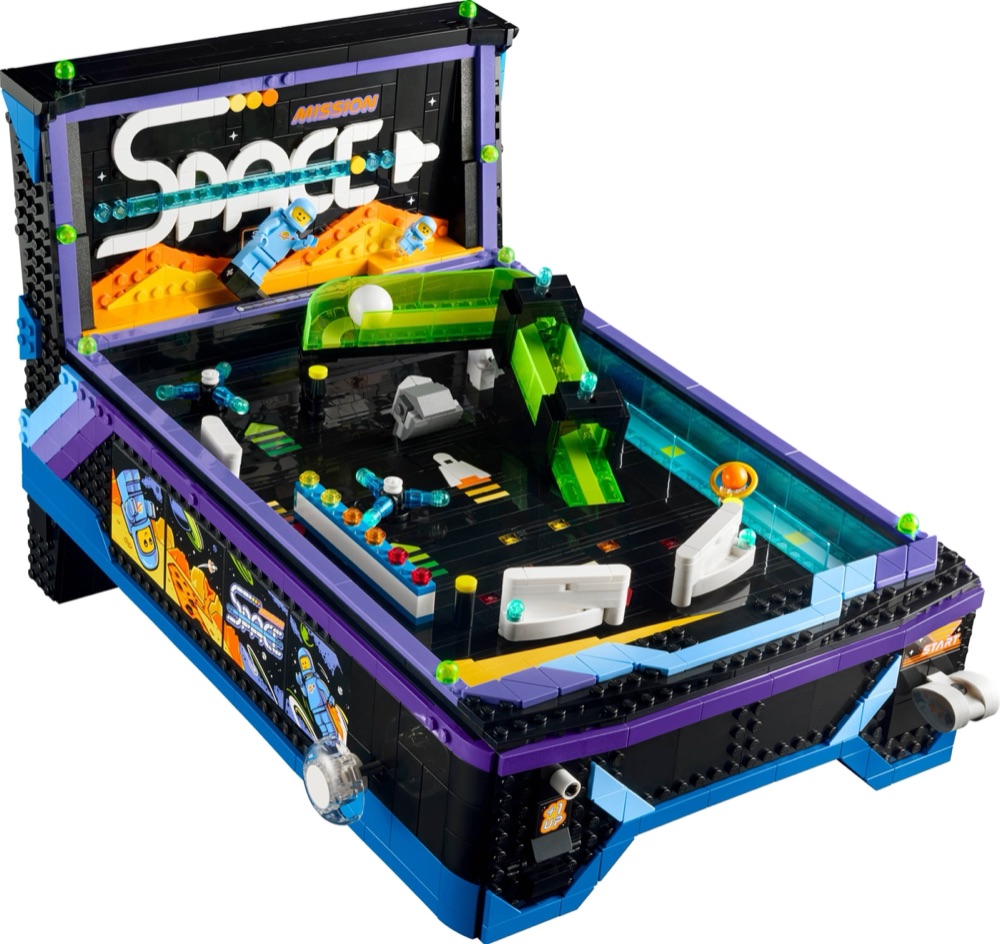
I have built a lot of Icons sets that look fantastic and do absolutely nothing once the last brick clicks into place. The Arcade Pinball Machine is not one of those sets. This is a functioning pinball table, complete with a spring-loaded launcher, two working flippers, spinning bumpers, and a ramp bridge you have to shoot the ball up and over. It sits in that rare category of LEGO sets that are genuinely fun after the build is finished, not just handsome to look at from across the room.
What sold me on this one is how seriously LEGO treated the mechanics. Pinball machines live or die on feel, on that satisfying snap of the flipper and the unpredictable bounce off a bumper, and the designers clearly understood that a LEGO pinball table needed to earn its keep as an actual game, not a static sculpture shaped like one. At 2,274 pieces, there is real substance here, and the astronaut-and-baby-astronaut theme gives the whole build a playful, slightly absurd energy that fits the arcade spirit perfectly. This is one of the more purely joyful sets LEGO has released in years.
The Arcade Pinball Machine builds in distinct functional zones, and that structure keeps the whole process engaging. You start with the cabinet base and legs, move into the internal mechanism for the launcher and flippers, then work up through the playfield itself, adding bumpers, ramps, and the asteroid target before finishing with the backboard and topper. Each zone teaches a different mechanical trick, so you are never repeating the same motion for more than twenty or thirty minutes at a stretch.
The flipper mechanism is the standout technique in the set. LEGO uses a compact gear-and-axle assembly hidden beneath the playfield that translates a simple external button press into a crisp, responsive flip. Building it, you can feel the design team iterating toward minimal slop in the linkage, because a mushy flipper would undermine the entire point of the set. The spring-loaded ball launcher uses a similar philosophy: a tensioned mechanism that stores energy in a spring and releases it cleanly, giving the ball genuine momentum up the shooter lane rather than a half-hearted nudge.
The playfield itself is where the piece count goes to work. Spinning bumpers, an up-and-over ramp bridge, and a progress-bar mechanism tied to the asteroid target all live on this single deck, and getting them to coexist without physically interfering with each other required some genuinely clever layering. You will notice LEGO stacking plates and tiles at slightly different heights to create channels for the ball to travel without snagging, which is not a trivial engineering problem when the medium is injection-molded plastic bricks rather than steel and glass.
Pacing-wise, this is a comfortable multi-session build. Plan for somewhere in the range of six to nine hours depending on how often you stop to test the mechanisms as you go, which I strongly recommend doing. Watching the flipper snap for the first time, or seeing the launcher send the spare ball rocketing up the lane, is one of the more satisfying mid-build payoffs LEGO has engineered into a set. The instructions are clearly organized by function, so you always know whether you are building "the launcher" or "the left bumper bank," which keeps the mental model of the machine clear even as the piece count climbs.
The astronaut and baby astronaut minifigures show up late in the build as part of the theming and backboard artwork, and while they are a small piece of the overall package, they give the pinball table a story: rescue the drifting baby astronaut, hit the asteroid target, reset the bar, play again. It is a small narrative touch, but it elevates the set from "mechanism demonstration" to "actual game with actual stakes," and that distinction matters more than it sounds.
This is one of the few Icons sets built to be touched daily rather than admired from a respectful distance. The finished cabinet stands roughly nine and a half inches tall, about fifteen inches long, and eleven inches deep, which puts it comfortably on a desk, bar cart, or bookshelf without dominating the room the way some larger Icons builds do. The proportions read as a proper tabletop pinball cabinet immediately, with a raked playfield, a backboard graphic, and a cabinet base that widens slightly for stability.
The color palette leans into retro arcade energy: dark cabinet panels, bright accent colors on the bumpers and ramps, and a starfield-and-asteroid graphic across the backboard that ties directly into the astronaut theme. It reads as a piece of coin-op history reimagined in plastic, which is exactly the tone LEGO was chasing with this release. Under any kind of ambient light, the bright bumper colors pop against the darker cabinet shell, and the whole thing photographs well from almost any angle because there is genuine dimensional depth to the playfield layout.
Where this set separates itself from typical display pieces is that "display quality" and "function quality" are the same axis here. A pinball machine that looks perfect but does not play well is a failure, and one that plays well but looks cheap is equally disappointing. LEGO threaded that needle. The bumpers have a satisfying spring action, the ramp bridge has enough structural rigidity to survive repeated ball strikes without shifting out of alignment, and the whole cabinet has enough heft that it does not skid across a table top every time you hit the launcher with any real force.
The interactive nature also means this set earns a different kind of shelf real estate than a static Icons build. It works as a genuine conversation piece at a gathering, something guests can actually pick up and play a round on, rather than a museum piece you politely admire and then step away from. That is a rare quality in the Icons catalog, and it is worth factoring heavily into where you decide to display it. A coffee table or bar cart gets far more use out of this set than a high shelf ever will.
At 2,274 pieces, the Arcade Pinball Machine lands in a reasonable price-per-piece range for a mechanically complex Icons set, and the mechanism-heavy engineering justifies a premium over a purely static build of similar size. You are not just paying for plastic volume here; you are paying for gear trains, spring tension systems, and a playfield engineered to survive repeated impact from a rolling ball, which is a different manufacturing and design challenge than stacking bricks into a static shape.
The parts selection is a genuine mixed bag in the best way. There are plenty of small gears, axles, and Technic connector pieces that MOC builders will find useful for future mechanical projects, alongside a good supply of curved slopes and specialty tiles in the bright bumper colors that do not show up often in standard sets. The dark cabinet panels use large flat plates and tiles that are broadly useful for any builder working on furniture-scale MOCs or vehicle interiors.
From a value perspective, this set benefits from a genuinely novel mechanism that LEGO has not really attempted at this scale before. Playable pinball is a rare enough category in the LEGO catalog that this set carries real long-term interest for collectors who specifically chase mechanism-driven Icons releases, separate from the usual architecture-and-vehicle rotation. If you track our retiring sets tracker, novel-mechanism sets like this one tend to hold collector attention well after retirement precisely because they cannot simply be replaced by "another set that looks similar."
Pinball's roots stretch back to bagatelle tables in eighteenth-century Europe, but the machine we recognize today did not exist until Gottlieb introduced "Humpty Dumpty" in 1947, the first table with player-controlled flippers. Before that, pinball was a game of pure chance: you launched the ball and watched where gravity took it, with no way to influence the outcome once it left the plunger. Flippers changed pinball from a gambling curiosity into a skill game overnight, and the format exploded across drugstores, bars, and arcades for the next four decades.
The golden era of electromechanical pinball ran roughly from the 1950s through the late 1970s, when manufacturers like Gottlieb, Williams, and Bally competed on increasingly elaborate backboard artwork and mechanical scoring systems built from relays and stepper motors rather than any kind of digital logic. Solid-state electronics arrived in the late 1970s, adding digital scoring and sound, and pinball rode that wave into a second golden age through the 1990s before video games began eating into arcade floor space. By the early 2000s, pinball manufacturing had shrunk to a handful of dedicated companies keeping the format alive for a smaller but fiercely loyal enthusiast base.
What makes LEGO's take genuinely interesting is that it recreates the electromechanical era's core promise, tactile, physical feedback you control with your own hands, using an entirely different set of engineering constraints. Real pinball machines rely on steel balls, wound springs, and solenoids. LEGO has to achieve a comparable feel using injection-molded ABS, LEGO-standard axles, and hand-wound tension. That the flippers snap with any real authority at all is a small triumph of constraint-driven design, and it places this set in conversation with the actual history of the format rather than just borrowing its aesthetic.
Anyone who grew up feeding quarters into an arcade cabinet is the obvious audience, and this set delivers a genuine hit of that nostalgia without requiring an actual arcade cabinet's worth of space or maintenance. If you have fond memories of chasing a high score on a mall pinball table, or if you currently own or covet a real pinball machine but do not have room for one, this set scratches that exact itch at a fraction of the footprint.
Mechanism-focused LEGO builders will find plenty to love in the flipper linkage, launcher spring, and bumper mechanisms, even if this is not a Technic set in the strictest sense. It shares more engineering DNA with LEGO's Great Ball Contraption community than with a typical Icons architecture build, and builders who enjoy that intersection of function and form should move this near the top of their list.
Families and casual builders should also take note. Unlike most 18+ Icons sets, this one rewards you with an actual game once construction wraps up, which makes it a rare Icons release that continues to deliver value long after the last piece is placed. We covered this angle in our best LEGO sets for adults roundup, where playable sets consistently punch above their piece count in long-term satisfaction.
The Arcade Pinball Machine pairs naturally with other Icons sets that lean into nostalgia and Americana, even outside the arcade specifically. The LEGO Central Perk set and other pop-culture Icons builds share a similar "recreate a cultural touchstone" energy, and grouping this pinball table with them on a themed shelf builds a display narrative around leisure and entertainment across different decades.
For builders chasing a more ambitious Icons showcase, pairing this set with our Minas Tirith review creates a deliberately jarring but effective contrast: the towering, ornate fantasy citadel next to a compact, playful, interactive arcade cabinet. Both sets represent LEGO's Icons line at its most ambitious, just aimed at completely different emotional registers, and displaying them together highlights just how wide the range of the Icons theme has become.
If you want to build a dedicated "playable LEGO" corner, look for other mechanism-driven sets from LEGO's history, including previous Great Ball Contraption compatible builds and any past pinball or arcade-adjacent releases. A shelf where every set actually does something when you pick it up makes for one of the more engaging display setups you can build, and this set is the obvious anchor piece for that kind of collection.
Pros
- Genuinely playable, not just display, with working flippers, launcher, and bumpers
- Flipper mechanism is crisp and responsive, not mushy or vague
- Compact footprint fits a desk or coffee table without dominating the room
- Fun narrative theme with the astronaut and baby astronaut characters
- Strong mix of mechanism-focused and structural build phases
- Bright, retro arcade color palette photographs beautifully
- Useful gears, axles, and specialty pieces for future MOC projects
- A rare Icons set that stays fun to interact with long after the build ends
Cons
- Repeated play will eventually loosen some mechanism connections over time
- Only two minifigures, and they are a minor part of the overall package
- Some specialty bumper pieces have limited reuse outside similar mechanism builds
- Not a true full-size pinball experience, so expect a scaled-down feel to the ball physics
The Arcade Pinball Machine is one of the most genuinely fun Icons sets LEGO has produced, precisely because it refuses to settle for looking the part. The mechanisms work, the theming is charming, and the finished piece rewards you every time you pick it up rather than just the one time you finish building it. That is a rare quality in this price bracket of the Icons lineup.
It earns its excellent rating on the strength of its build variety, its mechanical ambition, and its display presence, all of which land solidly above average. It falls just short of masterpiece territory only because the mechanism, while impressive for LEGO, is still a scaled-down approximation of real pinball physics, and a handful of specialty pieces have narrower reuse value than a typical architecture-focused Icons set.
If you want a set that keeps earning its shelf space long after the last brick clicks in, this is one of the strongest arguments in the current Icons lineup. Available now, and worth clearing actual usable space for, not just display space.
- Minas Tirith Review - Another Icons flagship at the opposite end of the ambition spectrum
- Best LEGO Sets for Adults 2026 - Where playable sets like this one consistently rank
- April 2026 - What to Buy, Skip, and Wait On - Our monthly buying guide
- Retiring Sets Tracker - Know when novel-mechanism sets like this one leave the catalog
- All Reviews - Browse the full Earl of Bricks review archive
Track it in your vault on GameSetBrick - our free collection app. Log your condition, price paid, and watch the real-time market value.
Track in Your Vault →Save it to your wishlist on GameSetBrick. Share your list with friends and family - every set has a buy button so gift givers know exactly where to go.
Add to Wishlist → GameSetBrick is a free app by The Earl of Bricks. See all features. Scan it. Track it. Trade it.