Is the LEGO Road Bike Worth Buying?
8.1/10. Worth buying. Working steering, a genuine pedal-and-chain drive with freewheel coasting, and the first road bike LEGO Icons has ever built.

LEGO Icons has done cars, motorcycles, and just about every other form of ground transport worth displaying, and it took until now to give us a road bike. That gap always struck me as odd, because a bicycle is arguably a purer engineering challenge than a supercar. There is no engine to hide the mechanical work behind. Every moving part has to actually move convincingly, in full view, or the whole illusion falls apart.
This set does not hide from that challenge. It leans directly into it, with working steering, a genuine chain-driven pedal system, and a freewheel mechanism that lets the rear wheel coast independently of the pedals, exactly like a real bike. That last detail is the kind of thing a lot of builders will not even think to test, and the fact that LEGO's engineers bothered to include it tells you this was designed by people who understand what makes a bicycle actually work, not just what makes it look right sitting still.
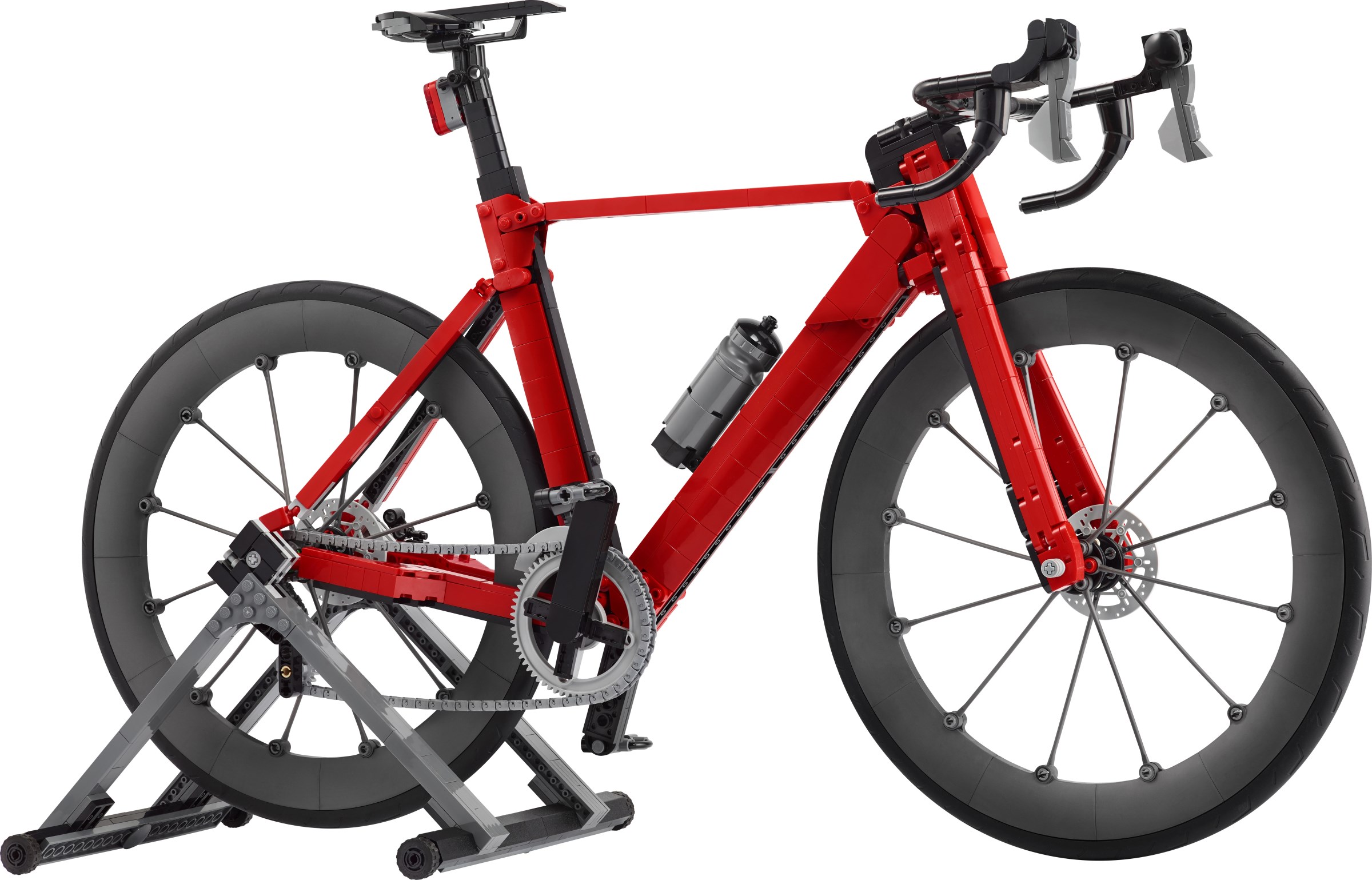
The Road Bike is a 1,015 piece Icons set built around functional mechanical engineering rather than pure aesthetics, though it manages both convincingly. The build constructs a detailed road bike replica complete with smooth front-wheel steering, a working pedal-and-chain drive with a freewheel mechanism for coasting, sporty rims wrapped in rubber tires, a rear wheel-lift display stand, a removable water bottle, and a rear light.
The build opens with the frame, and this is where designer Robert Heim's engineering priorities become clear immediately. Rather than building a solid, static frame shape first and adding mechanisms as an afterthought, the internal geometry is planned from the very first steps to accommodate the chain routing and steering linkage that come later. That forward planning pays off: nothing feels bolted on or compromised once the moving parts are added.
The drivetrain assembly is the technical highlight of the entire build. Constructing a functional chain loop connecting the pedal crank to the rear wheel, with a freewheel mechanism that allows the rear wheel to spin freely without turning the pedals when you stop pedaling, is genuinely sophisticated mechanical engineering rendered in LEGO Technic pieces. Watching it click into place and actually work the way a real bicycle drivetrain works is one of the most satisfying moments in the build.
The steering assembly is similarly well thought out, with a linkage system connecting the handlebars to the front fork that turns smoothly and holds its position without flopping loose, a common failure point in lesser vehicle builds. The wheels themselves use genuine rubber tires over detailed rim assemblies that capture the lightweight, high-performance look of real road cycling components.
Plan for four to five hours of build time. The instructions handle the mechanical sub-assemblies with the clarity you would expect from a Technic-adjacent Icons release, breaking the drivetrain and steering builds into digestible stages rather than overwhelming you with a single dense mechanical section.
Displayed on its included rear wheel-lift stand, the Road Bike tilts up at an angle that mimics how a bicycle rests when propped on a kickstand or repair stand, a small design choice that gives the model a natural, lived-in presentation rather than a stiff, artificial pose. At 36 by 60 by 19 centimeters when mounted, this is a substantial piece that reads clearly as a bicycle from across a room, thanks to accurate proportions and a genuinely convincing silhouette.
The color and material work does a lot to sell the illusion of a real racing bike. Sporty rims, rubber tires, and a slim, purposeful frame shape all read as performance cycling components rather than a toyish approximation. The removable water bottle and rear light are small details that add authenticity without adding unnecessary bulk to the overall silhouette.
Where this set particularly shines is in its willingness to actually let you interact with it after completion. Turn the pedals and watch the chain drive the rear wheel. Test the freewheel by spinning the wheel independently. Turn the handlebars and watch the front wheel steer smoothly. Very few Icons display pieces invite this much hands-on interaction after the build is finished, and that tactile quality genuinely sets this set apart from more static display-only releases.
The one tradeoff of this mechanically ambitious approach is that the bike, as a display object, has a narrower visual footprint than a wide skyline or a colorful character build. It rewards close inspection and hands-on interaction far more than it rewards being admired passively from across a room, which is worth knowing going in.
At 1,015 pieces, the price-per-piece works out to roughly 12.8 cents, noticeably higher than several other sets in this batch. That premium is directly attributable to the specialized Technic elements required for the working drivetrain, steering linkage, and freewheel mechanism, components that are more expensive to engineer and mold than standard architectural or figure-building pieces.
The parts selection is heavy on Technic pins, axles, gears, and the chain elements themselves, all of which carry strong secondary value for anyone building their own functional vehicle MOCs. Unlike the more purpose-built architectural or character pieces found in several other sets in this batch, these Technic components have genuinely broad applications across countless other mechanical builds, which softens the higher price-per-piece somewhat when you factor in long-term part reuse.
As the first road bike ever released in the Icons line, this set occupies a genuinely novel niche within LEGO's adult-targeted catalog. Novelty within an established line, combined with functional engineering that goes well beyond typical display-only construction, has historically been a strong combination for aftermarket interest, though cycling-specific subject matter naturally appeals to a narrower audience than cars or motorcycles. Worth watching through our retiring sets tracker as the set moves through its lifecycle.
The modern road bike represents over a century of incremental engineering refinement, and the details this LEGO set chose to replicate are not arbitrary. The freewheel mechanism, which allows a rear wheel to spin independently of the pedals, was one of the genuine breakthroughs in bicycle history, patented in various forms in the late 19th century and standard on virtually every geared bicycle since. Before the freewheel, riders on fixed-gear bikes had to keep pedaling continuously any time the bike was moving, since the pedals and rear wheel were mechanically locked together.
Road bike geometry itself is a careful balance of competing engineering priorities: a frame stiff enough to transfer pedaling power efficiently into forward motion, but light enough to minimize the energy cost of that same power output. Professional road cycling frames are engineered to shave grams wherever structurally possible while maintaining enough rigidity to handle sustained high-power output over hours of racing, a tension that has driven decades of material innovation from steel to aluminum to modern carbon fiber.
The chain-driven drivetrain itself, connecting pedal power to rear wheel rotation through a simple loop of linked plates and pins, has remained fundamentally unchanged in principle since the safety bicycle emerged in the 1880s, even as gearing systems around it have grown far more sophisticated. That a system this mechanically simple in concept could remain the dominant human-powered drivetrain design for well over a century is a genuine engineering success story, and this LEGO set gives you a hands-on appreciation for exactly why it works.
Cycling enthusiasts are the clear primary audience, and anyone who has spent real time on a road bike will appreciate the accuracy of the frame geometry, the drivetrain mechanics, and small authentic touches like the removable water bottle. This is a set built by people who understand cycling, not just people who looked at reference photos.
Technic-curious builders who enjoy the mechanical engineering side of the LEGO hobby but prefer the display polish of the Icons line over the more industrial aesthetic of pure Technic sets will find this an excellent middle ground. You get genuine functional mechanisms without sacrificing the refined, shelf-ready presentation Icons buyers expect.
This set is a slightly tougher recommendation for buyers purely chasing broad visual display impact or color variety, given its narrower, more mechanically focused silhouette and restrained color palette. If you want a set to admire from across the room rather than interact with up close, other Icons releases may serve that goal better.
Within the Icons line, this pairs naturally with other functional, mechanically ambitious builds that emphasize genuine engineering over pure aesthetics, giving you a small shelf dedicated to sets you can actually interact with rather than simply admire. Vehicles and mechanisms with real moving parts share a certain kinship regardless of subject matter.
For a broader sports and athletic achievement themed display, this set complements the LEGO Lionel Messi: Celebration wall art piece surprisingly well, one celebrating mechanical human-powered performance, the other celebrating a legendary athlete's peak moment. Both speak to different forms of athletic excellence within the same display area.
If you want to build out a broader vehicle and transportation shelf, look toward other Icons and Technic releases that share this set's commitment to functional mechanisms, creating a themed collection built around things that actually move rather than static display pieces.
Pros
- Genuinely functional chain-driven pedal system with a working freewheel mechanism
- Smooth, accurate steering linkage that holds its position
- First road bike ever released in the Icons line, filling a real gap in the catalog
- Technic pieces used throughout carry strong secondary reuse value
- Rear wheel-lift display stand gives the model a natural, lived-in pose
- Rewards hands-on interaction well after the build is finished
- Accurate frame geometry and details that real cyclists will appreciate
- Excellent teaching build for functional Technic mechanisms
Cons
- Higher price-per-piece than most sets in this batch due to specialized mechanisms
- Narrower visual footprint compared to wider or more colorful display sets
- Restrained color palette limits impact when viewed from a distance
- Niche subject matter appeals more narrowly than cars or motorcycles
The Road Bike earns its Excellent rating through genuine mechanical ambition rather than sheer visual spectacle. The working drivetrain, functional freewheel, and smooth steering linkage represent real engineering achievement condensed into just over a thousand pieces, and the build experience rewards builders who appreciate mechanisms as much as aesthetics.
The technique value here is the standout metric, genuinely high thanks to the sophisticated chain and steering systems, and the build experience stays engaging throughout thanks to the careful staging of mechanical sub-assemblies. Value runs slightly lower than the batch average due to the premium cost of specialized Technic components, but that premium buys you a level of functional realism most display sets never attempt.
Available now, and highly recommended for cyclists, Technic enthusiasts, and anyone who has ever wondered exactly how a freewheel actually works.
- Lionel Messi: Celebration Review - Another set celebrating athletic achievement, in a very different format
- Best LEGO F1 Sets Ranked - More functional vehicle builds worth your shelf space
- Best LEGO Sets for Adults in 2026 - See where the Road Bike lands in our annual roundup
- Featured Builds - More hands-on, mechanically ambitious LEGO builds
- LEGO Investing 101 - How novelty-within-a-theme sets tend to perform after retirement
If you take nothing else away from this review, spend the extra thirty seconds after finishing the build to actually test the freewheel. Spin the pedals forward and watch the rear wheel turn. Then stop pedaling and give the rear wheel a spin by hand, and watch it keep turning independently while the pedals stay still. That one small interaction is the entire engineering thesis of this set proven out in front of you, and it is a genuinely delightful moment that a lot of buyers will rush past on their way to photographing the finished model.
Most display sets ask you to admire them. This one asks you to understand them, and I think that distinction is exactly why LEGO finally decided a road bike belonged in the Icons line. Some subjects are worth building specifically because building them teaches you something about how they actually work, and this is one of those sets.
Track it in your vault on GameSetBrick - our free collection app. Log your condition, price paid, and watch the real-time market value.
Track in Your Vault →Save it to your wishlist on GameSetBrick. Share your list with friends and family - every set has a buy button so gift givers know exactly where to go.
Add to Wishlist → GameSetBrick is a free app by The Earl of Bricks. See all features. Scan it. Track it. Trade it.