Is the LEGO Jaguar E-Type Worth Buying?
8.8/10. Worth buying. 1,673 pieces of British Racing Green, an opening bonnet over an inline-six, and the curves Enzo Ferrari once called the most beautiful ever drawn. LEGO Icons finally builds the E-Type.
There are cars that are fast, cars that are important, and then there is the Jaguar E-Type, which is simply beautiful, and has been coasting on that fact for sixty-odd years without anyone once complaining. When Enzo Ferrari reportedly called it the most beautiful car ever made, he was not being generous. He was a rival admitting the obvious. So the moment I saw LEGO had committed the full Icons treatment to it, 1,673 pieces of it, in proper British Racing Green, I knew this was going to be a set I judged on one merciless question: does the front end look right? On an E-Type, the long bonnet is the whole car. Get that wrong and nothing else matters.
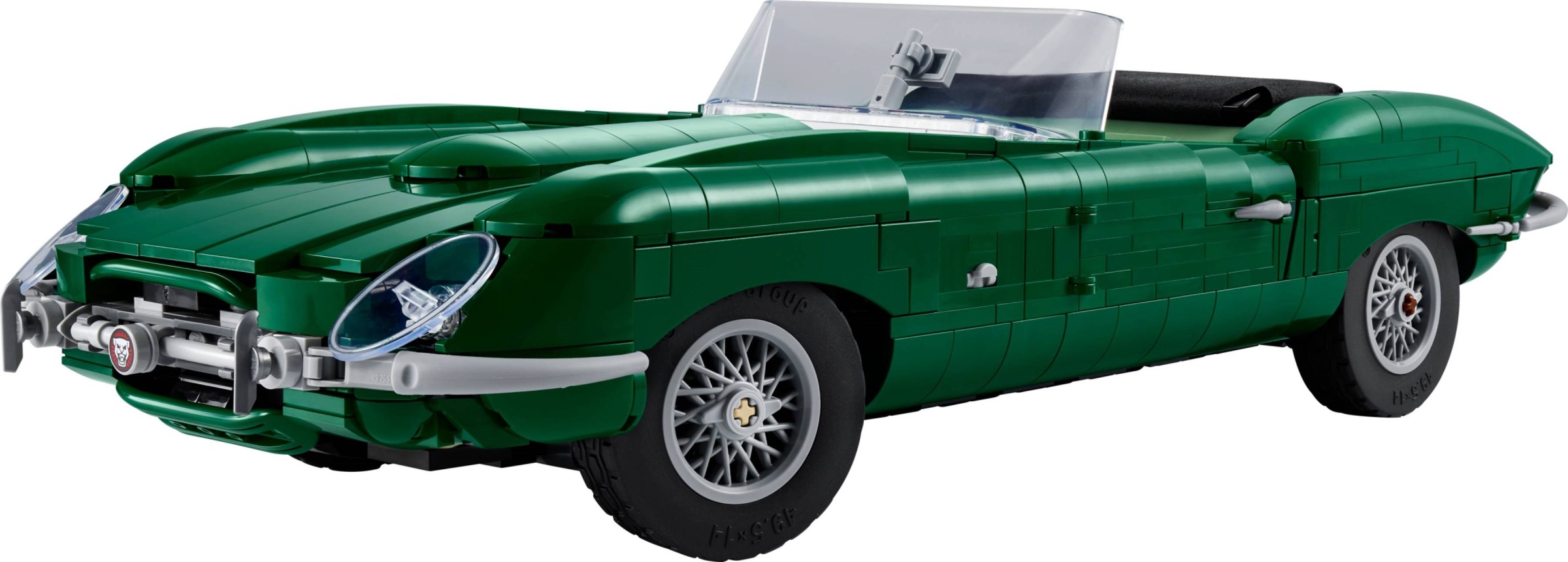
They got it right. The set nails the impossibly long nose, the faired-in headlamps, and the low, arching haunches that made the real thing look fast standing still. It is not a perfect build, and I will get to the couple of places where the studs win their argument against the curves, but as a piece of shelf sculpture this is one of the finest cars LEGO's Icons line has produced. It sits alongside the Ford Model T not as a rival but as the other bookend of the same story: one car that made the world drive, and one car that made it dream.
At 1,673 pieces this is a genuine evening-and-a-bit build, and it is structured the way the best Icons cars are: from the mechanical bones outward. You start with a Technic-reinforced chassis and the functional steering assembly, which links the front wheels to a turnable input so the model is not just a static shell. That structural core matters more here than on most cars, because the E-Type's silhouette asks LEGO to hang a very long, very smooth bonnet off the front, and the frame has to hold all of that rigid without sagging.
The inline-six engine is the first real reward, and it is a proper little assembly built up under the bonnet with the long, ribbed cam covers that made the XK straight-six such a handsome thing to look at. Dark tan plume elements stand in for the polished cam-cover finish, and when the forward-hinging bonnet lifts to reveal it, the effect is exactly what an Icons car should deliver: a display piece that opens up into a second model.
The bodywork is where the build earns its scores. The bonnet is a study in curved slopes and carefully stepped plates, and the rear haunches over the wheels are the fiddly, satisfying centrepiece, sculpting compound curves out of a medium that fundamentally does not want to make them. The doors are built to open with minimal gapping when shut, the boot opens via a hidden pin on the underside to reveal the stored toolkit, and the cloth roof folds back with a rear-window cutout so you can pose it as a coupe-style closed car or an open roadster.
It is not a beginner build. The panel alignment across the bonnet and the haunches wants patience, and a couple of stages ask you to trust the instructions through some structurally unintuitive steps before it all resolves into a shape. But it never becomes a chore, and the payoff moments, first engine, first haunch, first time the whole nose is on, keep the pace up across the full session.
Finished, this is a showstopper. At roughly 37 cm long it has real presence, the proportions of the real car carried across almost intact: that famous elongated bonnet stretching out ahead of a compact cabin, the low roofline, and the sensuous curve of the rear deck. British Racing Green is exactly the colour this car should wear, and against the sand-green upholstery inside the cabin it reads as unmistakably, gloriously period-correct 1960s Britain.
The faired-in headlamps under their covers are the detail that sells the front end, and the new wheel design, integrated with the mudguards to suggest the wire-style wheels of the original, gives the whole thing the right delicate, spoked-and-slender stance rather than the chunky tyres of a modern build. Under a display light the green takes on depth and the long bonnet throws a shadow that makes the car look like it is moving.
Display flexibility is a quiet strength. Roof up, it is an elegant fixed-head coupe; roof folded, it is an open tourer ready for a summer road. Bonnet down it is a clean sculpture; bonnet up it is an engineering showpiece with that inline-six on show. Few Icons cars give you this many ways to pose the same model, and every one of them looks like it belongs in a gallery rather than a toy box.
The photographer's angle is the low three-quarter front, where the length of the bonnet and the arc of the front wing are both in frame at once. It is the same angle every motoring magazine has shot this car from since 1961, and the LEGO version holds up to it better than a brick-built car has any right to.
At 1,673 pieces the E-Type is a substantial haul, and the palette is a gift to anyone who builds cars. This is one of the larger concentrations of British Racing Green curved slopes, wedge plates and arch elements you will find in a single box, and those are precisely the parts that vintage and sports-car MOC builders hoard. The sand-green interior elements are less common still, and the wheel-and-mudguard assembly is a set-specific technique worth studying for anyone recreating classic wire-wheeled cars.
The five-piece toolkit that stores in the boot is a charming inclusion that doubles as a small parts bonus, and the inline-six engine sub-build is a reusable lesson in packaging a detailed motor into a tight bay. There is no minifigure here, which is entirely correct for a display car of this class, so the value is all in the build, the parts and the finished object rather than a collectible figure.
On the longer view, the E-Type is about as blue-chip as automotive subjects get. It is one of the most revered and instantly recognised cars in the world, and licensed LEGO sets tied to genuinely iconic machines tend to hold collector interest far better than sets riding a passing trend. Our LEGO Investing 101 guide walks through why halo-car and design-icon sets tend to age the way they do.
The Jaguar E-Type broke cover at the Geneva Motor Show in March 1961, and it did not so much arrive as detonate. Here was a car that looked like nothing else on the road, with a bonnet that seemed to go on for a week, headlamps smoothed under glass covers, and a shape drawn not by a stylist chasing fashion but by the aerodynamicist Malcolm Sayer, who came to car design from the aircraft industry and treated the body as a problem of airflow first and beauty second. That it turned out to be one of the most beautiful objects of the twentieth century was almost a side effect of getting the physics right.
Under that long bonnet sat Jaguar's XK straight-six, 3.8 litres at launch and later 4.2, feeding a car that Jaguar claimed would reach 150 mph at a time when that number belonged to exotic machinery costing several times as much. The E-Type democratised the supercar look and the supercar speed, which is exactly why it caused such a stir. Enzo Ferrari, a man not given to praising the competition, is famously said to have called it the most beautiful car ever made, and few who have stood in front of one have argued with him since.
Across its run from 1961 to 1975 the E-Type evolved through three series, gaining a larger cabin, revised lamps and eventually a 5.3-litre V12, with more than seventy thousand built before production ended. Today it sits in the permanent design collection of New York's Museum of Modern Art, one of very few cars ever granted that status, which tells you everything about how the world came to regard it: not merely a fast Jaguar, but a piece of sculpture that happened to have an engine.
Classic car enthusiasts are the obvious heart of the audience, and for anyone who has ever stopped dead on a street to watch an E-Type go by, this is an immediate yes. The colour, the proportions and the opening bonnet over a detailed six give it exactly the reverence the real car deserves, and it will mean something to a Jaguar fan in a way few licensed sets manage.
Adult builders who want a display-scale car with genuine sculpting challenge will find plenty here. The haunches and the long bonnet demand real curve work, the functional steering and folding roof add mechanical interest beyond a static shell, and the finished model is one you will be happy to leave on show indefinitely rather than pack away.
It is also a superb gift for the person who is not necessarily a LEGO builder but is unmistakably a car person. The E-Type carries such universal recognition that the recipient will know exactly what they are looking at, and the build is involved enough to reward an experienced hobbyist while remaining a set anyone patient can complete. As a bridge between the LEGO shelf and the motoring enthusiast's study, it is close to ideal.
The natural shelf-mate is the Ford Model T (11376), the other end of the Icons automotive timeline. One car put the world on wheels and one car taught it to dream, and side by side they tell the whole arc of the twentieth-century automobile from utilitarian black to British Racing Green.
For a specifically 1960s sports-car grouping, the E-Type sits beautifully alongside the Shelby Cobra (10357), giving you the transatlantic rivalry of the era in brick form: British elegance against American muscle, both wearing the low-slung roadster silhouette that defined the decade.
And for a Jaguar corner of the collection, pair it with the Speed Champions Jaguar Project 7 and Land Rover Defender (77264), whose Project 7 speedster nods directly back to the D-Type and E-Type bloodline. The scale contrast between the display-grade Icons E-Type and the pocket Speed Champions Jaguar is a fun conversation in its own right.
Pros
- The long-bonnet silhouette and faired-in headlamps are captured superbly
- British Racing Green over sand-green interior is period-perfect
- Forward-hinging bonnet reveals a detailed inline-six engine
- Folding cloth roof lets you pose it open or closed
- Functional steering and opening doors and boot add genuine play and detail
- A rich haul of racing-green curved and wedge elements for MOC builders
Cons
- The compound curves of the haunches show their studs at some angles
- A demanding build with a few structurally unintuitive stages
- No minifigure, though that suits a display car of this class
- Panel alignment across the bonnet needs patience to sit flush
The Jaguar E-Type is one of the most beautiful cars ever made, and LEGO Icons has given it a build worthy of the compliment. At 1,673 pieces it delivers the length, the stance and the curves that made the real thing a legend, wrapped in exactly the right green and opening up into an engine bay and cabin that reward a closer look. This is Icons doing what it does best: a display object that is also a genuinely engaging build.
It takes EARL APPROVED status with room to spare, carried by a display quality that ranks among the finest cars the theme has produced, a satisfying and characterful build, and a parts palette that MOC builders will raid for years. It is held just short of a flawless score only by the handful of angles where the bricks lose their argument with the E-Type's impossible curves, which is about the most forgivable sin a set like this could commit.
Available now, and an easy recommendation for any classic car lover, Jaguar devotee, or collector who wants the single most elegant silhouette in motoring history sitting on their shelf. Sixty years on, the E-Type still stops the room.
- Ford Model T Review - The other Icons automotive bookend, the car that put the world on wheels
- Shelby Cobra Review - The American muscle roadster to the E-Type's British elegance
- Jaguar Project 7 & Land Rover Defender Review - The Speed Champions Jaguar that nods to the E-Type bloodline
- LEGO Investing 101 - Why sets tied to design-icon cars tend to age well
Track it in your vault on GameSetBrick - our free collection app. Log your condition, price paid, and watch the real-time market value.
Track in Your Vault →Save it to your wishlist on GameSetBrick. Share your list with friends and family - every set has a buy button so gift givers know exactly where to go.
Add to Wishlist → GameSetBrick is a free app by The Earl of Bricks. See all features. Scan it. Track it. Trade it.