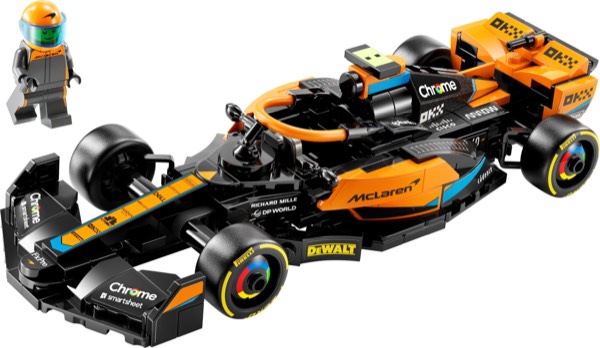
The McLaren Formula 1 Race Car was the set that proved LEGO could do modern F1 justice at Speed Champions scale. At 245 pieces, the build takes roughly 30-40 minutes and delivers a tight, focused construction experience that wastes nothing. The 8-wide format - wider than the older 6-stud Speed Champions cars - gives LEGO's designers room to capture the MCL38's proportions with a fidelity that smaller formats could not achieve. Every piece placement feels purposeful, and the papaya orange livery begins asserting itself from the very first bodywork elements.
Construction follows the sequence that has become standard for Speed Champions F1 cars: flat chassis plate first, then cockpit tub, then sidepod assemblies, and finally the aerodynamic elements - front wing, rear wing, and halo. The nose cone assembly is the most satisfying subassembly, using a clean wedge plate arrangement that captures the MCL38's tapered front end without overcomplicating the construction. The rear wing uses a dual-element approach that suggests the DRS flap, and the halo clicks over the cockpit with a secure fit that holds the driver minifigure in proper position.
This was the first Speed Champions McLaren F1 car, and it set a standard that the subsequent MCL38 2025 version (#77251) would build upon. The 2024 version remains a strong build in its own right - slightly smaller in piece count but no less satisfying in execution. For builders who own both, the comparison reveals the incremental refinements LEGO makes between model years at this scale.
The sidepod construction uses curved slope elements to create the aerodynamic undercut that defines modern F1 cars. At 8-wide scale, suggesting the complex airflow channels of a real F1 sidepod requires careful element selection, and the McLaren does it well. The inverted slopes tucked under the main body create a visual recession that reads as aerodynamic intent from normal viewing angles. The front wing uses thin plate elements at slight angles to suggest multi-element aero surfaces, demonstrating how LEGO compresses complex geometry into a handful of pieces.
The printed elements handle key identity details without stickers: the nose livery, the rear wing endplates, and the driver helmet all use pad-printed decoration that avoids the alignment issues stickers inevitably introduce. This print-over-sticker approach is one of the things that makes the 2024 F1 Speed Champions wave feel premium. For builders studying how Speed Champions communicates car identity through element selection and print placement, comparing this McLaren to the Red Bull RB20 (#77243) or the Ferrari SF-24 (#77242) shows how different color palettes and print designs create distinct visual identities on the same underlying chassis platform. The consistency of the 8-wide platform is what makes these comparisons so instructive - every car starts from the same chassis architecture, and the differences in the finished product come entirely from bodywork element selection and color placement. That controlled variable approach makes the 2024 F1 wave an ideal study set for anyone learning how to differentiate vehicles through surface treatment rather than structural change.
245 pieces with a strong papaya orange concentration. Orange is one of LEGO's less common colors in bulk, and the McLaren provides a selection of curved slopes, wedge plates, and standard plates in this shade that are immediately useful for any warm-toned vehicle or creative build. The papaya orange elements from this set are identical to those in the MCL38 (#77251) and the McLaren W1 (#77257), so builders accumulating orange across multiple McLaren sets are building a genuinely useful color inventory.
The wide rear tires with Pirelli printing are shared across the 2024 F1 Speed Champions wave and are among the most sought-after wheel elements for custom vehicle builds. The structural elements - dark grey and black chassis pieces, bracket connectors, and standard plates - are universally useful. The driver minifigure with printed McLaren racing suit adds figure value. At the 2024 price point, the per-piece cost is excellent for a licensed set, making this one of the most accessible entry points into both Speed Champions collecting and the LEGO F1 universe.
Papaya orange on a shelf stops people in their tracks. The McLaren's livery is inherently photogenic - bright, warm, and distinctive against any background - and LEGO's consistent element color matching means the orange reads evenly across the entire bodywork. From three feet away, the car presents a clean, recognizable F1 silhouette in one of motorsport's most iconic colors. The black accents along the sidepods and engine cover provide enough contrast to define the car's aerodynamic surfaces without breaking up the orange impact.
The proportions are accurate for a modern F1 car at 8-wide scale: low nose, wide body, tall rear wing, prominent halo. The driver minifigure seated in the cockpit adds scale reference and visual interest. For McLaren collectors, this 2024 version sits alongside the 2025 MCL38 (#77251), the Technic MCL39 (#42228), and the City McLaren (#60442) to create the most comprehensive single-manufacturer F1 display in the LEGO catalog. Four scales of papaya on one shelf tells the complete McLaren story.
Under warm display lighting, the orange elements take on a golden quality that makes the car look even more premium than it already does. This is one of those sets that photographs better than it looks in person, and it looks excellent in person. For desk display, bookshelf placement, or a dedicated Speed Champions grid, the McLaren earns its position at the front of the visual field.
245 pieces at the 2024 Speed Champions price point delivers one of the best per-piece values in the F1 wave. The printed elements, the papaya orange parts selection, and the licensed minifigure combine to create a purchase that feels like more than the price suggests. Speed Champions has always punched above its weight on value, and the McLaren F1 continues that tradition. You are getting a licensed F1 car that looks this good for the price of a casual dinner out.
For builders choosing between multiple McLaren sets, this 2024 version offers the most accessible entry point. The 2025 MCL38 is a slight refinement, the Technic MCL39 is a major investment, and the McLaren W1 is a hypercar rather than an F1 car. This 76919 is the sweet spot: the right amount of car, the right amount of build, the right amount of money. For our complete ranking of every LEGO F1 set, see the definitive guide.
A single McLaren F1 driver minifigure is included wearing the team's papaya orange racing suit with black accent printing. The torso features the McLaren speedmark logo, team sponsor graphics, and the orange-to-black color transition that defines the 2024 race suit design. The leg printing continues with sponsor details on the thighs. The papaya orange suit is vibrant and instantly recognizable as McLaren at minifigure scale.
The helmet uses the 2024 Speed Champions mold with McLaren branding in the papaya and black scheme. An alternate hair piece is included for helmetless display. This figure is from the 2024 wave and features slightly different printing from the 2025 MCL38 driver, reflecting the year-over-year livery evolution. For McLaren minifigure collectors, owning both the 2024 and 2025 driver figures shows the incremental branding changes that the real team makes between seasons.
The McLaren Formula 1 Race Car 76919 is for F1 fans who want the car that started the 8-wide revolution. As the first Speed Champions McLaren F1 car, it holds a place in LEGO F1 history that the subsequent 2025 MCL38 refinement cannot claim. For collectors who value first editions and historical significance within a product range, the 76919 is the original and the one that proved the concept.
For McLaren completists building a multi-scale papaya display, this 2024 version is a required component. Alongside the 2025 MCL38, the Technic MCL39, and the City McLaren, it completes a four-car lineup that spans four scales and three LEGO themes - the most comprehensive single-manufacturer representation in the current catalog. The subtle printing differences between the 2024 and 2025 driver minifigures document the real team's year-over-year branding evolution, which adds a layer of detail that dedicated fans will appreciate.
Selective buyers choosing between this and the 2025 MCL38 should note that the 2024 version offers marginally better per-piece value and essentially identical display quality. The 2025 version has minor refinements in the rear diffuser area, but the differences are subtle enough that most buyers will be equally satisfied with either. If you find the 76919 at a discount - which is increasingly likely as the 2025 version takes over shelf space - it becomes one of the best values in the Speed Champions F1 range.
The 2024 McLaren F1 car predates the full 10-team 2025 Speed Champions grid, which means it occupies an interesting position in a collector's display. It is technically a previous-season car, built to a slightly different design standard than the 2025 wave. The proportions are marginally different. The livery details reflect a different sponsor arrangement. For completionists who want both the 2024 and 2025 McLaren representations, owning both creates a year-over-year comparison that reveals how LEGO's Speed Champions design team iterates on the same car across seasons. For builders choosing between this and the 2025 McLaren MCL38, the newer car has the edge in build refinement, but this 2024 version carries the historical weight of McLaren's resurgent championship year. Both have a place on the shelf. The question is whether your collection tells the story of one season or the evolution across multiple seasons.
- ✓ Papaya orange livery is instantly recognizable and photographs beautifully
- ✓ Printed elements avoid sticker frustration on key details
- ✓ Strong shelf presence in the 8-wide format
- ✓ Excellent per-piece value for a licensed F1 set
- ✓ Orange parts are valuable and uncommon in bulk
- ✓ First Speed Champions McLaren F1 - historical significance in the range
- ✗ Rear diffuser area feels slightly simplified compared to 2025 wave
- ✗ No display stand or pit accessories included
- ✗ Superseded by the refined 2025 MCL38 version
Some products may be provided by manufacturers. This page contains affiliate links. All opinions are my own.
- McLaren MCL38 Review - The updated 2025 McLaren F1 in Speed Champions
- McLaren MCL39 Technic Review - McLaren at massive 1:8 Technic scale
- McLaren W1 Review - McLaren's ultimate hypercar in Speed Champions
- McLaren F1 City Review - McLaren at the entry-level City scale
- Every LEGO F1 Set Ranked - The definitive F1 guide
Track it in your vault on GameSetBrick - our free collection app. Log your condition, price paid, and watch the real-time market value.
Track in Your Vault →Save it to your wishlist on GameSetBrick. Share your list with friends and family - every set has a buy button so gift givers know exactly where to go.
Add to Wishlist → GameSetBrick is a free app by The Earl of Bricks. See all features. Scan it. Track it. Trade it.