
Most builders treat bulk bricks as a compromise, something to use up until they can afford the "real" pieces for a project. That's backwards. Bulk lots are where constraints become creative decisions, and creative decisions separate a finished MOC from one gathering dust on a shelf. The Chevrolet and Shell logos on the IMS Pagoda garage wall came from exactly this mindset: dig through what arrived in that Facebook Marketplace haul, figure out what colors and pieces actually showed up, then build around those specifics instead of chasing a predetermined design. The result is more authentic than if I'd ordered exactly what I thought I needed.
Building with inventory instead of a wish list teaches you something straight-line planning never will. You discover which color transitions work, which piece counts force you to simplify a shape, where a sticker saves you from impossibly tedious construction. You also move faster. No waiting for orders, no second-guessing which element will show up, no paralysis over whether to commit expensive inventory to an experiment. The wall details got built because the materials showed up and the building window was open. That's how real progress happens.
You are scrolling Facebook Marketplace on a Tuesday night and you see it: a gallon-size ziplock bag of LEGO bricks, ten dollars, local pickup. The listing says "my kid's old LEGO" and the photo is blurry, but you can see color. Lots of color. Red, yellow, blue, white, some gray. You do not know exactly what is in there. You just know it is LEGO, it is cheap, and it is a gamble you are willing to take.
Every AFOL has done this. The Facebook Marketplace bulk buy is a rite of passage in this hobby - the moment you stop thinking of LEGO as a retail product and start thinking of it as raw material. I wrote about my first marketplace haul in Part 8: The Bulk Buy of the IMS Pagoda series, and I put together a full guide to sourcing bulk bricks based on community advice from two Facebook groups. But this story is not about the sourcing strategy. This story is about what happened when I dumped that bag out on the table and started sorting.
The bag was heavy on red. Heavy on yellow. A decent amount of blue and white. Some dark gray, some light gray, a smattering of green and orange. The white and light gray bricks went straight into the Pagoda inventory - those are the primary colors of the build and every piece counts. But the reds and yellows and blues sat there in their sorted piles, and I looked at them and thought: I have plans for you. I just do not know what they are yet.
That is the honest truth of bulk buying. You acquire parts before you have a use for them, and then you carry those parts around in the back of your mind until the build presents an opportunity. Sometimes it takes days. Sometimes weeks. For these particular bricks, it took until I started building the pace car garage - and then it clicked.
When you are building a MOC that needs thousands of white and light bluish gray bricks - which is exactly what the IMS Pagoda demands - bulk buying from Facebook Marketplace is the only affordable option. BrickLink is excellent for specific parts in specific colors, but the per-seller shipping costs make it impractical for acquiring hundreds of basic bricks. The Pick-a-Brick wall at the LEGO store is great when the rotation includes what you need, but you cannot count on it. Marketplace bulk lots give you volume at a fraction of the cost. The math works.
But bulk lots come with whatever the previous owner had. You are not ordering from a catalog. You are inheriting someone else's collection - the sets they built, the colors they preferred, the parts that accumulated over years of birthdays and holidays. Which means for every twenty white 1x4 bricks you pull from the sorted pile, you also end up with fifteen red 2x4s, a dozen yellow plates, a handful of blue slopes, and an assortment of parts in colors that have no place in your build's palette.
This is the trade-off every bulk buyer knows well. You get what you need at a great price, but you also get a pile of parts you did not ask for. And that pile sits on your building table, taking up space, demanding a decision. Do you sort them into a bin and forget about them? Do you list them on BrickLink and try to recoup a few dollars? Or do you look at those colors - really look at them - and ask yourself if the build has a place where they might belong?
I chose the third option. And the answer was already staring at me from across the building table: the back wall of the pace car garage.
The pace car garage is one of the ground-floor features of the IMS Pagoda build. It is the bay where the pace car sits - in this case, a micro-scale McLaren - and the back wall of that garage needed to be something. At 1:38 scale, the wall is visible when you look through the garage bay opening from the front of the build. It is one of the few interior surfaces that a viewer actually sees without picking up the model.
Plain light gray would have been the safe choice. It would have matched the Pagoda's structural palette. It would have been architecturally accurate in a generic sense. Nobody would have questioned it. But safe is boring, and I had these piles of red, yellow, blue, and white bricks with no home.
Here is the thing about the Indianapolis Motor Speedway: it is not a blank canvas. It is one of the most heavily sponsored venues in motorsport. Every wall, every surface, every piece of signage carries a brand. Chevrolet has been the official pace car partner and engine supplier for the IndyCar Series. Shell is a major fuel sponsor with a presence throughout the facility. If you have attended the Indy 500 - and I have been going for 26 years - you know that the Chevy bowtie and the Shell pecten are as much a part of the visual landscape as the Pagoda itself.
And what colors make up the Chevrolet logo? Red, white, and yellow on a blue field. What colors make up the Shell logo? Red and yellow on a white background. What colors did I have in abundance from my marketplace bulk buy? Red. Yellow. Blue. White.
Sometimes the build tells you what it needs. You just have to listen.
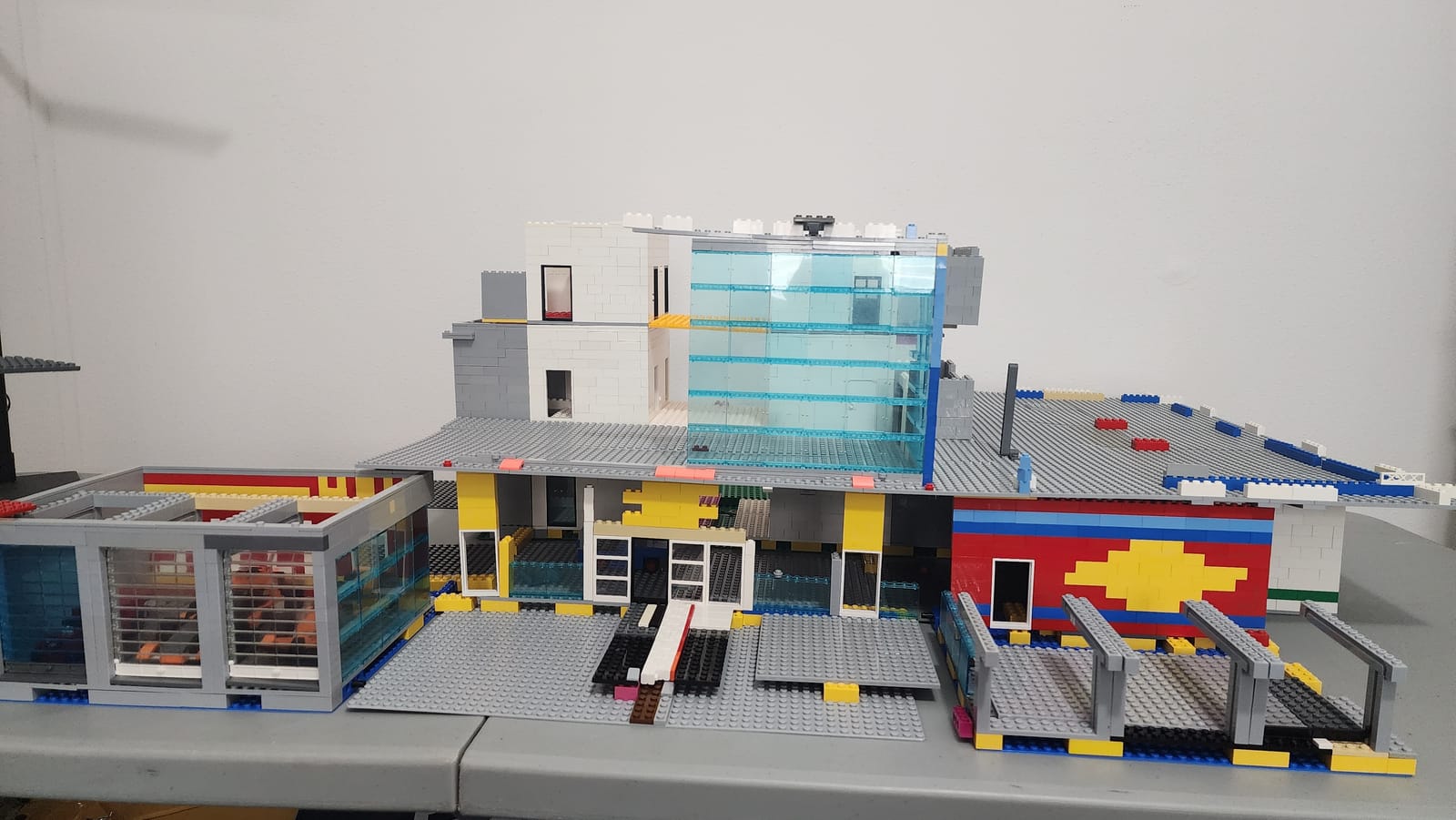
The Chevrolet and Shell walls visible through the garage bays - both logos built entirely from bulk marketplace bricks.
The Chevrolet bowtie is one of the most recognizable logos in the world. A horizontal cross shape - technically a modified bowtie or butterfly shape - with the iconic gold fill on a silver or white background. In the real world, it is a precise piece of graphic design with exact proportions and color specifications. In LEGO, at 1:38 scale, it is an exercise in abstraction.
The wall behind the first garage bay became the Chevy wall. The approach was straightforward: build the wall in a base color, then use contrasting bricks to approximate the bowtie shape. The red and yellow bricks from the bulk buy formed the cross shape against a white and blue field. At this scale, the logo is maybe eight studs wide. You cannot reproduce the exact curves and proportions of the real bowtie. What you can do is create a shape that reads as a bowtie - that gives the viewer's brain enough information to fill in the rest.
This is one of the fundamental principles of building at small scale. You are not trying to replicate every detail of the source material. You are trying to capture enough of the essential geometry and color that the subject is recognizable. The Chevy bowtie works at this scale because its shape is so distinctive - even a rough approximation in the right colors on the right background triggers recognition. Your brain sees red, yellow, and blue arranged in a horizontal cross pattern on a wall inside a garage at a motorsport building, and it thinks: Chevrolet. That is all it takes.
The constraints of available brick sizes and colors dictated the exact proportions. I did not design the logo first and then source the parts. I looked at the parts I had, looked at the wall space available, and built the closest approximation the inventory allowed. A 1x2 red brick here. A 1x1 yellow plate there. The shape emerged from what was on the table, not from a plan on paper. And that is exactly how it should work when you are building with bulk bricks.
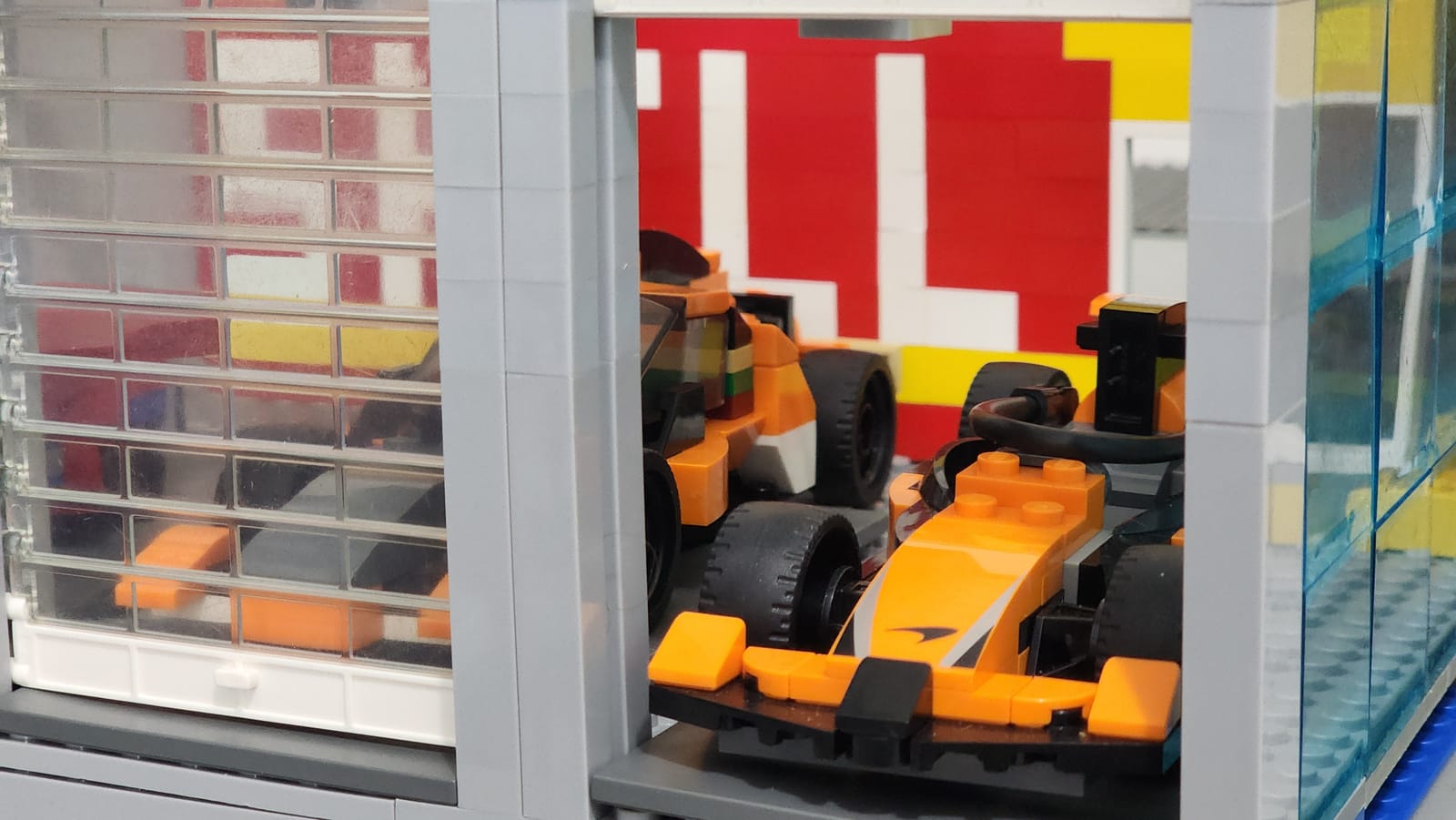
The Chevy bowtie wall behind the McLaren - the red, yellow, and white bricks came from a single marketplace bulk purchase.
The Shell wall on the adjacent garage bay followed the same logic. The Shell pecten - the stylized scallop shell that has been the company's logo since the early 1900s - is a more complex shape than the Chevy bowtie, but it has a simpler color palette: red and yellow on white. At this scale, the pecten becomes a roughly fan-shaped arrangement of red and yellow bricks against a white background. It is not a precise reproduction. It is an impression - a suggestion of the Shell brand in a context where that brand belongs.
Together, the two walls transform the garage interior from a generic gray space into something that feels specific to IMS. A viewer who knows the Speedway looks at those walls and recognizes the sponsors. A viewer who does not know the Speedway sees colorful branded walls inside a garage bay and understands that this is a professional motorsport facility, not a backyard workshop. Either way, the walls are doing their job. And every brick in those walls came from a ten-dollar bag off Facebook Marketplace.
There is a philosophy in the AFOL community that does not get talked about enough. It is the idea that constraints - not unlimited resources - produce the best creative work. Every builder who has ever dug through a parts bin looking for a piece that almost works, and then found a way to make it work perfectly, knows this feeling. The solution you arrive at through constraint is often better than the solution you would have reached with unlimited choice.
If I had placed a BrickLink order for exactly the parts I wanted, I might have built those garage walls in accurate LEGO colors with precise proportions. The logos would have been cleaner. The color matching would have been tighter. But I also might not have built them at all. The idea for sponsor logos on the garage walls did not come from a design plan. It came from looking at a pile of leftover bulk bricks and asking what they could become. The constraint - having these specific colors in these specific quantities - was the spark. The creative solution followed from there.
This is true across the entire hobby. The builders who produce the most interesting MOCs are rarely the ones with the deepest parts inventories. They are the ones who look at what they have and see possibilities instead of limitations. A dark red 1x2 slope is not a missing white 1x2 slope - it is a roof tile, a hood scoop, a bookshelf accent, a muddy path. Every part has infinite uses if you are willing to see beyond its intended purpose.
The best creative decisions come from constraints. Working with what you have forces solutions you would never reach if you had unlimited parts.
In Part 5: The Details of the Pagoda series, I established a rule about BrickLink verification - every structural part gets verified for accuracy, availability, and cost before it goes into the build. That rule is critical for the parts that define the Pagoda's architecture: the white facades, the gray structural columns, the specific slopes and tiles that create the building's profile. Those parts need to be right because they are the backbone of the model.
But decorative elements like the garage wall are a different category entirely. They are the creative margin - the space where improvisation lives. The BrickLink verification rule applies to structure. The garage walls are pure expression. And that distinction matters because it gives you permission to play. Not every brick in a MOC needs to be sourced with precision. Some bricks just need to be the right color at the right time, and a ten-dollar bag from Facebook Marketplace can deliver that just as well as a carefully curated BrickLink order.
I think about this when I see newer builders get paralyzed by the idea that they need exactly the right parts before they can start building. You do not. You need parts - any parts - and the willingness to see what they can become. The Chevy and Shell walls are not perfect reproductions. They are approximations built from whatever was in the bag. And they are two of my favorite details in the entire build precisely because of that. They have character. They have a story. They came from a ziplock bag on someone's porch for ten dollars, and now they are sponsor logos on the back wall of the Indianapolis Motor Speedway pace car garage.
That is the AFOL way. Build with what you have. Let the parts guide the design as much as the design guides the parts. Never throw a bulk brick into the reject pile without first asking it what it wants to be.
Building with bulk bricks teaches you something that buying individual parts from BrickLink never will: how to think in terms of what is available rather than what is ideal. This is not a lesser skill. It is arguably the more important one. Any builder can produce a great MOC with unlimited resources and precise part selection. The builder who can produce something memorable from a bag of random marketplace bricks has developed an instinct that transcends parts - an ability to see the build inside the brick pile before it exists.
The garage walls are a small detail in a large build. They are maybe forty or fifty bricks total, spread across two interior surfaces that most viewers will only glimpse through the garage bay openings. But they represent something bigger than their brick count suggests. They represent the moment in a build when surplus becomes story, when leftovers become intentional, when the parts you did not plan for become the parts you are most proud of.
If you are sitting on a pile of bulk bricks that do not fit your current build's color palette, do not shove them in a bin. Spread them out. Look at the colors together. Ask yourself what they remind you of. A flag. A logo. A brand. A pattern. The answer might be the most creative detail in your entire MOC. It was in mine.
Twenty-six years of going to the Indianapolis 500 means those corporate logos are burned into my visual memory. Chevrolet. Shell. Firestone. Borg-Warner. They are part of the texture of race day - as present as the sound of the engines and the smell of the fuel. When I saw those colors sorted on the table, some part of my brain was already assembling them into the brands that live on the walls of the Speedway. All I had to do was listen and let my hands follow.
That is what I love about this hobby. The moment when building stops being assembly and starts being art. A ten-dollar bag of random LEGO from a stranger's porch became Chevrolet and Shell on the walls of my dream build. If that is not the AFOL spirit, I do not know what is.
The garage walls are just one detail in a build that has been consuming my building table for months. If you want to follow the full journey, the IMS Pagoda build series covers every phase from initial concept through the current state of construction. Here are some related posts from the series:
- The Pace Car Garage - the full story of designing and building the garage bay where the McLaren lives.
- The Reveal Feature - how the Pagoda's front facade opens to show the interior floors.
- Steel Bones - the Technic-based internal structure that holds the entire build together.
- Progress Update - March 2026 - where the build stands as of this month, with photos of every completed level.
If you have built anything from bulk marketplace bricks - logos, patterns, mosaics, or just clever use of leftover colors - I want to hear about it. That is the kind of building story that makes this community worth being part of. Get on the mailing list and share what you have built with what you had.
Bulk brick building directly impacts how you see secondary market value and what you actually stock. If you only build from instruction-set pieces, you're blind to the real utility of your collection. Spent 40 dollars on a bulk lot and completed two functional wall sections that would have cost twice that in singles? That's not scrappy workaround building, that's efficient inventory management. The pieces that looked generic in the bin revealed themselves as essential once the project demanded actual problem-solving. Your understanding of color theory, proportion, and piece efficiency gets sharpened on every build that forces you to work with what landed in front of you.
The second point hits the secondary market itself. Knowing how to build with mixed inventory makes you a better buyer and seller. You stop overbidding on specific lots because you understand what bulk inventory actually yields. You see a 15-pound mixed haul and calculate real build potential instead of salvage value. This feeds back into your MOC planning. Better builders recognize opportunity in chaos, which means they finish more projects and have sharper instincts about what's worth acquiring in the first place.