
Building a functional garage for display models sits in that weird gap between pure aesthetics and practical engineering. Most builders see it as window dressing, a backdrop to make the car look good. What they miss is that a garage with working doors and realistic proportions forces you to solve actual spatial problems, material constraints, and scale consistency that don't come up in a standard display stand. The Pagoda pace car garage is the kind of project that teaches you more about structure and planning than building five standalone cars ever could.
The marketplace approach here changes everything. Bulk brick buying from resellers or broken-set lots means working with what you have rather than ordering specific pieces, and that constraint pushes creative solutions. You're not designing in Stud.io with infinite inventory, you're building with real material limitations and figuring out manual door mechanisms that actually swing smoothly on the pieces in front of you. That's where legitimate MOC work lives, and it's completely different from following a set instruction manual.
If you have ever been to the Indianapolis Motor Speedway, you know the Pagoda is not just a timing and scoring tower. The ground level of the real structure is functional space - garages, operations rooms, the infrastructure that keeps a race weekend running. When I started planning this MOC, I knew the ground floor had to include a garage bay. Not the team garages - those are separate structures that line pit lane, each one assigned to a car and crew for the month of May. This is the pace car bay. The garage where the official pace car is housed before it rolls out to lead the field.
At IMS, the pace car is not an afterthought. It is an institution. The pace car leads 33 cars and 300,000 people into the first turn at speed, and the driver who gets that job has earned one of the most coveted roles in motorsport. The car itself is always a production vehicle - Corvette, Camaro, whatever the manufacturer is running that year - and it sits somewhere on the property, prepped and ready, before it takes its position at the front of the field. In this build, that somewhere is the ground floor of the Pagoda. A dedicated bay with doors that open, a car inside, and sponsor walls behind it.
I have attended the Indianapolis 500 for 26 consecutive years. I have walked past the Pagoda hundreds of times, in May heat and in January cold when the track is empty and the grandstands are silent. The building has a presence that photographs do not capture - it anchors the entire facility. Building the garage bay first was a deliberate choice. Start with the functional. Start with the thing that connects the building to the race. Everything else - the levels above, the observation deck, the facade - sits on top of this foundation, both literally and conceptually.
A garage without a working door is just a box. I knew early on that the pace car bay needed doors that could open and close - not because anyone is going to play with this MOC like a toy, but because functional elements in a display build create a connection between the model and the real thing. When you can lift the door and see the car inside, the build stops being a sculpture and starts being a building. That distinction matters.
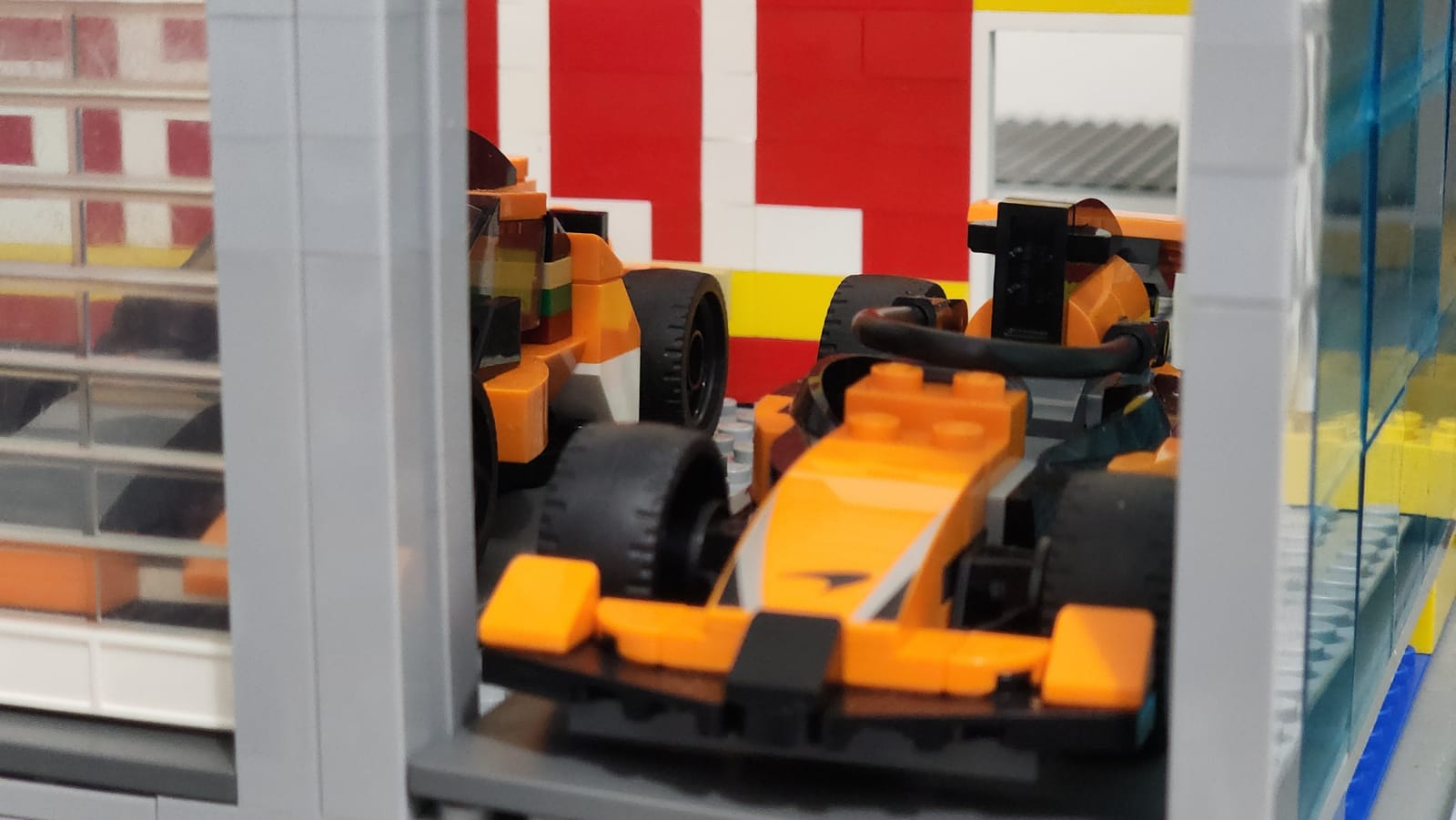
The pace car garage with manual doors - the McLaren #60442 sits inside, visible through the opening.
The doors are manual - no Technic motors, no rubber bands, no spring-loaded mechanisms. You lift them up and they stay up. You push them down and they stay down. The engineering is simple but deliberate: the door panels ride in channels formed by the surrounding wall structure, and friction holds them in position. I experimented with several approaches before settling on this one. A hinged door that swings outward looked wrong at this scale - real garage doors on buildings like this roll up or slide up, they do not swing. A Technic-driven mechanism added bulk behind the wall that ate into the interior space. The manual channel approach gave me the visual accuracy of an overhead door without the mechanical complexity.
The satisfaction of a working door in a display MOC is hard to explain to someone who has not built one. It is not about function in the practical sense - nobody needs to park a LEGO car inside a LEGO garage. It is about completeness. When every element of the build works the way the real thing works, even in a simplified form, the whole model feels more honest. You are not just representing a building. You are representing how a building operates. That is a different level of modeling, and it is one of the things that separates a MOC from a static diorama.
The LEGO City McLaren F1 #60442 is not a set I bought for this MOC. I bought it because it is a great little car. But when I started planning the Pagoda build and needed to establish a scale, this car became the anchor for every measurement that followed. The McLaren is 6 studs wide. A real F1 car is roughly 6 feet wide at the body. That gives you a conversion: 1 stud equals approximately 1 foot, which works out to roughly 1:38 scale. The math is covered in detail in the scale math article, but the short version is this: without the McLaren sitting on my desk as a physical reference, the Pagoda would have been built at a different scale and none of the proportions would have validated the same way.
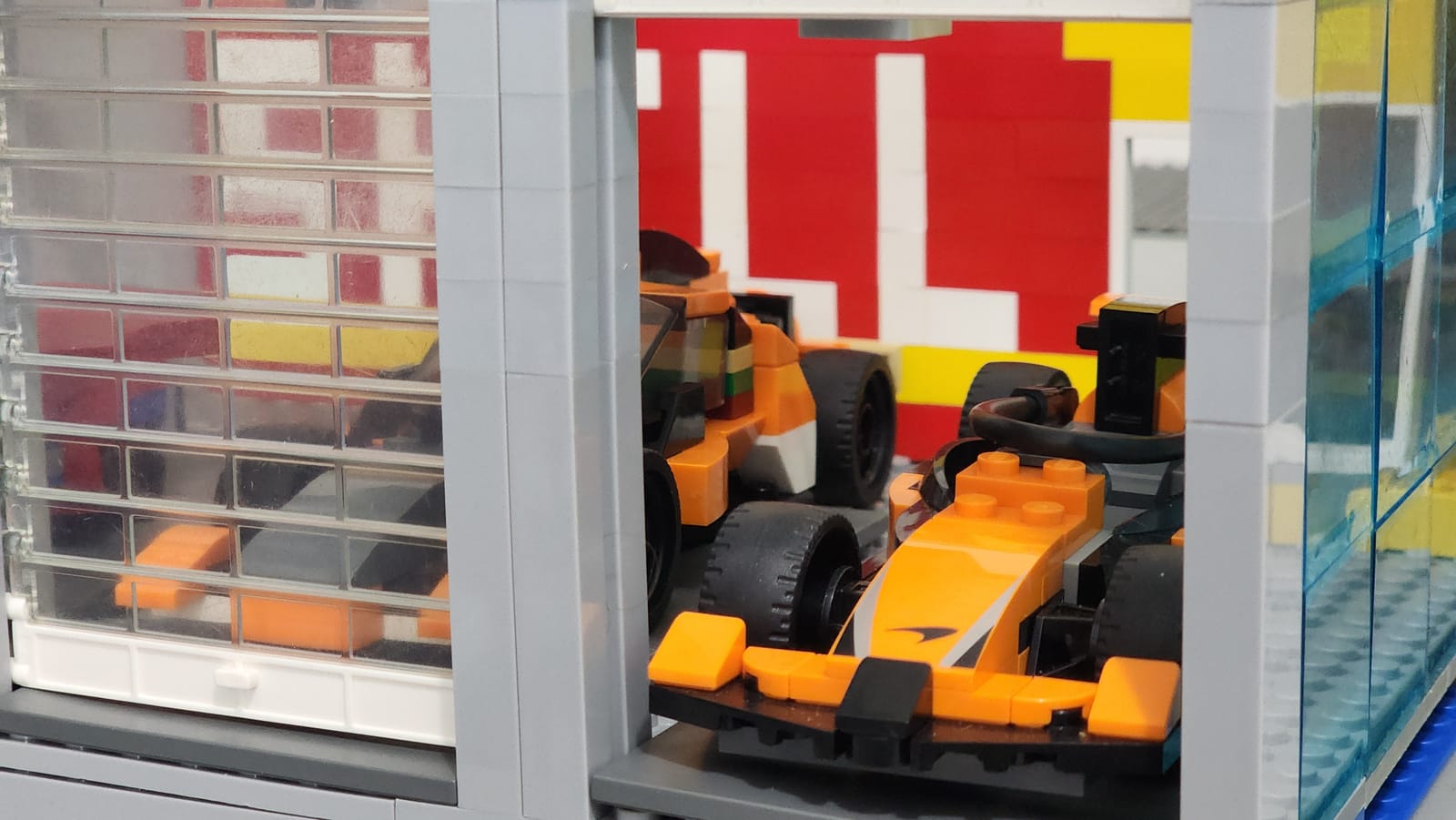
The Chevrolet wall visible behind the McLaren - built from bulk marketplace bricks in the brand’s distinctive colors.
Scale is everything in a building MOC. Get it wrong and doors look too small for the people who would walk through them. Windows look too large or too narrow. Floors are too short for anyone to stand in. The Pagoda is a real building with published dimensions, and I wanted this build to feel proportionally correct even if the exact measurements are simplified. The McLaren gave me a yardstick. If the car fits in the garage, and the garage fits in the ground floor, and the ground floor fits under the second level - then the building is at the right scale. Every dimension cascades from that 6-stud car width.
There is a particular kind of satisfaction in seeing a set you bought for one reason become essential to a completely different project. The McLaren was a $15 impulse buy. It became the single most important design decision in a build that will eventually use thousands of bricks. I keep it parked in the garage bay as a constant reference - when I am framing a new level or sizing a window, I can glance down at the ground floor and confirm that the proportions still make sense relative to the car. It is the measuring tape that never leaves the build table.
The back wall of the pace car garage has two things on it: a Chevrolet logo and a Shell logo. Neither was planned. Both emerged from the same bulk brick purchase that supplied a significant portion of this build’s standard bricks, which I covered in the bulk buy article. When you buy LEGO by the pound from Facebook Marketplace, you do not get to choose your colors. You get whatever the previous owner had - which usually means a lot of primary colors, some gray, and whatever specialty pieces happened to be in the mix.
In this case, the mix included a surprising number of gold-yellow and red bricks alongside white ones. The Chevrolet bowtie is gold and white. The Shell pecten is red and yellow. I did not sit down with a plan to build sponsor logos on the back wall of a pace car garage. I sat down with a pile of bricks and realized I had the right colors to do it. That is AFOL reality - you work with what you have, and what you have shapes what you build. The logos are simplified, obviously. At 1:38 scale, you are not reproducing fine typography or smooth curves. You are capturing the essence: the right colors in the right shapes in the right location. Anyone who knows racing will recognize what they are looking at.
This is one of the things I love most about building with bulk bricks. Constraints create creativity. If I had ordered exactly the parts I thought I needed from BrickLink, I probably would have built plain white walls behind the car and moved on. The available colors pushed me to add detail I would not have otherwise attempted. The garage went from a functional bay to a branded environment, and the build is better for it. For anyone sourcing parts for a large MOC, I wrote a full guide on sourcing bulk bricks - the strategies range from Pick-a-Brick walls to LUGBulk to the exact kind of marketplace purchase that produced these logos.
The colors you did not choose become the details you did not plan. That is not compromise - that is the creative process working as intended.
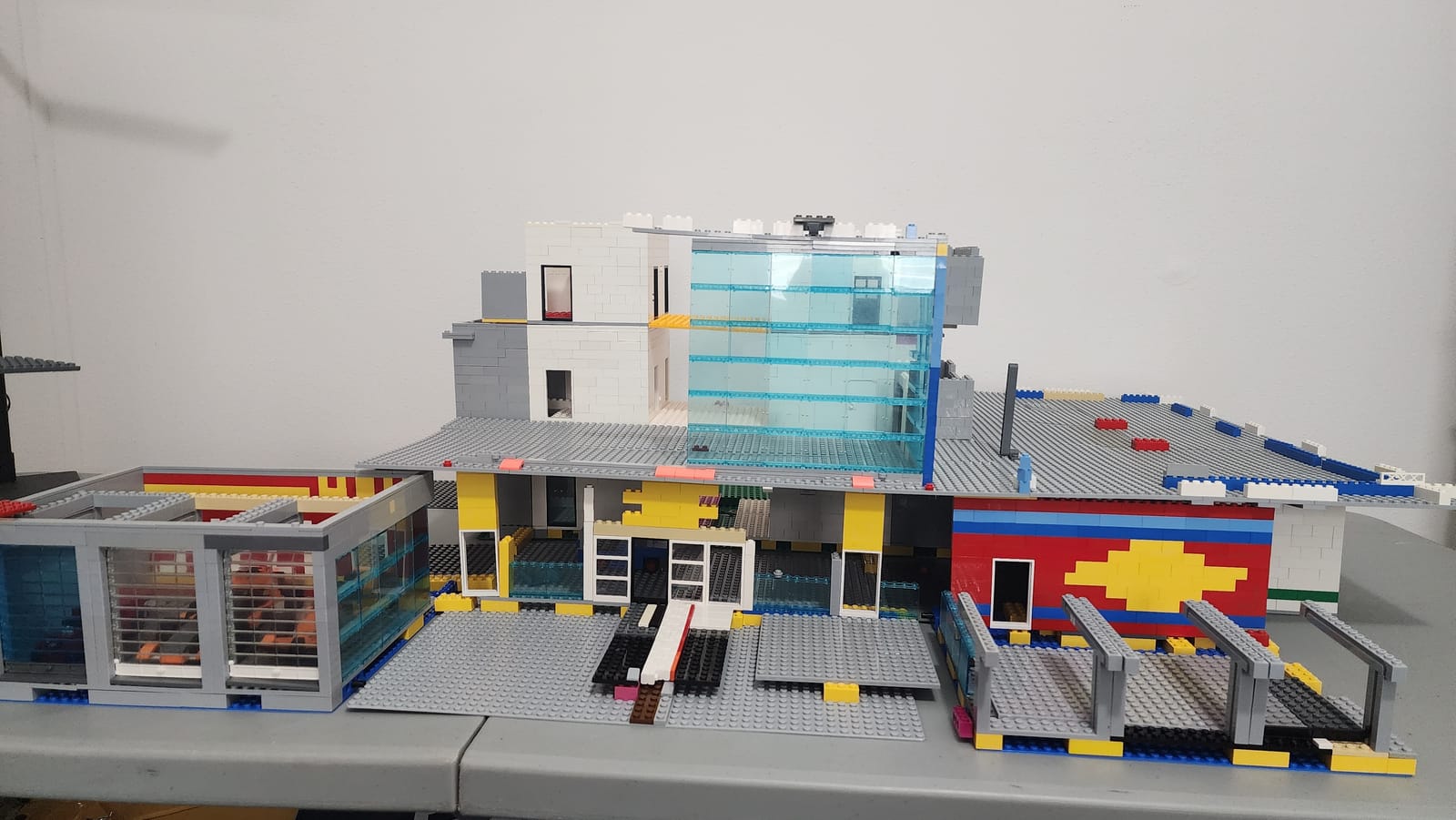
The full front facade - the pace car garage sits on the right side of the ground floor, with the Chevrolet and Shell walls forming its back.
The pace car garage does not exist in isolation. It is one element of the Pagoda’s ground floor, which I covered in Part 4: Ground Floor Footprint. The ground floor establishes the full footprint of the building - the width, the depth, the structural grid that every level above will inherit. The garage bay sits on the right side of the facade, occupying a defined section of that footprint. To its left is the central section of the ground floor, which contains the main entry area and additional functional space. The entire composition reads as a unified facade when viewed from the front, with the garage doors providing a visual anchor on the right side.
Getting the garage proportions right was critical because it set the standard for every other ground-floor element. The door opening had to be wide enough for the McLaren to pass through with clearance on both sides - you would not build a real garage door that the car barely squeezes through. The ceiling height had to accommodate the door mechanism while leaving enough vertical space for the floor above. The depth had to be sufficient for the car plus the back wall with its logos. These are not arbitrary dimensions. They are the result of the pace car sitting on the baseplate and everything else being measured relative to it.
When you zoom out and look at the full front facade, the garage bay is one of the most immediately recognizable elements. The doors, the car visible through the opening, the sponsor colors glimpsed behind - it reads as a garage instantly. That legibility is the goal. At 1:38 scale, you are working with limited resolution, so every element needs to communicate its purpose clearly. A viewer should be able to look at the ground floor and understand what each section is without explanation. The garage doors do that work - they are unmistakable, and they establish the functional character of the ground level before the eye travels upward to the more complex levels above.
The pace car garage is one piece of a much larger story. This build has been months in progress, and each major element has its own challenges, solutions, and lessons worth sharing. If you are following along with the IMS Pagoda build series, here is what is coming next.
The Reveal Feature covers the walls that open to expose the interior. A display MOC that you can only see from the outside is hiding half the work. The Pagoda has walls that swing open so you can see every level, every detail, every functional element - including this garage - without removing a single brick. The engineering behind that reveal system is its own article.
Steel Bones gets into the structural engineering that holds the whole thing together. A multi-level LEGO building at this scale has real structural challenges - weight, flex, connection strength across long spans. The internal framework that keeps the Pagoda rigid and level is not visible in the finished build, but without it, nothing above the ground floor would be possible.
Bulk Bin to Back Wall tells the full story of how marketplace bulk bricks became the sponsor logos and interior details you see in the garage and throughout the build. It is a deeper dive into the creative process of working with available materials rather than ordering exactly what you think you need.
And the March 2026 Progress Update will pull back to show all three completed levels in context - the ground floor, the second level, and the beginning of the third. The Pagoda is growing upward, and seeing the full vertical stack reveals how the proportions and design language carry from one level to the next.
The build is far from finished. But the ground floor - and the pace car garage in particular - is where the whole thing became real. It went from a concept and some scale math to a physical structure with a working door and a car inside. Every build needs that moment where it stops being an idea and starts being a thing. For the IMS Pagoda, that moment happened when I closed the garage door for the first time and the McLaren disappeared behind it. The building had a room. The room had a purpose. And the build had momentum that has not stopped since.
Garage MOCs get overlooked in the AFOL space because they're not centerpieces. They're supporting structures. But a well-built garage is exactly where scale integrity gets tested. A McLaren F1 at 1:38 demands different proportions from the space around it than you'd build for a 1:18 car, and cutting corners on those proportions immediately reads as wrong to anyone with trained eyes. The garage forces you to commit to your scale decisions because every dimension has to work with the car inside it. That discipline carries into everything else you build afterward.
The manual door mechanism is also where engineering skill actually shows up. Motorized doors look clean, but a manual door that swings true on standard LEGO hinges without binding, warping, or catching is genuinely harder. Getting the frame square, the hinge points aligned, and the door weight balanced teaches you about structural integrity in ways a motorized solution skips right over. It's slower, cheaper, and more honest. That's the builder's advantage right there.