
Three stories done. Eight to go. That ratio tells you everything about where this build stands, and it's the reality of tackling a structure this size at 1:38 scale. The IMS Pagoda isn't just another landmark MOC, it's a test of whether someone can sustain focus through the long middle stretch where progress feels incremental and the novelty of initial construction phases has worn thin. Most builders talk about their big projects in terms of piece count or overall dimensions, but what actually matters is whether you're still engaged when you hit month six and the real work is just beginning. That engagement lives in the details, in how you solve problems with the elements you've chosen, in how a reveal feature or structural choice forces you to rethink what comes next.
What separates builders who finish these projects from those who don't is almost never ambition, it's architecture. The Pagoda demands real structural thinking because it isn't symmetrical, it isn't simple, and it can't be rushed. The garage work, the broadcast area, the steel framework that holds everything together, these aren't afterthoughts or decoration. They're load-bearing decisions that determine whether the upper five stories sit solid or flex when you move the model. Watching this build move from foundation through mid-structure is watching someone either commit to the discipline or discover why they should have started smaller.
This is the first physical progress update for the IMS Pagoda LEGO MOC build. If you’ve been following the IMS Pagoda build series from the beginning, everything up to this point has been design phase - reference photos, scale calculations, Stud.io renders, bulk brick purchases, and a lot of staring at Google Earth. That phase is over. The model has moved from screen to table, and there are real bricks stacked in the shape of a real building.
As of late March 2026, three of the eleven stories that make up the Pagoda’s core tower are built. The ground floor is largely complete - pace car garage, interior room divisions, elevator shafts, structural columns, and the full building footprint established from photograph reference. The steel skeleton is in place. The broadcast area on the left side is starting to take shape. And the whole thing is sitting on my build table looking exactly like a building that is 27 percent finished and the build continues at its own pace.
I’ve been going to the Indy 500 for 26 years. I’ve watched the Pagoda from every angle - Turn 1 grandstands, the Snake Pit, Gasoline Alley, pit road, the Coke Lot at five in the morning. I know what this building looks like in person better than I know most buildings I’ve actually been inside. That familiarity is both the motivation and the standard. If something doesn’t look right at 1:38 scale, I’ll know. And I’ll rebuild it until it does.
Here’s where everything stands.
The ground floor was always going to be the most complex level. It’s where all the architectural chaos lives - the pace car garage, the building entrance bays, the sponsor signage walls, the structural columns that carry the entire tower above. Every other floor is essentially a rectangular box with windows. The ground floor is where the Pagoda stops being a tower and starts being a building with purpose.
The pace car garage is complete and covered in detail here. Working doors that open and close. The McLaren P1 pace car (set #60442) sitting inside, which I reviewed here - and which, at City scale, ended up being the reason the entire model is built at 1:38 rather than a rounder number. The car had to fit. The garage had to fit the car. The building had to fit the garage. Scale decisions cascade.
Behind the front facade, the interior is divided into rooms and corridors. The Chevrolet and Shell back walls were built entirely from bulk bin bricks - no BrickLink orders, no Pick a Brick, just whatever white, light gray, and branded-color bricks I could pull from the bins I bought. The full story on that process is worth reading if you’re interested in how a bulk buy actually translates into usable building material for a specific project.
The footprint itself was established from photographs - measuring proportions, counting window bays, cross-referencing aerial shots with ground-level images. Part 4 of the build series covers that process in detail. Getting the width right was critical because every floor above has to match. There’s no going back once the ground floor is locked in.
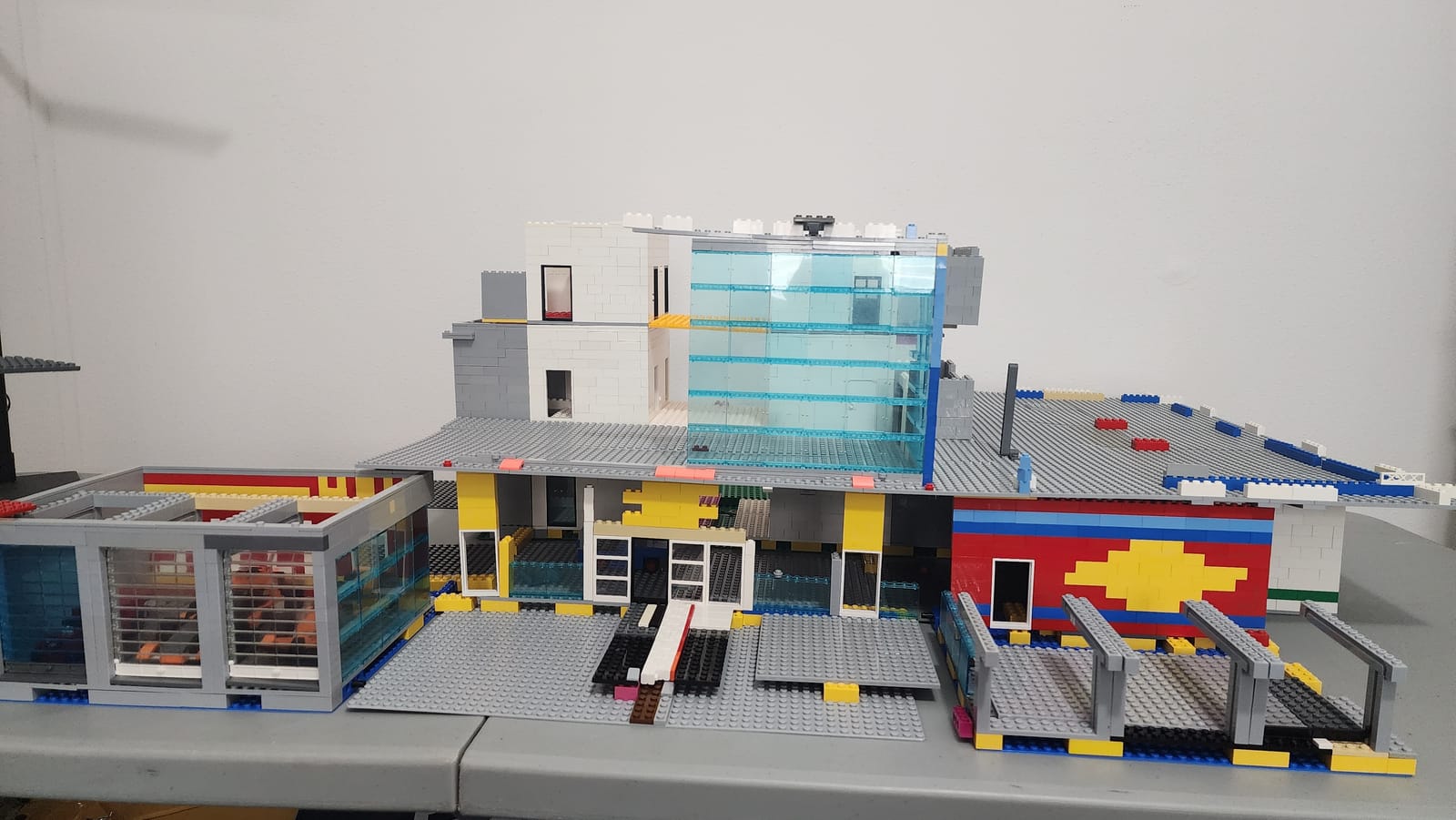
The ground floor front facade - pace car garage on the right, central entrance bays, and the full building width visible.
Standing back from the table and looking at just the ground floor, it reads correctly. The proportions feel right. The garage sits where it should. The entrance bays have the right rhythm. That’s the test - not whether every brick is in the perfect position, but whether the overall shape triggers the same recognition as the real thing. Three months of reference hunting and scale math paid off here.
The core tower is the vertical spine of the Pagoda - the elevator shafts and stairwells that run from ground level to the observation deck at the top. In the real building, this is the structural core that everything else hangs from. In the LEGO version, it serves the same purpose. The core tower is what gives the model its rigidity and its height.
Three of the eleven stories are built. White brick construction with clearly defined elevator shaft walls and stairwell openings. At this stage it looks like a stubby white rectangle, which is exactly what it should look like - the interesting exterior features come later when the floor plates and glass facades are attached. The core is just bones.
The most important feature of the core tower is the reveal mechanism. I designed a hinged front wall that swings open so you can see the interior construction - the elevator shafts, the room divisions, the structural details that would otherwise be hidden forever behind white walls. Detailed here. This was a deliberate design choice from the beginning. A building this complex deserves to be seen from the inside, not just the outside.
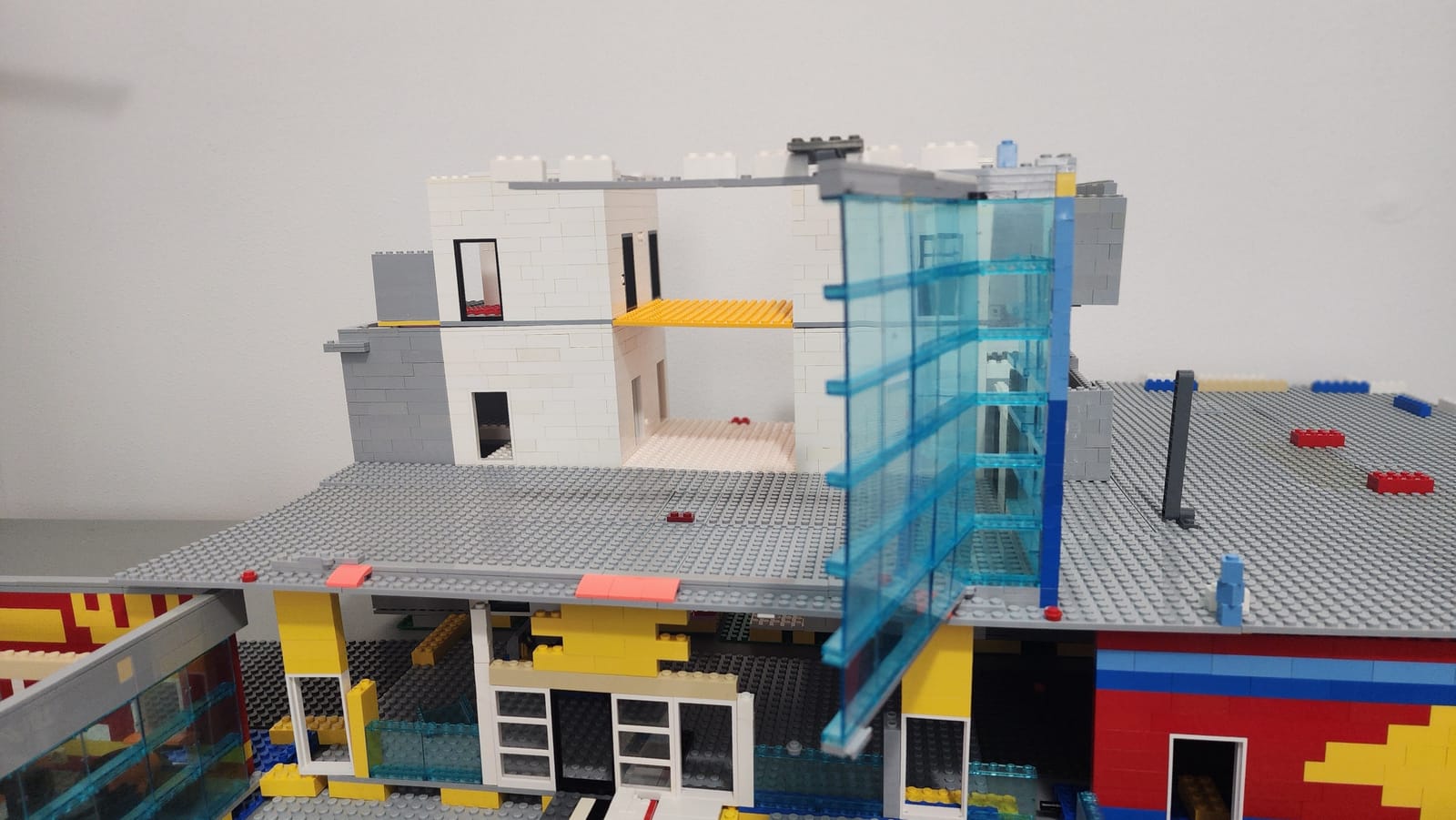
Three stories of the core tower - elevator shafts and stairwells visible through the reveal feature.
Building the core tower in isolation before attaching the floor plates was a conscious decision based on the modular approach outlined in Part 2. Each floor will be a self-contained module that slides onto the core. That means the core has to be straight, plumb, and consistent for all eleven stories. Any wobble at story three becomes a disaster at story eleven. So far, it’s tracking clean.
On the left side of the building, the beginnings of the level 2 broadcast area are emerging. This is one of the Pagoda’s most distinctive architectural features - the slanted glass front that angles outward from the second floor. In the real building, this is where the television broadcast crews set up during race weekends. ABC, NBC, Fox - whoever has the broadcast rights - they’re behind that glass, looking out over the front straight while the world watches on screens at home.
Translating a slanted glass facade into LEGO bricks is exactly the kind of problem that separates a MOC from a stack of bricks. LEGO doesn’t naturally do angles. Everything wants to be 90 degrees. Getting a convincing slope on the glass front requires either hinge plates, SNOT techniques, or some creative bracketing - and the angle has to be consistent across the full width of the broadcast area, not just close enough.
The approach I’m using builds on the angled facade discussion from Part 5: The Details. Hinge plates at the base of the glass section, with trans-clear panels mounted at the calculated angle. The trick is that the angle has to match the reference photos precisely enough that it reads as "the Pagoda" and not "a building with a slightly tilted window." That line between accurate and approximate is thin, and it matters.
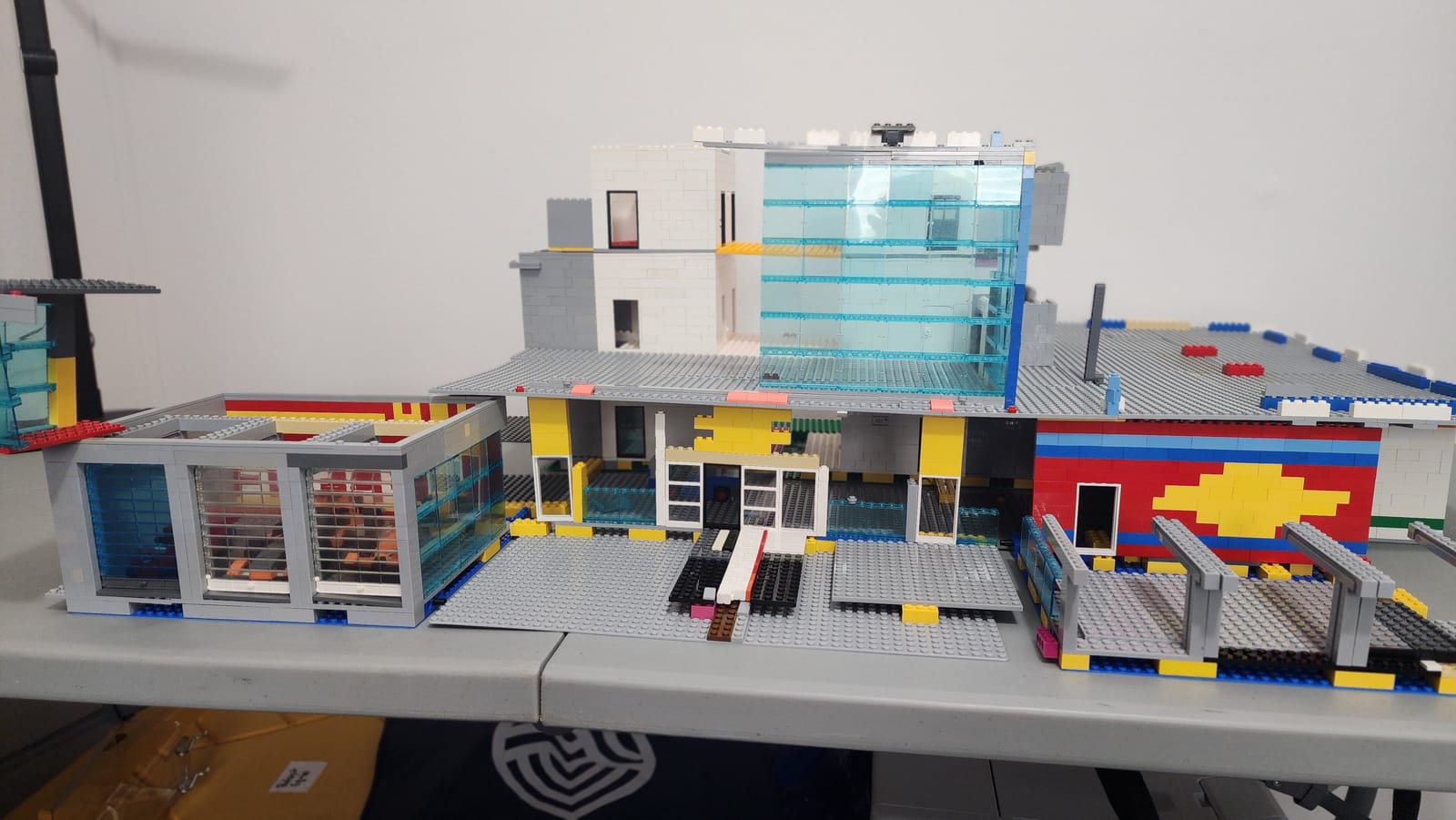
Pulled back to show the full width - the left side shows the early stages of the slanted glass front for the level 2 broadcast area.
What I like about where this section is right now is that it’s starting to give the model its distinctive silhouette. The ground floor and core tower alone could be any building. Add the angled broadcast area, and suddenly it’s recognizable. That’s the moment a MOC starts working - when the shape alone tells you what it is.
The structural steel is in place. Every column position, every beam location, every load-bearing connection was derived from photograph reference. Not estimated. Not eyeballed from memory. Measured from photos using the scale math established in Part 3 and cross-referenced against multiple angles to confirm positions.
The steel bones of this model are covered in detail here, but the short version is this: the Pagoda’s structural grid is visible in certain photographs - particularly during construction and renovation images, and in shots where the ground floor columns are visible through the glass. That grid became the skeleton. Dark bluish gray Technic beams and plates standing in for structural steel.
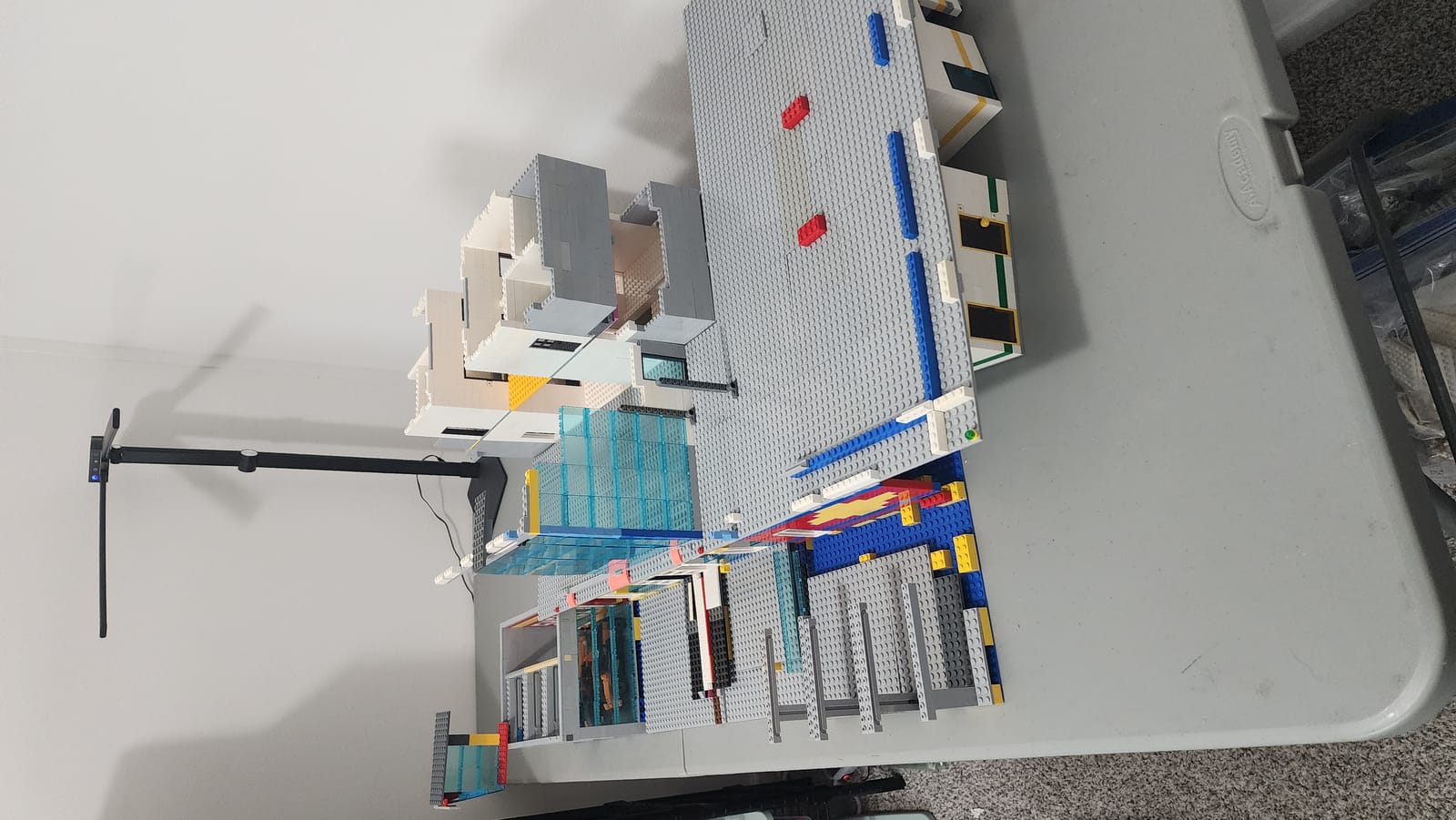
From above - the steel beam locations and structural column grid are clearly visible across the ground floor.
The skeleton is now ready to support the remaining eight stories. That’s the structural promise - if the columns are in the right places and the beams are the right lengths, then every floor plate that sits on top of them will land where it should. If they’re off, nothing above will line up. At three stories, I’m confident they’re right. At eleven stories, I’ll be sure.
3 of 11
Largely complete
Complete with doors
3 stories, reveal feature working
Level 2 slanted glass in progress
All columns and beams placed
1:38
150+
Eight stories remain. That sounds like a lot, and it is - but the pace should accelerate now that the ground floor complexity is behind me. Each remaining floor will be a modular unit following the system outlined in Part 2: build the floor plate, attach the exterior walls and glass, slide it onto the core tower, and lock it in place. Repeat eight times with increasing height and decreasing anxiety.
The hospitality areas on levels 4 and 5 will use transparent glass panels that I’m currently testing. These floors are where corporate sponsors host guests during race weekend - the views are spectacular, the air conditioning is aggressive, and the bar is always open. In LEGO terms, that translates to lots of trans-clear panels, some interior furniture if I can fit it at scale, and the challenge of making glass walls structurally sound at height.
Race control sits higher up the tower. This is where the race director calls the shots - yellows, reds, restarts, penalties. It’s one of the most important rooms in all of motorsport, and at 1:38 scale it’s going to be roughly the size of a small sandwich. But it needs to be there, and it needs to be identifiable.
Timing and scoring occupies its own floor. The observation deck sits at the very top - open air, 360-degree views, the highest publicly accessible point at the Indianapolis Motor Speedway. That’s the finish line of this build in every sense. When the observation deck goes on, the Pagoda is done.
The canopy edge treatment remains the one unsolved design problem. The real Pagoda has a distinctive overhang around the roof line - a canopy that extends beyond the glass walls and creates a shadow line. Replicating that overhang in LEGO at 1:38 scale without it looking clunky or fragile is an open question. Part 5 discusses the challenge in more detail. I have some ideas. None of them are confirmed.
There is no deadline on this build. The Pagoda will be finished when it is finished - the build continues at its own pace, one level at a time, with each floor getting the attention it deserves.
The reference hunt continues in parallel - every new photo I find has the potential to reveal a detail I missed or confirm a decision I made. And the scale math remains the constant reference point for every measurement. Those two resources are the foundation that everything else builds on, literally and figuratively.
This build has been documented from the very beginning - from the first scale calculation to the first brick placed. Here’s the complete reading list, in order.
Design phase:
- Part 1: The Build
- Part 2: Modular Design
- Part 3: Scale Math
- Part 4: Ground Floor
- Part 5: The Details
- Part 6: Reference Hunt
- Part 7: Learning Stud.io
- Part 8: The Bulk Buy
Build progress:
- The Pace Car Garage
- The Reveal Feature
- Steel Bones
- Bulk Bin to Back Wall
- Progress Update: March 2026 (you are here)
More updates are coming as the build continues. The next progress post will cover the first modular floor plate attachment - the moment the Pagoda starts growing vertically. Follow along.
Three stories built. Eight to go. The bricks are sorted. The reference photos are organized. The steel is in place. The pace car is parked. The ground floor is set. The build continues at its own pace - no rush, no deadline, just the steady work of getting each level right before moving to the next.
The Pagoda isn’t just a building at IMS. It’s the building. The one that appears in every aerial shot, every pre-race broadcast, every time-lapse of Gasoline Alley filling up at dawn. Building it in LEGO at a scale that does it justice is the most ambitious MOC I’ve attempted - and it’s the one that matters most.
Time to stack some bricks.
Most builders approach tall MOCs like they're stacking blocks upward until they reach a target height. The Pagoda is the opposite problem. You're building something that exists to be functional and recognizable at a specific landmark scale, which means every floor has a reason for being there and a structural purpose that can't be hidden behind clever angles. The garage foundation and broadcast area aren't filler, they're anchors that distribute load and give the upper structure something real to sit on. Skip those details or underestimate their complexity, and you're looking at a model that looks tall but feels hollow. That's the difference between completing a structure and finishing a MOC that holds up under its own weight, literally and conceptually.
The reveal feature is where most builders stumble on projects like this. You can build a tall building. You can build a functional building. Building something tall that opens to show internal detail without compromising structural integrity requires planning three stories ahead. Every floor's interior has to align, every hinge or sliding section has to account for the weight above it, and the exterior facade has to close cleanly when you're done revealing. At eleven stories total, miscalculate that approach by even one or two studs and you'll be taking apart completed sections to fix it. That's why progress at this stage isn't just about brick count, it's about whether the builder caught those problems now or will discover them at story nine.