
Reveal features separate the builders who think about their creations as static objects from those who build for actual engagement. The IMS Pagoda swinging glass facade isn't just decoration, it's the difference between a model you look at and a model you interact with. After twenty-five years of building, the projects that stick in my memory aren't the ones with the most pieces or the cleanest exterior, they're the ones where someone thought hard about what happens when hands touch the model.
Most MOC designers skip this step entirely. They lock their interiors behind solid walls, treat the model as a sealed box, and call it done. That approach works fine if your goal is photographs for Instagram, but it misses the core reason serious builders spend hundreds of hours on a single creation: the act of revealing what's inside matters. The engineering required to make that happen, the testing at different scales, the careful decisions about weight distribution and friction, those details are where craftsmanship actually lives.
Here is the uncomfortable truth about large-scale LEGO architecture builds: the more detailed the interior, the more painful it is to close the walls. You spend weeks - sometimes months - designing rooms, corridors, elevator shafts, stairwells, tile patterns on floors, furniture arrangements, signage. Then you attach the exterior walls and all of that work disappears behind a facade. The only person who knows the interior exists is the person who built it.
I have been building LEGO for decades. I have attended the Indianapolis 500 for twenty-six years. The IMS Pagoda is not just a building I admire from across the track - it is a structure I have studied from every angle, in every light, across more than half my life. When I committed to building it at 1:38 scale with full interior detail on every floor, I knew from the start that the interiors had to be visible. Not just in photos taken during construction. Not just as a memory of what I built before sealing it up. Visible. All the time. To anyone standing in front of the finished model.
The modular design already gives partial access. Every floor separates cleanly from the one below it, which means you can lift off upper stories and look down into any level. That solves the problem for documentation and maintenance. But it does not solve the display problem. When the Pagoda is fully assembled, eleven stories stacked and standing tall, a visitor looking at the model from the front sees exactly what they would see looking at the real building from the main straight - a glass facade with the suggestion of activity behind it. The interiors are there, but they are behind walls.
The reveal feature changes that. The front glass wall of the Pagoda swings open on a hinge mechanism, exposing the interior of the building without disassembling anything. No lifting floors. No removing panels. The wall opens like a door, the interior is fully visible, and the wall closes back into place when you are done. It transforms the model from a display piece into something closer to a museum exhibit - something people can interact with, explore, and actually understand from the inside out.
There is a rule I follow on every large MOC project, and it is this: never build the full version of a mechanism until you have proven the mechanism works at partial scale. It sounds obvious. It is not. The temptation on a build like this - where you have been designing for months and you can see the finished product in your mind - is to jump straight to the final implementation. Build the full glass wall, attach the hinges, swing it open, and celebrate. Except if it does not work, you have just wasted days of build time and potentially damaged finished sections of the model.
So I built half the front glass wall first.
Only the left half of the facade glass was constructed for the initial test. One panel, half width, placed at the current build height to test three things: whether the hinge connection is strong enough to support a transparent wall panel of this size, whether the swing arc clears the canopy overhangs without collision, and whether the wall seats back into its closed position precisely enough that the facade reads as seamless from the front.
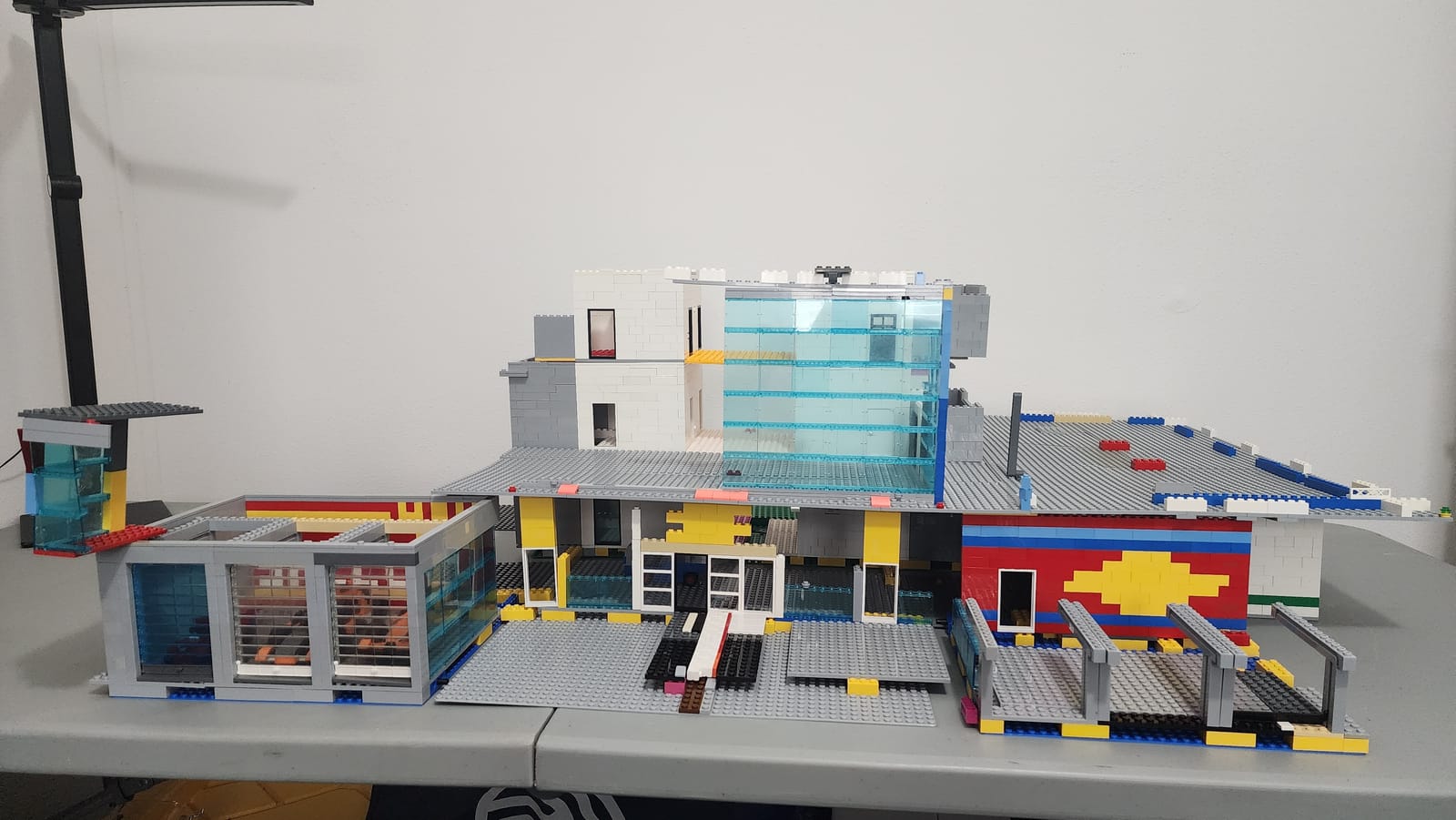
The glass wall test - only half the front facade glass is built, proving the reveal mechanism before committing to the full width.
The test was built at the current height - three stories - but the glass wall is designed to eventually rise to levels four and five, which are the hospitality and seating areas of the real Pagoda. Those upper levels have some of the most detailed interior work planned for the entire build: individual seats arranged in hospitality suite configurations, window-facing observation areas, and the transition from enclosed floors to the open-air viewing decks above. All of that interior work would be invisible without the reveal feature.
Building the half-width test first revealed two things immediately. First, the hinge mechanism worked. The wall swung open smoothly without catching on the canopy overhang or flexing at the connection points. Second, the transparent panels - even at half width - created enough visual weight when closed that the facade read correctly. Trans-clear elements can sometimes look insubstantial when used in large panels, but the framing structure between the glass sections gave the wall the density it needed.
What the test also revealed was a problem I had not anticipated: the wall, when open at a full ninety-degree swing, blocked access to the side of the building. That meant either limiting the swing arc to about sixty degrees - enough to see in but not enough to reach in - or redesigning the hinge placement to shift the pivot point. This is exactly why you test at half scale. A problem discovered at half width with three stories built is a minor adjustment. The same problem discovered at full width with eleven stories built is a redesign.
The moment the glass wall swings away from the building, the interior of the Pagoda is exposed. And this is where all the interior work either justifies itself or does not. If you open a wall and see a hollow shell with a few token details, the reveal feature is a gimmick. If you open a wall and see rooms, corridors, mechanical systems, and architectural structure that mirrors what exists in the real building, then the feature has purpose.
What you see right now - with three of eleven planned stories built - is the core tower. The central structural spine of the building, containing the elevator shafts and stairwells that run the full height of the real Pagoda. In the LEGO model, these are not decorative suggestions. The elevator shafts are enclosed vertical channels with door openings on each floor. The stairwells have actual steps built from alternating plates, turning at landings between floors exactly as they would in a real stairwell core.
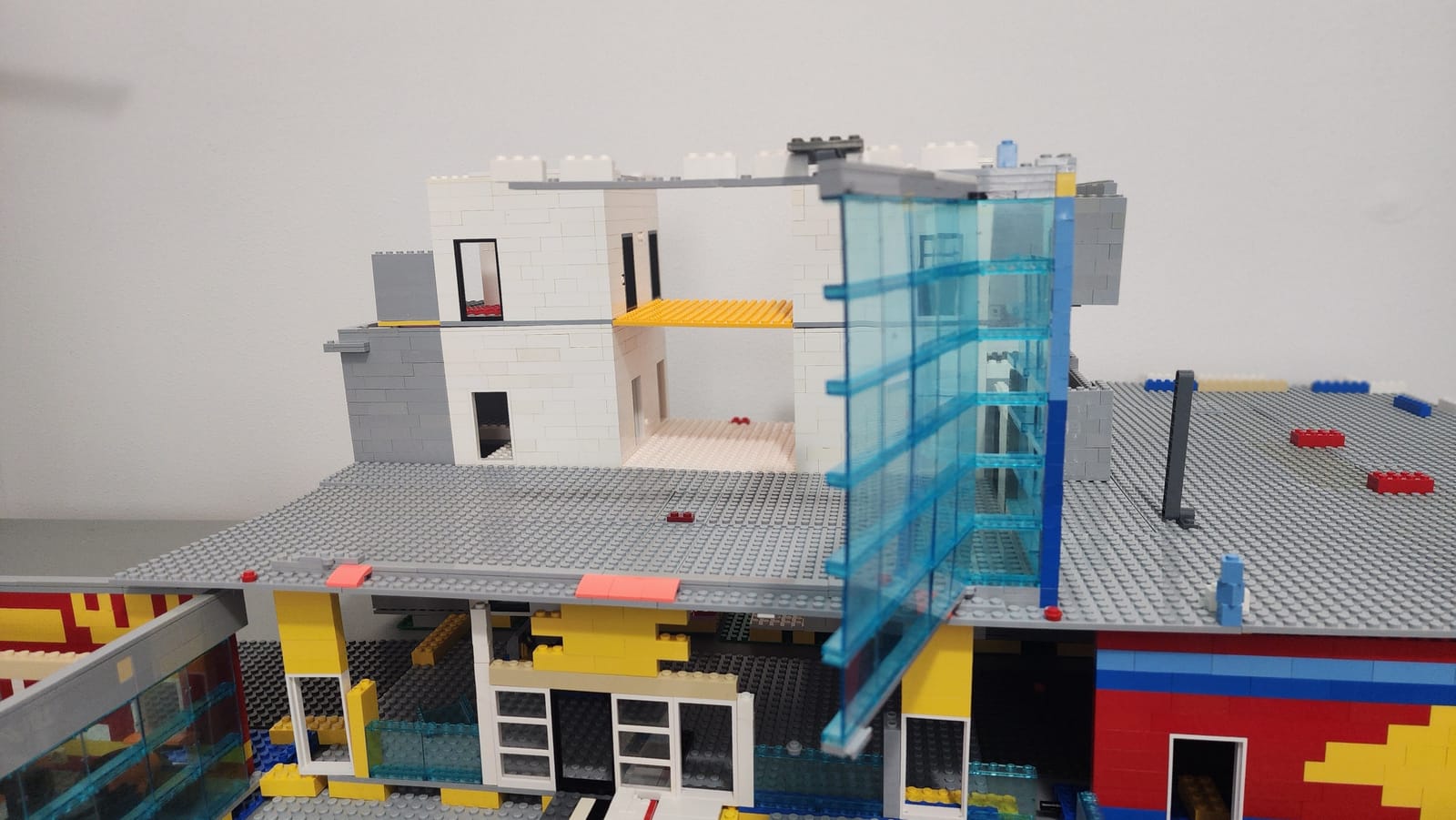
The reveal - wall opened to show the core tower. Three of eleven planned stories are visible, with elevator shafts and stairwells clearly defined.
Surrounding the core tower, on each of the three completed floors, is the beginning of the floor layout. The ground floor has the most detail at this stage - rooms framed out with interior walls, corridors connecting the front of the building to the back, and the structural columns that support the canopy overhangs visible from the inside as load-bearing elements rather than just exterior decoration. The second and third floors have their floor plates, core connections, and perimeter walls in place, with interior detailing still in progress.
The transparent windows that will eventually cover the hospitality seating on levels four and five are visible as well, stored temporarily at the current build height. These are the same trans-clear panels that form the front glass facade, and seeing them from the interior side - looking out through the glass from inside the building - gives a sense of what the finished model will feel like. Standing at shelf height, looking through the opened wall, through the interior, and out the transparent far-side windows, the depth of the building becomes real in a way that exterior-only viewing never achieves.
Three stories is a fraction of the finished product. But even at this early stage, the reveal demonstrates that the interior work is not wasted effort. Every corridor, every elevator shaft, every stair landing is visible. The design philosophy - that the inside of this building matters as much as the outside - is validated every time the wall swings open.
There is a long-standing divide in the AFOL community between display MOCs and play MOCs. Display models are built to be looked at. They sit on shelves, in cases, at exhibitions. They are optimized for external appearance, structural stability, and photographic quality. Play models are built to be handled. Doors open, roofs come off, vehicles roll, minifigures interact with the environment. They sacrifice some exterior polish for functionality and access.
The IMS Pagoda does not fit neatly into either category, and that is deliberate.
From the outside, with the glass wall closed, this is a museum-quality display model. The proportions are researched to architectural accuracy. The color scheme matches the real building. The canopy overhangs, the facade angles, the rooftop observation deck - all of it is designed to be photographed, exhibited, and admired as a static architectural reproduction. It belongs on a shelf or behind glass.
But the reveal feature makes it interactive. Not play-interactive in the way a child interacts with a LEGO set - there are no minifigure scenarios happening inside the Pagoda. Interactive in the way a museum exhibit is interactive. You can open the building. You can look inside. You can see the engineering, the interior detail, the structural systems that make the building work. Visitors, friends, fellow AFOLs who see this model do not have to take my word for it that the interior is detailed. They can see for themselves.
That matters more than most builders admit. There is a particular kind of frustration that comes from investing serious time in interior work that nobody ever sees. I have built models before where I know there are rooms behind the walls, furniture inside buildings, engine bays under hoods, and none of it is accessible without partial disassembly that I am not willing to do every time someone asks to see the build. The reveal feature eliminates that frustration entirely. The hours spent on interior detail - the rooms, the corridors, the elevator shafts on every floor - are not hidden. They are one wall-swing away from being visible.
There is also a therapeutic dimension to this kind of building that is worth acknowledging. The act of designing interiors that no one will see can feel like wasted effort, and that feeling undermines the meditative, restorative quality that LEGO building provides. Knowing that the interior work will be seen - that there is a mechanism built into the model specifically to display it - changes the psychology of the build. Every interior detail becomes an investment in something that will be shared, not buried. That shifts the experience from solitary craft to something closer to storytelling.
A display model that you cannot look inside is just a shaped stack of bricks. The reveal feature turns the Pagoda into a building - one with rooms, corridors, elevators, and stairs that exist for a reason. Because someone will see them.
The engineering challenge of the reveal feature is simple to describe and hard to execute. You need a transparent wall panel - made from trans-clear elements and structural framing - that is rigid enough to maintain its shape during repeated opening and closing, connected to the building via a hinge mechanism that allows a clean swing arc, and seated precisely enough when closed that the facade reads as a continuous glass wall from the exterior.
Start with the wall panel itself. Trans-clear LEGO elements are structurally weaker than their opaque counterparts. This is not a material deficiency - it is a consequence of the manufacturing process. Transparent ABS requires different additives than standard ABS, and those additives slightly reduce the clutch power of the studs. In a standard build, where transparent elements are used as windows in a surrounding opaque frame, this does not matter. In a reveal panel, where the transparent elements are a significant portion of a large, moving wall section, the reduced clutch power compounds across every connection point.
The solution is a rigid frame. The glass wall is not a sheet of trans-clear plates. It is a grid of structural framing members - opaque bricks and plates in the building's color scheme - with trans-clear panels filling the openings between frame members. This mirrors how the real Pagoda's glass curtain wall is constructed: steel mullions and transoms forming a grid, with glass panels set into the grid. The framing gives the LEGO wall its rigidity. The trans-clear panels give it its transparency. And the visual result - a gridded glass facade - is architecturally accurate to the real building.
The hinge mechanism uses LEGO's standard hinge plates - the 1x2 hinge plate pairs (parts #3937 and #3938) that have been in the system for decades. These are not exotic parts. They are not Technic-based. They are the same hinge plates you find in $20 LEGO sets. But their simplicity is their strength: they provide a consistent, repeatable swing arc with minimal play in the joint, and they are strong enough to support the weight of the wall panel without sagging over time.
The connection point between the hinge and the building structure is where the real engineering lives. The hinge plates attach to a vertical column at the edge of the facade opening. That column has to serve three functions simultaneously: it anchors the hinge, it provides a stop surface that the wall seats against when closed, and it integrates structurally with the floor modules above and below. In a modular build where every floor separates, that integration is critical. The hinge column cannot be part of only one floor - it has to span the joint between floors and remain stable when the modules are stacked.
The solution is a column that is part of the building's core structure, not part of any individual floor module. It runs continuously from the ground floor through every level that the glass wall covers, and it connects to each floor's perimeter wall via Technic pins that allow vertical separation without disrupting the hinge alignment. When you stack the floors, the hinge column aligns automatically. When you separate the floors, the column stays with the lowest module and the upper floor modules detach cleanly.
Then there is the canopy overhang problem. Every floor of the Pagoda has canopy overhangs that extend outward from the building face. When the glass wall swings open, its swing arc has to clear those overhangs. If the wall is mounted flush with the outer face of the building, it will collide with the canopy on the very first degree of rotation. The wall has to be recessed slightly - set back from the facade surface by just enough that the swing arc passes inside the canopy's leading edge.
That recess is approximately two studs deep. It is invisible from the front when the wall is closed - the framing members of the glass wall sit flush with the surrounding facade, and the two-stud recess is hidden behind the frame. But it means the wall, when open, sits two studs deeper into the building than the exterior surface, which actually improves the interior viewing angle. You are not looking at the interior from the surface of the building - you are looking in through a two-stud-deep opening, which frames the view and creates a natural depth perspective that makes the interior feel larger than it is.
The half-width test proved the concept. The next step is building the full-width glass wall and extending it vertically through levels four and five as those floors are constructed. The hospitality suites and seating areas on those levels are some of the most visually interesting interiors in the entire Pagoda - rows of seats facing outward through floor-to-ceiling glass, with views that in the real building overlook the start-finish straight of the Indianapolis Motor Speedway. In the LEGO model, those seats will face outward through the transparent facade panels, and when the reveal wall opens, visitors will see the seats from behind - looking in from outside at the same view the occupants would see from inside.
There is also the question of whether the reveal feature should extend to the side walls. Currently, only the front glass facade opens. The side walls are solid construction with window openings. But the side walls also hide interior detail - particularly the corridors that connect the front of the building to the core tower and the rooms along the building's flanks. A side-wall reveal is architecturally less natural than the front glass wall (the real building does not have opening walls), but from a display and access standpoint, it would expose significantly more interior work. That decision is still open.
This post is part of an ongoing series documenting the IMS Pagoda LEGO build. The build is being constructed one level at a time, with each phase of the project covered in detail as it progresses.
Other posts in this series:
- The Pace Car Garage - the ground-level garage structure and how it anchors the Pagoda's base
- Steel Bones - structural engineering and the internal frame that holds eleven stories together
- Bulk Bin to Back Wall - how a bin of random bricks became the rear facade of the building
- Progress Update - March 2026 - where the build stands and what comes next
For the full build series - including scale calculations, reference photography, and the modular floor system - start with the IMS Pagoda build series.
A functioning reveal mechanism forces you to design the entire model differently. You can't hide structural weaknesses behind solid walls anymore. Every hinge, every support, every point where the glass meets the frame has to work under actual stress. The half-scale testing isn't busywork, it's the only honest way to catch problems before committing to the full build. At reduced scale, failures are cheaper and faster to diagnose. At full scale, a hinge failure means months of work cracking open a finished model.
Playability in a display piece also shifts how collectors and other builders perceive the work. When someone can open that facade themselves, the model stops being something distant and untouchable. They understand the complexity differently because they feel it in their hands. That interaction, brief as it might be, creates a memory that static display pieces never will. For secondary-market value, that matters too. Fully functional MOCs with legitimate engineering hold their value better than visually similar pieces without moving parts.