Is the LEGO Eiffel Tower Worth Buying?
9.0/10. Worth buying. 10,001 pieces standing roughly 150cm tall. Check your ceiling before you check your wallet.

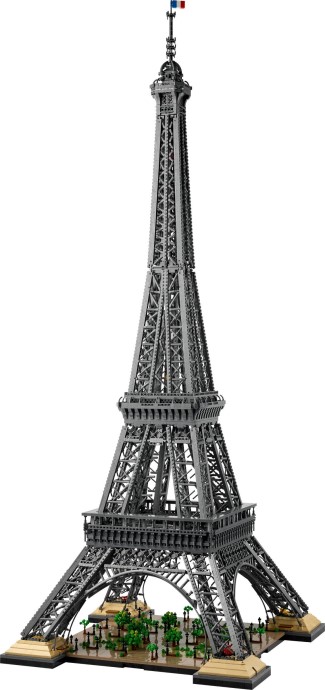
Most large LEGO sets ask where you'll put them. The Eiffel Tower asks whether your ceiling can accommodate it. At roughly 150cm (4 feet 11 inches) tall, this is the tallest set LEGO has ever produced, and that single fact reshapes the entire ownership decision before you've clicked a single brick. This is not a coffee-table piece. It is a floor-standing monument that will dominate a corner of a room the way a piece of furniture does. I want you to internalize that before you get seduced by the 10,001-piece count, because the height is the whole story here. Build it in a room with an 8-foot ceiling and you'll have a comfortable clearance. Build it under a low basement soffit and you will have a very expensive problem.
What makes the Eiffel Tower fascinating is how honestly it earns its scale. The real tower is a lattice - an exercise in structural repetition where the same iron truss pattern climbs skyward and tapers as it rises. LEGO's build mirrors that exactly. You will assemble the same lattice technique over and over, and how you feel about that repetition determines whether this set is meditative or maddening. There's a Technic-reinforced spine hidden inside doing the unglamorous work of keeping 10,000 pieces vertical and rigid. This is a set that rewards patience over technique variety, and understanding that trade before you commit matters more than any score I can hand you.
The Eiffel Tower is a build defined by its vertical journey. You start with a wide, four-legged base that establishes the tower's footprint and houses the structural core, then you climb. And climb. And climb. The build progresses in stages that map directly to the real landmark: the four splayed legs and the first platform, the arched connections, the tapering second stage, the narrowing third stage, and finally the summit with its antenna. By the time you place the final pieces, you are quite literally standing on a chair to reach the top of your own creation.
Expect to invest 15 to 25 hours across multiple sessions. This is not the second-largest set in the catalog by accident - 10,001 pieces takes time regardless of technique. But here is the honest caveat that separates this from a set like the Titanic: much of that time is spent repeating the same lattice assembly. The ironwork of the Eiffel Tower is, by design, a repeated truss module. LEGO reproduces it faithfully, which means you build the same sub-assembly many times over as the tower rises and tapers. Some builders find this genuinely meditative, a rhythmic flow state where your hands learn the pattern and your mind drifts. Others find it a grind by the third stage. Know which type of builder you are before you commit.
The engineering payoff arrives as you build upward and feel the structure stay rigid. A massive Technic-reinforced internal spine runs up the center of the tower, and watching that skeleton take shape is the most satisfying structural lesson in the set. This is the invisible work that makes a 150cm brick tower stand without sagging or leaning, and the instructions do an excellent job of building the core before cladding it in decorative lattice.
The instruction manual is well sequenced, with clear bag numbering and sensible phase breaks that give you natural stopping points between the tower's stages. LEGO clearly designed this as a multi-session build, and the pacing respects that. Just be prepared for the reality that the later stages require increasing vertical reach, which is a build ergonomics factor no manual can solve for you.
The headline technique here is large-scale structural repetition, and it is worth understanding what that means for your skill development. The lattice ironwork uses a repeated truss module that stacks and tapers as it climbs. Individually, the technique is not the most advanced thing LEGO has published. What is impressive is the scale at which it is deployed and the way the internal Technic frame keeps everything true across nearly five vertical feet. This is a masterclass not in a single clever connection but in structural engineering at monumental scale.
The tapering is the genuinely instructive part. The real Eiffel Tower narrows as it rises, and translating that graceful taper into brick requires the build to step inward at calculated intervals while maintaining the lattice pattern. Learning how LEGO handles a large-scale taper - keeping the structure symmetrical, rigid, and visually continuous as the footprint shrinks - is a lesson that transfers directly to any ambitious tower, spire, or skyscraper MOC.
For MOC builders, the value is in the Technic reinforcement strategy. The hidden spine demonstrates how to keep a tall, top-heavy structure from becoming a wobbling liability. If you have ever tried to build tall and watched your creation lean or twist, the internal framing here is the answer key. It is less a catalog of flashy techniques and more a deep, repeated study of how to make brick stand up straight and stay that way.
Ten thousand and one pieces in a palette dominated by dark tan, medium nougat, and the bronze-brown tones that give the tower its distinctive iron patina. This is one of the deepest single-color hauls of warm earth tones you can acquire in one purchase, and for builders working on architectural or landscape projects in those shades, the value is significant. Dark tan and nougat elements in this volume are difficult and expensive to source individually on the secondary market.
The set is heavy on Technic elements thanks to the internal reinforcement structure. Beams, connectors, pins, and axles arrive in serious quantities, and these are the universally useful workhorses of any technical build or custom frame. If you build MOCs that need internal skeletons, this set is a Technic parts reservoir disguised as a display model.
Beyond the structural pieces, the lattice work uses vast quantities of small bars, clips, and repeated detail elements. These are the kind of common-but-always-needed pieces that you can never seem to have enough of. The count of individual small elements is enormous given the repetitive truss design, which makes this set surprisingly practical as a bulk parts source despite its monumental final form.
Parting out an Eiffel Tower would be a strange decision given its display presence, but the sheer volume of warm-toned pieces and Technic elements means the parts value is genuinely substantial. This is a set where the palette is as much a reason to buy as the finished model.
This is where the Eiffel Tower is untouchable. At roughly 150cm (4 feet 11 inches), the completed tower does not sit on a shelf, a mantel, or a sideboard. It stands on the floor, or on a low sturdy platform, as a piece of architecture in its own right. The display impact is unlike anything else in the LEGO catalog because it operates at human scale. You do not look down at this set. You look up at it.
The silhouette reads perfectly from across a room - the splayed legs, the arched first platform, the graceful taper, the summit antenna. It is instantly, universally recognizable, which is part of the appeal. Non-builders who would shrug at a technical spaceship stop and stare at a five-foot Eiffel Tower. It has crossover presence that transcends the hobby.
Lighting the tower is transformative. Uplighting from the base, in particular, mimics the way the real monument is illuminated at night and throws the lattice into dramatic relief. The warm bronze tones catch light beautifully, and the negative space of the ironwork creates shadow patterns that shift as you move around it. A single well-placed floor lamp turns this from a large model into a genuine architectural feature.
The practical warnings are unavoidable and I will not soften them. First, ceiling clearance is a real constraint - a 150cm tower on a low table or in a room with a low ceiling simply will not fit, and this is the single most common regret I see with this set. Measure your intended location vertically, not just horizontally. Second, the footprint of the base is wide and the whole structure is top-aware, so it wants a stable, level surface away from foot traffic, curious pets, and doorways. Third, dusting a five-foot lattice is a genuine chore. Factor that reality in before you build.
The Eiffel Tower sits at flagship pricing, in line with LEGO's other 10,000-piece D2C monuments. The per-piece economics are competitive with the rest of the flagship tier, and given that a meaningful chunk of the parts are structural Technic elements and warm-toned architectural pieces, the raw parts value holds up well against the retail number.
Where the value calculation gets interesting is display return per footprint. Because this set builds up rather than out, it delivers enormous visual presence while occupying a surprisingly modest floor area - a corner, really. Compared to a set like the Titanic that demands a dedicated 135cm horizontal surface, the Eiffel Tower's vertical footprint is more forgiving of a space-constrained room, provided the ceiling cooperates. You are buying maximum visual impact per square foot of floor.
As a flagship landmark set from the Icons line, it also carries the long-term collectibility that these monumental sets tend to develop as they move through their lifecycle. For builders who view a purchase partly as an investment, an iconic, universally recognized landmark at record-breaking scale is exactly the profile that tends to hold and appreciate. At retail, this is a straightforward recommendation for any builder with the space and the patience. Above retail, you are paying for the privilege, which becomes a personal call rather than a financial one.
The Eiffel Tower is for the builder who wants a landmark centerpiece and has the vertical space to do it justice. It assumes patience above all - comfort with repetition, willingness to commit multiple sessions, and the physical space (and ceiling height) to display a five-foot model. It is not a set for someone who craves constant technique variety, because the repetitive lattice is the defining experience.
It is for the traveler and the Francophile who wants the most iconic structure in the world rendered at monumental scale. It is for the collector building a landmarks shelf who wants the one piece that anchors the entire room. And it is for the builder who genuinely enjoys flow-state repetition, because the rhythmic lattice work is either the best or the worst part of the build depending entirely on your temperament.
If you have the floor space, the ceiling clearance, and the patience for a tall repetitive build, the Eiffel Tower rewards you with the single most commanding display piece LEGO has ever made.
The Eiffel Tower usually stands alone as a floor piece, but it anchors a landmarks or travel theme beautifully if you have the room. The LEGO Titanic (10294) creates a transatlantic travel narrative - the ship that crossed the ocean and the tower that symbolized the European destination. Our Titanic review covers that flagship in full if you are weighing the two monuments against each other.
For a broader landmarks display, the tower pairs naturally with other Icons and Architecture scale models, though be mindful that at 1:340 scale the Eiffel Tower dwarfs most smaller Architecture pieces. If you are planning a mixed-scale shelf, our scale guides will help you understand how these landmark sets relate in size before you commit floor space to the arrangement.
Track the current market value of the Eiffel Tower and compare it against other flagship landmark sets on GameSetBrick.
- The tallest LEGO set ever at roughly 150cm - unmatched vertical presence
- 10,001 pieces including a deep haul of warm-toned and Technic parts
- Universally recognizable silhouette with genuine crossover appeal
- Massive Technic-reinforced spine delivers a real structural engineering lesson
- Vertical footprint packs maximum display impact into a modest floor area
- Meditative flow-state build for those who enjoy rhythmic repetition
- Ceiling clearance is a hard constraint - measure vertically before buying
- Repetitive lattice technique can feel like a grind for some builders
- Significant financial investment at flagship pricing
- Dusting a five-foot lattice is an ongoing chore
- LEGO Titanic Review - The other 10,000-piece flagship monument compared head to head
- LEGO Scale Guides - How landmark sets like the Eiffel Tower relate in size
- LEGO Investing 101 - Is a flagship landmark a good investment piece?
- Retiring Sets Tracker - Which flagship sets are leaving shelves in 2026
- All Reviews - Browse every honest verdict from The Earl
What genuinely caught me off guard was the ergonomics of the build itself, something no piece count or photograph prepares you for. By the third and fourth stages you are building above your own eye line, and depending on where you assemble the tower you will find yourself standing, reaching, and eventually needing a step stool to place the summit. Most large sets are a test of patience while seated at a table. This one becomes a physical activity in its final act, and that vertical build ergonomic is a real, unadvertised part of the experience.
The other surprise is how much the repetition changes character depending on your mindset. I went in expecting the lattice to be a slog, and for the first stage it was. But somewhere in the second stage my hands learned the pattern and the whole thing shifted into a genuine flow state - the kind of rhythmic, low-cognitive-load building that is quietly one of the best stress relievers the hobby offers. The repetition I dreaded became the reason I kept sitting back down to build. Whether that happens for you depends entirely on temperament, but it is worth knowing the grind can flip into something meditative if you let it.
Track it in your vault on GameSetBrick - our free collection app. Log your condition, price paid, and watch the real-time market value.
Track in Your Vault →Save it to your wishlist on GameSetBrick. Share your list with friends and family - every set has a buy button so gift givers know exactly where to go.
Add to Wishlist → GameSetBrick is a free app by The Earl of Bricks. See all features. Scan it. Track it. Trade it.